














ON Page vs OFF Page SEO
Discover the differences between On-Page and Off-Page SEO, including strategies, techniques, and best practices for optimizing your website.
As a digital marketing specialist with years of experience helping businesses rank higher in search engines, I’ve often been asked, "What’s the difference between ON Page vs OFF Page SEO, and which one should we focus on?" This is a question that has come up countless times, and the truth is, that both are crucial in any solid SEO strategy. Understanding the subtitles between ON Page vs OFF Page SEO can be the key to unlocking better search engine rankings, driving organic traffic, and ultimately increasing business revenue.
From the technical aspects to the more creative parts, these two strategies work hand in hand, but with distinct approaches. On Page SEO deals with the factors that you can directly control on your website, while off-page SEO focuses on external elements that influence your site's authority and credibility. By optimizing both on-page elements like content, structure, and keywords, and off-page factors like backlinks and social signals, businesses can create a comprehensive SEO strategy. This combined effort improves visibility, builds trust with search engines, and enhances the user experience leading to long-term growth and success in the competitive digital environment.
What is ON Page SEO?
On Page, SEO refers to all the activities you do within your website to optimize it for search engines. These are the elements you can control directly, such as website content, design, user experience (UX), and site structure. Essentially, ON Page SEO is the foundation of your website’s ability to rank well in search engines.
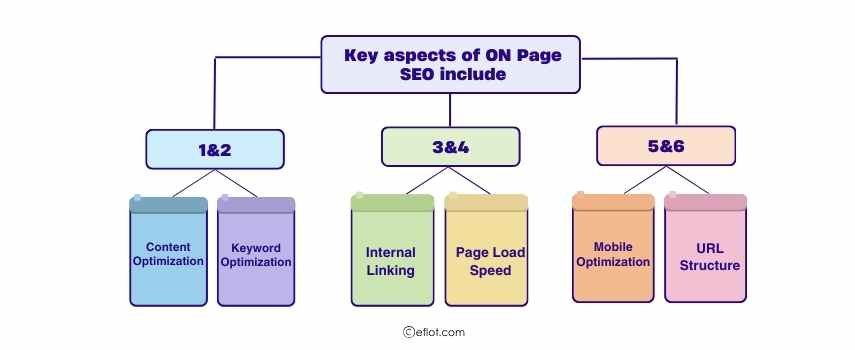
Key aspects of ON Page SEO include
-
Content Optimization: Creating high quality, relevant, and engaging content is a key pillar of ON Page SEO. Search engines prioritize websites that offer valuable and original content to users.
-
Keyword Optimization: Including targeted keywords in titles, meta descriptions, headers, and content throughout the website ensures that search engines can easily understand what your page is about.
-
Internal Linking: Properly linking to other relevant pages within your website helps search engines crawl and index your site more effectively.
-
Page Load Speed: Fast loading pages contribute to a better user experience and are a ranking factor for Google.
-
Mobile Optimization: Since most searches now happen on mobile devices, ensuring your website is mobile-friendly is essential.
-
URL Structure: Clean, well-structured URLs help both users and search engines navigate your site more easily.
What is OFF Page SEO?
Off-page SEO refers to all the activities you do outside of your website to improve its position in search engine results. The primary goal of OFF Page SEO is to increase your site’s authority, credibility, and relevance through backlinks, social signals, and other external factors. While you don’t have direct control over OFF Page SEO, you can still influence it with strategic efforts.
Key aspects of OFF Page SEO include:
-
Backlinks: Links from other reputable websites to your site are among the most influential ranking factors. Quality backlinks from authoritative domains help increase your site’s domain authority and search engine rankings.
-
Social Media Signals: Engagement on social platforms, such as likes, shares, comments, and mentions, indirectly impacts your site’s visibility and credibility. While social media signals are not direct ranking factors, they contribute to brand visibility and user trust.
-
Influencer Marketing: Partnering with influencers to promote your brand can help you gain exposure, build trust, and earn backlinks.
-
Brand Mentions: Even without direct links, being mentioned across the web on forums, news outlets, or review sites contributes to your site’s authority and visibility.
-
Guest Blogging: Contributing valuable content to other websites in exchange for a backlink is a tried-and-true OFF Page SEO strategy that can drive traffic and improve SEO performance.
-
Local Listings and Reviews: Ensuring your business is listed on online directories like Google My Business, Yelp, and other review sites can improve local SEO and brand visibility.
ON Page vs OFF Page SEO: Key Differences
While both ON Page and OFF Page SEO are essential for achieving high search rankings, they differ in their methods and areas of focus. Here’s a quick comparison of the two:
|
ON Page SEO |
OFF Page SEO |
|
Direct control over website elements |
Indirect control through external factors |
|
Focuses on content and website structure |
Focuses on external links, mentions, and signals |
|
Aimed at optimizing a website for search engines |
Aimed at improving a website's authority and relevance |
|
Includes technical aspects like page speed and mobile optimization |
Involves building backlinks, social media engagement, etc. |
|
Focuses on enhancing the user experience |
Focuses on external credibility and trust |
|
More immediate results in terms of website visibility |
A long-term strategy that helps build domain authority over time |
Both strategies should work together for the best results. On Page, SEO helps search engines understand what your site is about, while OFF Page SEO establishes its credibility and authority in the broader digital ecosystem.
How ON Page and OFF Page SEO Work Together
It’s important to note that ON Page SEO and OFF Page SEO are not isolated strategies but complementary elements that work together to improve your website’s search rankings.
-
On-Page optimizations make sure search engines can crawl, index, and understand your website’s content. For example, having a well-optimized title tag and meta description makes it easier for search engines to index your site.
-
Off-Page strategies, on the other hand, help establish the credibility of your website by gaining quality backlinks and improving your site’s reputation outside of your own domain.
For the best possible outcomes, it’s important to integrate both strategies effectively. For instance, if you have great content on your website but lack backlinks, search engines may struggle to recognize your site’s value. Conversely, a website with a high number of backlinks but poor content or slow loading times will fail to provide a satisfactory user experience, which could lead to higher bounce rates.
Which One Should You Focus On?
Now that you understand the difference between ON Page vs OFF Page SEO, the question remains: which one should you prioritize?
-
The reality is that ON Page SEO is the foundation for any SEO strategy. Without a properly optimized website, all the backlinks in the world won’t help you rank higher. So, it’s essential to start with solid ON Page SEO practices and then move to OFF Page SEO to enhance your site's authority and visibility.
-
If you’re just starting, focus on optimizing your website first. Once that’s in place, then work on building your backlink profile and increasing your external signals. For more established websites, combining both strategies can help you see the best results.
Case Studies
Case Study 1:
FreshMenu, a cloud kitchen and food delivery startup based in Bengaluru, aimed to expand its digital footprint and improve local search visibility. As a new player in the competitive food delivery industry, the company needed to focus on SEO to drive more organic traffic and increase orders.
Challenges:
FreshMenu faced a significant challenge in competing against well-established food delivery platforms in a highly competitive industry. Although the brand offered a wide range of meals and specialized in delivering healthy food, it struggled to rank for location-based keywords and other relevant search queries like “healthy lunch delivery” or “food delivery in Bengaluru.” The company’s website lacked proper local SEO optimization and didn’t feature enough localized content for its target audience.
Solutions:
FreshMenu addressed these issues by implementing a dual approach to ON Page SEO and OFF Page SEO. On the on-page front, the company focused on improving keyword usage by updating website content with location-specific phrases like “healthy food delivery in Koramangala” and “order lunch in Whitefield.” They optimized the navigation structure to enhance the user experience, and they improved page speed and mobile friendliness, which contributed to better SEO rankings.
Case study 2 :
Zolve is a fast growing fintech company that provides cross border financial services, including credit cards, bank accounts, and financial products tailored for students and professionals moving internationally. Their platform simplifies global banking for people moving to countries like the United States, making it easier for newcomers to get financial services without needing a credit history in the new country.
Challenges:
Zolve, a fintech company offering cross-border financial services, faced challenges in driving traffic to their website and improving conversions. Their primary challenge was that their ON Page SEO was not optimized for the specific financial products they offered, such as global credit cards and international banking services. The website content lacked sufficient keyword optimization, leading to low organic rankings for important keywords like “global credit cards for students” or “international bank accounts for expats.”
Solutions:
To address the ON Page SEO issues, Zolve started by optimizing its landing pages for specific financial products. They created unique content for each product, using long-tail keywords to capture user intent more effectively. They also worked on improving page load speed and mobile optimization, which are crucial for user experience and SEO. For example, they used structured data to make it easier for search engines to understand the different products and services offered.
Both ON Page vs OFF Page SEO are essential for driving traffic, improving rankings, and boosting overall business success. While ON Page SEO directly impacts your site’s content and structure, OFF Page SEO focuses on building your website’s credibility and authority in the digital space. By ensuring both aspects are handled effectively, you can create a comprehensive SEO strategy that gives you an edge over your competitors and helps you achieve long-term success in search engine results. If you want to maximize your online presence and improve your rankings, consider working with a professional SEO agency to help you optimize both ON Page and OFF Page elements.
Digital Marketing services in Other Locations in India
Bangalore | Hyderabad | Chennai | Pune | Ahmedabad | Coimbatore | Mumbai | Kolkata | Patna | Amritsar | Indore | Kozhikode | Trivandrum | Jaipur | Nagpur | Gwalior | Dehradun | Noida | Vizag | Raipur | Agra | Gurgaon | Madurai | Udaipur | Thrissur |