
















How to Manage Bounce Rate in SEO for Business Growth
Struggling with high bounce rates? Learn how managing bounce rate in SEO can boost engagement, improve rankings, and drive business growth. Start today!

Is your site experiencing high bounce rates?
Are you confused about why people leave your site so quickly without converting? Bounce rate management in SEO is important to enhance your site's user experience, increase engagement, and drive business growth. Bounce rate is the number of visitors who exit your site after looking at a single page without engaging further. A high bounce rate can indicate issues with your website’s design, content, or relevance, directly affecting your SEO rankings and, ultimately, your business’s bottom line.
Websites that have lower bounce rates have a greater level of engagement, and that means greater SEO performance and higher conversions. Research indicates that reducing the bounce rate by 10% will improve conversions by 5-10%. A lower bounce rate also makes your site more valuable in the eyes of Search engines like Google, possibly improving your ranking. For example, online retailer Zappos managed to decrease its bounce rate by optimizing product pages and enhancing loading times, which increased sales and customer satisfaction.
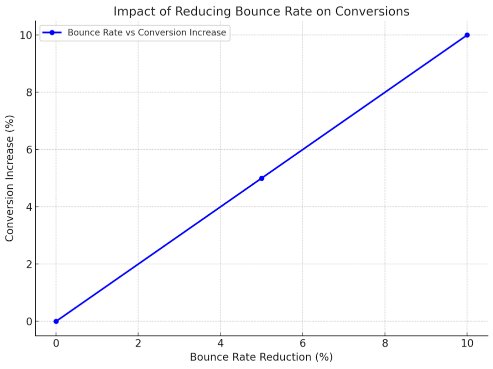
Airbnb, a worldwide online marketplace for travel and lodging experiences, experienced high bounce rates on its website. Visitors would leave the website without finalizing bookings, having a serious impact on conversions and overall sales.
Airbnb had a high bounce rate as a result of a complex user experience on its website, particularly on mobile. The users had a hard time navigating the website, and the booking process was long and annoying. Therefore, most visitors would exit the site before finalizing their booking. By optimizing the site for improved user experience and making the booking process more straightforward, Airbnb was able to effectively lower its bounce rate.
This case study illustrates how SEO bounce rate management can have direct and measurable consequences on the business growth and success of a company. By streamlining processes, optimizing for mobile, and improving user experience, Airbnb was able to design an effortless platform that invited visitors to engage, convert, and repeat.
What is Bounce Rate in SEO?
The bounce rate in SEO refers to a measure that monitors the percentage of users who visit your site and leave without engaging with the content or clicking on other pages. It is a vital measure since it provides information about how well your site engages users and prompts them to explore more. If a high percentage of visitors leave right away, it could mean that the website is not engaging, the content is irrelevant, or there is poor user experience (UX).
Google employs bounce rate as one of the metrics to assess the quality of your website. A high bounce rate could indicate to search engines that users aren't getting what they need, which would hurt your search rankings. Reducing your bounce rate is thus vital towards enhancing SEO and sustainable business growth.
Why is Managing Bounce Rate in SEO Important for Business Growth?
-
Improves User Engagement
Managing bounce rate in SEO improves user engagement on your website. When visitors stay longer and explore more pages, they are more likely to interact with your content, make purchases, or sign up for newsletters. A lower bounce rate signifies that your content is relevant, the design is appealing, and the website is easy to navigate, which directly increases engagement.
-
Boosts SEO Rankings
A lower bounce rate signals to search engines that your site is relevant and useful to visitors, which can positively impact your rankings. Google, for instance, favors websites that keep users engaged and offer valuable content. Therefore, reducing your bounce rate can enhance your SEO efforts, leading to better visibility and increased organic traffic.
-
Increases Conversion Rates
Bounce rates have a direct impact on conversion rates. If visitors leave without interacting with your website, they aren’t taking actions like signing up for newsletters, making a purchase, or filling out a contact form. A lower bounce rate means more visitors are staying on your site and completing the desired actions, which boosts your conversions and ultimately drives revenue.
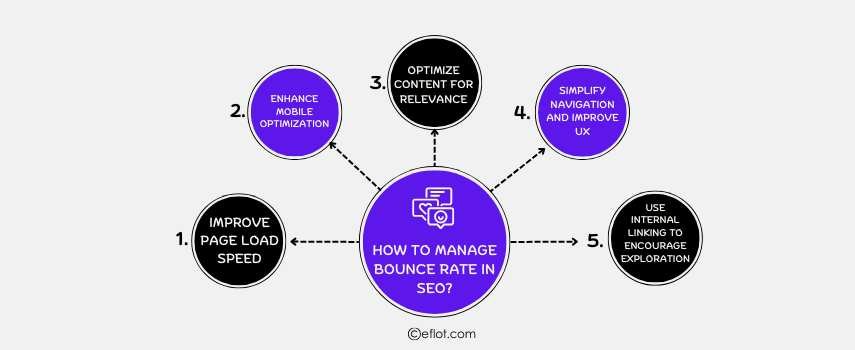
How to Manage Bounce Rate in SEO?
-
Improve Page Load Speed
One of the most common reasons for high bounce rates is slow-loading pages. Visitors expect fast access to websites, and if a page takes too long to load, they are likely to leave before the content even appears. You can reduce your bounce rate in SEO by optimizing images, leveraging browser caching, and using content delivery networks (CDNs) to speed up your website.
-
Enhance Mobile Optimization
In today’s mobile-first world, ensuring your website is mobile-friendly is crucial. A significant portion of web traffic comes from mobile devices, and if your site isn’t optimized for mobile viewing, visitors will leave quickly. Make sure your website has a responsive design, loads quickly on mobile devices, and provides a seamless user experience across all screen sizes.
-
Optimize Content for Relevance
Your content should be relevant to your target audience’s needs and interests. Make sure that your headlines are clear, the content is informative, and the layout is easy to read. Use compelling calls-to-action (CTAs) that encourage visitors to explore other pages on your website or take action, such as purchasing a product or subscribing to your newsletter.
-
Simplify Navigation and Improve UX
A website that’s difficult to navigate will have a high bounce rate. Visitors should be able to find what they’re looking for quickly and easily. Simplify your site’s navigation, use clear menus, and ensure that important information is accessible. A well-designed user interface (UI) contributes to a better overall experience and keeps visitors engaged longer.
-
Use Internal Linking to Encourage Exploration
Encourage visitors to explore more pages on your website by using internal linking. This can help guide users to related content or products, reducing the likelihood of them leaving after viewing just one page. By improving the user experience through relevant links, you can increase engagement and lower your bounce rate.
Maintaining bounce rate is key to bettering your site's performance, increasing SEO ranks, and sustaining business growth. With faster page load speed optimization, better mobile usability, and relevant, interest-driven content delivery, you will decrease your bounce rate and hold onto visitors. Begin optimizing and analyzing your website's bounce rate today because a lower bounce rate equals a more powerful brand, better customer experience, and greater business growth.
Ready to lower your bounce rate and expand your business? Reach out to us now at [email protected] to learn how we can assist you in optimizing your website for improved performance!
Digital Marketing services in Other Locations in India
Bangalore | Hyderabad | Chennai | Pune | Ahmedabad | Coimbatore | Mumbai | Kolkata | Patna | Amritsar | Indore | Kozhikode | Trivandrum | Jaipur | Nagpur | Gwalior | Dehradun | Noida | Vizag | Raipur | Agra | Gurgaon | Madurai | Udaipur | Thrissur |