
























How to Use Canonical Tags SEO to Protect Your Content
Protect your content from duplicate content and boost SEO rankings with the effective use of canonical tags. Learn how to implement them now!

As a digital marketing specialist, one of the most frequently asked questions I receive is how businesses can protect their website content from duplicate content penalties and improve their SEO rankings. Duplicate content can hurt your site's visibility in search engines, and it can lead to indexing issues where your content may not appear in search results at all. One of the best solutions to this problem is utilizing Canonical Tags SEO.
Over the years, I've helped numerous businesses understand and implement Canonical Tags SEO as part of their website strategy. The beauty of these tags is that they tell search engines which page is the “preferred version” of content that appears on multiple pages, helping them avoid the pitfalls of duplicate content. Here, I will share with you what Canonical Tags are, why they're important, and how you can use them to protect your content, improve SEO rankings, and keep your website safe from penalties.
What Are Canonical Tags SEO?
A Canonical Tag is an HTML link element placed within the section of a webpage that helps search engines identify the preferred version of a page. This tag tells search engines that even though similar or identical content might appear on other pages or URLs, this particular page is the original or "canonical" version.
For example, if you have the same content on multiple pages of your website, like product descriptions in different categories, Google might have difficulty determining which page to rank. By using a Canonical Tag SEO, you can specify the page that should rank. This ensures that Google doesn’t penalize your website for duplicate content and that the preferred URL gets the traffic and link equity.
Why Are Canonical Tags SEO Important for Content Protection?
When it comes to managing your website’s content, protecting it from being flagged as duplicates is critical. Duplicate content can arise for a variety of reasons, such as URL variations, printer-friendly pages, and session IDs. Search engines like Google are diligent in ensuring that they serve the best and most relevant content in search results, which means they may choose to ignore a page that seems to have the same content as another.
These tags help search engines understand which URL should be considered the original and authoritative version, consolidating the ranking signals like backlinks, page authority, and indexing for that page. If you fail to use them correctly, you risk spreading your website’s SEO value across multiple URLs, diluting your rankings, and losing valuable traffic.
Additionally, duplicate content can lead to a significant loss in organic traffic. Search engines may get confused about which page to index, which means they might not rank any of the duplicate pages at all. By implementing Canonical Tags, you ensure that search engines are directed to the correct page, thereby improving visibility and increasing the chances of ranking higher on search engine results pages (SERPs).
How Does Canonical Tags SEO Work?
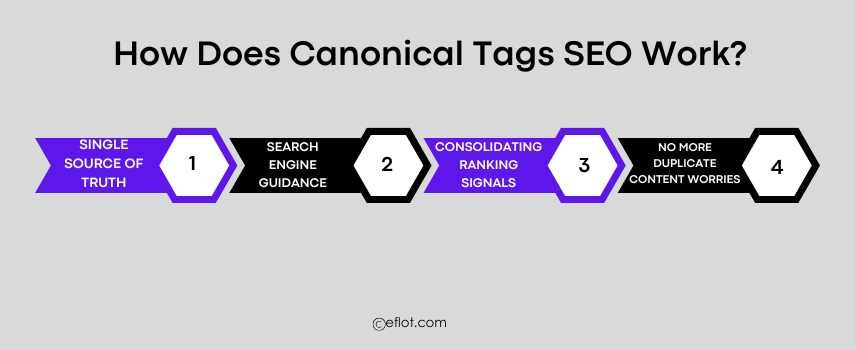
The Canonical Tag SEO works by pointing search engines to a "preferred" URL when multiple pages have the same or very similar content. It works like this:
-
Single Source of Truth: Suppose you have multiple pages on your site displaying the same or similar content. For instance, an e-commerce site may list the same product in different categories (e.g., a T-shirt in both the Men's and Women's sections). In this case, you would place both product pages to point to the original or preferred product page URL.
-
Search Engine Guidance: When Google crawls your website, it sees the canonical tag and understands which version of the page should be considered the original. Instead of treating the pages as duplicates, Google consolidates the ranking signals (such as backlinks, page authority, etc.) to the canonical URL.
-
Consolidating Ranking Signals: By ensuring that Google focuses on the correct URL, the Canonical Tag helps consolidate your ranking signals and boosts your site's authority. All backlinks and link equity are directed to the canonical page, preventing any dilution of ranking potential.
-
No More Duplicate Content Worries: Once the canonical tag is implemented, you don’t have to worry about Google penalizing you for duplicate content. This is particularly important for large websites with multiple pages of similar content or e-commerce sites with similar products listed under various categories.
Best Practices for Using Canonical Tags SEO
Here are a few best practices for using Canonical Tags SEO effectively on your website:
-
Use Absolute URLs: When implementing canonical tags, always use absolute URLs (the full URL including the domain) rather than relative URLs. This helps ensure that search engines can easily find the correct page.
-
Point to the Correct URL: Be sure that the canonical tag points to the correct URL. Don’t use a canonical tag to point to a non-relevant page or a page that you don’t want to rank. For example, don’t use a canonical tag on a low-quality page to pass ranking signals to another irrelevant page.
-
Avoid Conflicting Canonicals: Don't have multiple canonical tags on the same page pointing to different URLs. This can confuse search engines and nullify the benefits of the canonical tag.
-
Don’t Use Canonical Tags for Different Content: Canonical tags should only be used to resolve duplicate content issues. If two pages genuinely contain different content, do not place a canonical tag pointing to one over the other.
-
Check for Incorrect Implementation: Make sure your canonical tags are implemented correctly by running audits on your website. Some CMS platforms or plugins might generate duplicate content or canonical tags incorrectly.
Case Studies
Case Study1:
Amazon, one of the largest e-commerce platforms globally, faces challenges related to duplicate content due to the vast range of products listed in multiple categories. The company needed a way to ensure that their product pages would not be penalized for duplicate content issues.
-
Implementation: Amazon employed Canonical Tags SEO on their product pages to point to the original listing as the canonical version. For example, if a product like a T-shirt was listed in both the Men's and Women's clothing sections, the canonical tag would point to the primary product page URL.
-
Outcome: By using Canonical Tags SEO, Amazon effectively consolidated all ranking signals to the original product page, which helped the company maintain its dominant search rankings without suffering penalties for duplicate content. This also ensured that customers could easily find the correct product without confusion.
Case Study2:
Etsy, an e-commerce platform known for handmade and vintage products, faced similar challenges to Amazon with duplicate content across product listings. With many products being listed in multiple categories, Etsy had to find a way to prevent these duplicate pages from impacting search rankings.
-
Implementation: Etsy implemented Canonical Tags SEO to point to the primary product listing page whenever an item appeared in multiple categories. For example, if a handmade necklace appeared in both the jewelry section and the gifts section, Etsy used canonical tags to direct search engines to the original listing.
-
Outcome: Etsy's use of Canonical Tags SEO allowed it to maintain strong search rankings across its site and improve its overall visibility in search engines. This helped Etsy reduce duplicate content penalties and improve the user experience by consolidating rankings to the preferred product pages.
Canonical Tags SEO is a powerful tool for protecting your content and improving your search engine rankings. By using canonical tags correctly, you ensure that your website is not penalized for duplicate content, which in turn helps you maintain or improve your visibility in search engine results. To ensure your website stays ahead of the competition, it’s essential to implement canonical tags in the right way. With the right implementation of Canonical Tags SEO, you’ll optimize your site for better user experience, SEO performance, and search rankings, ensuring that your business stays competitive in the ever-changing digital environment.
Digital Marketing services in Other Locations in India
Bangalore | Hyderabad | Chennai | Pune | Ahmedabad | Coimbatore | Mumbai | Kolkata | Patna | Amritsar | Indore | Kozhikode | Trivandrum | Jaipur | Nagpur | Gwalior | Dehradun | Noida | Vizag | Raipur | Agra | Gurgaon | Madurai | Udaipur | Thrissur |