











The Hidden Rules AI Engines Use to Cite You
Discover how ChatGPT, Claude, Gemini, and other AI engines choose which pages to cite. See Eflot's research, findings, and AEO best practices.
Every agency is now talking about AEO and GEO. Very few have shown their working. So the Eflot SEO team ran an experiment: we took three real buyer questions from two different industries, put them to six AI engines, and recorded exactly what each engine did and which pages it pulled from.
What we found is that AI search is not one game. It is two. And most brands are optimizing for the wrong one.
Key Takeaways
-
AI search works in two different modes.
-
Most websites optimize for the wrong one.
-
Commercial queries and informational queries follow completely different citation patterns.
-
We analyzed six AI engines to discover what actually gets cited.
What is the thing nobody explains: why does AI answer in two different modes?
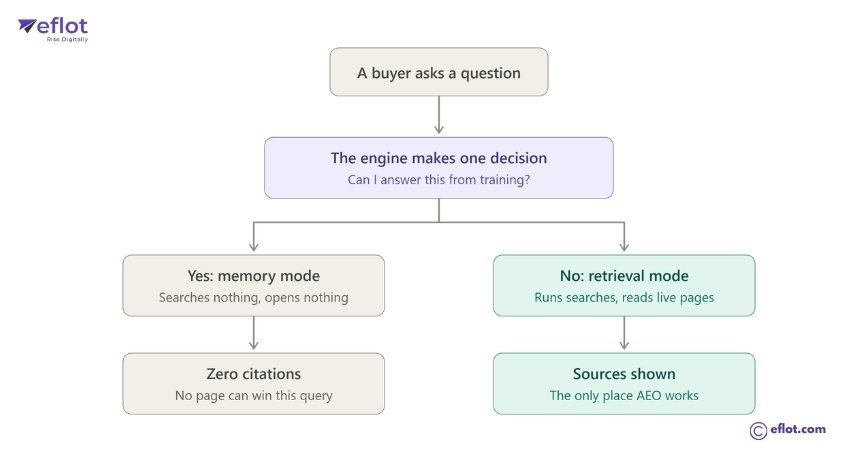
Before you optimize anything, you need to know what actually happens when a person asks an AI engine a question. There are two paths, and they behave very differently.
What is Mode 1: Memory?
The engine answers from what it already learned during training. It does not search. It does not open a single page. In our test, one engine said this out loud in its reasoning: it decided the question was straightforward and that it could answer from general knowledge without needing to search for current information.
If an engine answers a question from memory, there is no citation. There is no source list. There is no link. Nothing you publish today can appear in that answer, because the engine never went looking.
What is Mode 2: Retrieval?
The engine decides it needs live information. It runs its own searches, pulls a handful of pages, reads them, and builds the answer from what it found. It then shows the sources it used.
This is the only mode where your content can be cited. So the first question in any AEO program is not "How do I rank?" It is, "Does this query even trigger retrieval?"
What flips an engine from memory to retrieval?
From what we observed, retrieval kicks in when the answer depends on something the model cannot safely guess:
-
Named entities and rankings: who is the best, who should I hire, which company
-
Anything with a date or a year attached
-
Prices, rates, and costs
-
Reviews, ratings, and reputation
-
Topics that are newer than the model's training data
-
Local and location-specific questions
And it stays in memory mode when the question is stable, general, and explainable: definitions, processes, how something works, what something means.
Test 1: What happened with the listicle query?
We asked all six engines a commercial question: If I want to increase website traffic and leads, which digital marketing agencies should I hire in India?
Every single engine was retrieved. Nobody answered from memory. That makes sense: the model cannot invent a ranked list of real companies without checking.
What did the engines cite?
We logged the top three sources per engine. Then we counted how often each source appeared across engines.
|
Source cited |
Number of engines that used it |
|
Clutch (digital marketing agency directory, India) |
4 |
|
Fruitbowl Digital (top agencies listicle) |
3 |
|
Semrush agency directory (India) |
2 |
|
Rep India, Ranks Digital Media, Intileo, Digital SEO Land, Koffee Tech, a LinkedIn article, a Reddit thread |
1 each |
Two findings jump out.
First Finding: The engines converge. Clutch and Fruit Bowl kept showing up across different engines. AI search is not six separate games with six separate winners. Several engines lean on the same small pool of trusted pages.
Second Finding: not a single agency homepage was cited. Not one service page. Every source was either a directory or a "top agencies" listicle written by a third party. For this type of question, your own website is not in the conversation. The pages that speak of you are.
What did the quoted pages share?
All eleven cited pages were then separated out and scored on the same elements. Here is how many of the eleven had each one.
|
Element on the page |
Present on |
|
List format (numbered or ranked) |
11 of 11 |
|
Named specific agencies |
11 of 11 |
|
Direct answer in the opening paragraph |
10 of 11 |
|
Author byline |
8 of 11 |
|
Statistics or client results |
7 of 11 |
|
Visible published or updated date |
7 of 11 |
|
Comparison table |
6 of 11 |
|
FAQ section |
5 of 11 |
|
Pricing information |
4 of 11 |
|
Case studies with outcomes |
3 of 11 |
Read the top of that table, and you get the entry ticket. Read the bottom of it, and you get the opportunity.
The entry ticket is boring and non-negotiable: a list, real names, and the answer stated in the first paragraph. If a page makes the reader scroll to find out who the top agencies are, the engine does not wait either.
The opportunity is at the other end. Most cited pages carry no pricing and no case studies. Those are the two things buyers actually want and the two things almost nobody publishes. That gap is where a new page can win.
Test 2: What happened with the explanatory query?
Then we asked a completely different kind of question: what does an SEO agency actually do each month?
The engines split.
Two of them, including Claude and ChatGPT, answered entirely from memory. They wrote a clean, structured, genuinely useful answer about technical SEO, content, authority building, and reporting. They cited nobody, because they searched for nothing.
The other engines were retrieved. And look at who they cited: SE Ranking, Well-Dressed Walrus, Straight Up Digital, Brandleap, and FlyPost Marketing.
Those are not Clutch. Those are not Semrush. Those are small sites most people in the industry have never heard of.
Why does that difference matter more than anything else here?
Same industry. Same buyer. Two questions. Two completely different citation economies.
On the commercial question, the citation slots are owned by directories with review data and huge listicles. You are not going to displace Clutch. Realistically, nobody is.
On the explanatory question, the citation slots are held by small blogs that simply structured the answer well. Those are winnable. And they are winnable now, because there is no authority moat protecting them.
Test 3: Does a different industry show the same behavior?
Two queries from one industry prove nothing. So we ran the same method on a completely different sector: top AI consulting companies in India.
All six engines were retrieved again. Nobody answered from memory. Same as the agency query.
|
Source cited |
Number of engines that used it |
|
Clutch (AI consulting directory, India) |
3 |
|
Innovation blog |
2 |
|
Cognitute blog |
2 |
|
Sparx IT Solutions |
2 |
|
Fix n Hour, Top Developers, eSpark Info, Data Terminal, Infosense, EY, a LinkedIn article, ITProfiles, Good Men Project |
1 each |
Look at the top row. Clutch again. Different industry, different buyer, different keyword set, and the same directory sitting at the top of the citation list. That is not a coincidence. That is structure.
What was the one exception, and what does it teach?
Across both commercial queries, exactly one company's own website was cited: EY. Google's AI Overview pulled EY's own AI consulting services page.
So the rule is not that your site can never be cited. The rule is that your site gets cited when the engine already treats you as an authority on the topic. EY clears that bar. Almost nobody else in either query did. Until you clear it, the pages that talk about you are doing the work, not the pages you write about yourself.
Why are directories uniform while blogs are chaotic?
The AI consulting query gave us enough cited pages to split them into two groups: five directories and nine blogs or listicles. We scored both groups on the same elements. The difference is the most useful thing in this whole study.
What did all five directories do?
Every directory, without exception, carried all of the following:
-
A visible updated date
-
A stated evaluation methodology, so the reader knows how the ranking was made
-
Pricing per company: hourly rate, minimum project size, or both
-
Reviews and ratings per company
-
Verification badges
-
The list itself, shown immediately, with no preamble
Five out of five. Every single one. Directories are not winning because they are big. They are winning because they are complete, structured, and verifiable, and they never make the engine hunt for the answer.
What did the nine blogs do?
The blogs were all over the place. Out of nine cited blog posts:
|
Element |
Present on |
|
Services described per company |
9 of 9 |
|
Company overview per company |
8 of 9 |
|
A how-to choose section |
6 of 9 |
|
Industry-specific recommendations |
5 of 9 |
|
Named author with a bio |
5 of 9 |
|
Visible updated date |
4 of 9 |
|
Direct answer at the top |
4 of 9 |
|
Pricing per company |
4 of 9 |
|
Stated evaluation methodology |
4 of 9 |
|
FAQ section |
4 of 9 |
|
Case studies or client results |
3 of 9 |
|
Why we chose this company |
2 of 9 |
|
Best for: who each company suits |
1 of 9 |
|
Comparison table |
1 of 9 |
|
Common mistakes to avoid |
0 of 9 |
Read that bottom half again. Only one of nine cited blogs had a comparison table. Only one told the reader which company suits which kind of buyer. Not one covered the mistakes buyers make.
These pages are being cited despite those gaps, not because of them. Which means the bar to beat them is far lower than it looks.
Which blog behaved like a directory?
One page stood out: eSpark Info. It is a listicle, but it was built like a directory. It had a summary box at the top, a stated 10-point evaluation method, pricing, client testimonials, Clutch ratings pulled in per company, a how-to-choose section, an FAQ, and a table of contents. It scored higher on our checklist than any other blog in the set.
That is the template. Not "write a better blog." Build a blog that behaves like a directory.
So what does AEO actually mean?
AEO is not one strategy. It is three decisions, in this order.
How do you classify the query before you write anything?
Run the question through the engines first. Note what each one did. If most engines answer from memory, no page you write will ever be cited for it. That query is a dead end for AEO. Do not spend a month on it.
If the engines retrieve it, look at who they pulled. If it is Clutch and Semrush, that is a hard slot. If it is a small blog you have never heard of, that is an open door.
How do you play the right game for the query?
For commercial queries, the game is mostly not your website. It is getting your brand into the pages that already get cited: the directories, the listicles, the review platforms, the Reddit threads. Your homepage will not be cited unless you are already EY. The page that names you will be there. This is why Eflot now treats directory presence and third-party listings as an AEO activity, not a link-building one.
For explanatory queries, the game is your website. Write the page. Structure it so an engine can lift the answer cleanly. This is where an agency site can genuinely be the source.
How do you build the page the way the winners are built?
Straight from the pages we analyzed across all three queries:
-
Answer the question in the first paragraph, before any preamble
-
Use a list, and give the list real names and real specifics
-
Add a comparison table, because six of the eleven had one
-
Show a visible updated date, because seven of the eleven did
-
Put a named human author on it, not a brand byline
-
Add pricing, because most cited blogs skip it, and every cited directory has it. If you're using directory listings as part of your SEO strategy, check out our guide on how to choose the best website directory submission sites before building citations.
-
Add case studies with actual numbers, because almost nobody does
-
State your evaluation methodology, so the ranking looks earned rather than invented
-
Add an FAQ block, because the engines lift those directly
-
Add a best-for line per option, because only one page in nine did
-
Cover the common mistakes, because zero pages did
The last two lines are the whole point. The elements everyone copies get you level with the field. The elements nobody publishes are what get you picked.
Follow Our Ongoing AI Search Research
This is an ongoing study. Every month, we test the same buyer queries across six AI engines to track which sources get cited and how AI search evolves.
Want to explore the complete methodology, AI responses, screenshots, and raw data?
Want to know what AI engines say about your brand? We can analyze your buyer queries and show you what AI retrieves and cites.
Research by the Eflot SEO team.
Digital Marketing services in Other Locations in India
Bangalore | Hyderabad | Chennai | Pune | Ahmedabad | Coimbatore | Mumbai | Kolkata | Patna | Amritsar | Indore | Kozhikode | Trivandrum | Jaipur | Nagpur | Gwalior | Dehradun | Noida | Vizag | Raipur | Agra | Gurgaon | Madurai | Udaipur | Thrissur |