
























SEO for Lawyers: Attract More Qualified Inquiries
Learn how SEO for lawyers helps law firms attract qualified client inquiries through local search, practice-area pages, and sustainable growth.

If your law firm relies heavily on referrals or paid ads, you're missing one of the most sustainable ways to generate new business. SEO for lawyers helps firms attract qualified client inquiries by improving visibility in local search, building authoritative practice-area pages, and earning trust before prospects make contact. This guide explains how legal SEO works, the strategies that generate consistent inquiries, the mistakes to avoid, and how to choose the right SEO partner for long-term growth.
Key Takeaways
-
SEO for lawyers is a long-term client acquisition channel that reduces dependency on rising paid ad costs.
-
Legal SEO is shaped by high competition, strict local intent, and trust-driven decision-making; it cannot be approached in the same way as ecommerce or SaaS SEO.
-
Practice-area pages, not just the homepage, are what actually convert search traffic into consultations.
-
Local SEO and Google Business Profile optimization are often the fastest path to qualified inquiries for firms serving a defined geographic area.
-
The right SEO partner reports on inquiries and case value, not just keyword rankings.
Why SEO Matters for Modern Law Firms
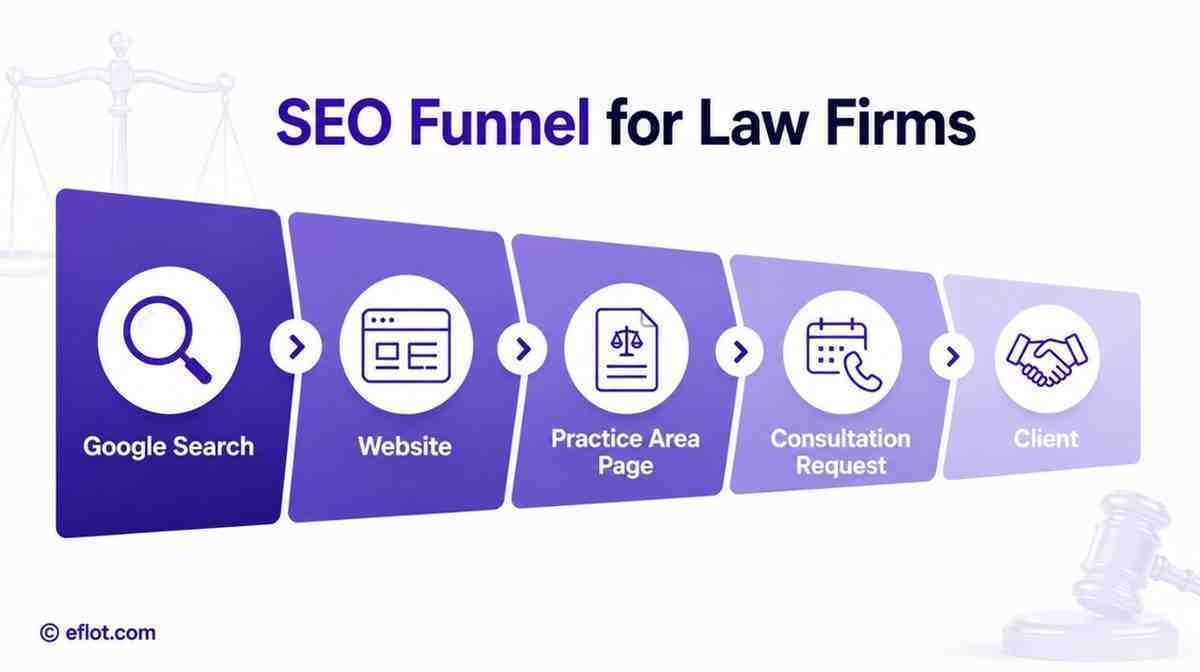
Search is where most legal decisions begin, even when the final choice is made through a referral or a recommendation. A prospective client who hears a friend mention a firm will still search the firm's name, read reviews, and often compare it against two or three competitors before calling. This means SEO for lawyers influences outcomes even in cases that started as word-of-mouth.
Three forces are making organic visibility more valuable right now:
-
Rising paid acquisition costs
Cost-per-click for high-value legal terms has increased steadily across most major markets, which compresses margins on paid campaigns unless conversion rates are unusually strong.
-
Longer client research cycles
Legal decisions, especially for personal injury, immigration, family law, and estate planning, involve real financial and emotional stakes. Prospective clients read multiple pages, check reviews, and compare credentials before reaching out.
-
AI-assisted search behavior
Tools like Google's AI Overviews and conversational assistants are increasingly used to research "do I need a lawyer for my property case" type questions, which rewards firms with clear, well-structured, authoritative content.
None of this means paid advertising should be abandoned. It means organic search needs to carry more of the long-term acquisition load, while paid campaigns handle short-term volume and testing.
What Makes SEO for Lawyers Different from Traditional SEO
A firm that hires a generalist agency without legal industry experience often ends up with technically correct SEO that still fails to produce inquiries. That happens because SEO for lawyers operates under a different set of pressures than most other industries.
-
High competition, concentrated demand: Legal keywords are dominated by well-funded firms, directories like Avvo and FindLaw, and national aggregators. Ranking requires a sharper content and authority strategy than a typical local business needs.
-
Local intent is almost universal: Even firms with a national brand still compete on "near me" and city-specific searches, because most clients want a lawyer who can appear in person, knows the local court system, and is reachable quickly.
-
Trust signals carry more weight than in most industries: Reviews, bar association credentials, case results (where ethically permitted), attorney bios, and years of practice all factor into both rankings and conversion. A page with strong technical SEO but no credibility signals will still underperform.
-
Practice-area pages, not the homepage, do the conversion work: A visitor searching "car accident lawyer in Bangalore" wants a dedicated page addressing that exact situation, not a generic homepage that mentions ten practice areas in passing.
-
Ethical marketing boundaries apply: Bar association advertising rules restrict certain claims, no guaranteed outcomes, no misleading case result language, and careful handling of testimonials depending on jurisdiction. Any agency running SEO for lawyers needs to understand these boundaries, not just SEO mechanics.
-
Higher keyword value justifies deeper content investment: Because a single signed case can be worth thousands or even tens of thousands of dollars in fees, it is worth investing far more time into a practice-area page than a typical ecommerce category page would receive.
How Law Firms Generate More Qualified Client Inquiries Through SEO
The goal of SEO for lawyers is not simply to rank for legal terms; it's to rank for the terms that qualified prospects actually use, and then convert that traffic into consultation requests. This requires three things working together:
-
Intent-matched pages: Each practice area, and often each sub-issue within it (e.g., "truck accident" vs. "car accident" under personal injury), needs its own page built around what that specific searcher needs to know.
-
Local relevance: A firm serving three offices needs location-specific signals — separate location pages, consistent NAP (name, address, phone) data, and a well-maintained Google Business Profile for each office.
-
Conversion-ready design: Every ranking page should make it obvious how to take the next step: call, book a consultation, or fill out an intake form, without forcing the visitor to hunt for contact details.
When these three elements are aligned, SEO for lawyers stops being a traffic exercise and becomes a genuine pipeline of pre-qualified prospects who already understand what the firm does and why they should call.
10 Proven SEO Strategies for Lawyers
1. Build Dedicated Practice-Area Landing Pages
A firm that lists five practice areas on one page will consistently lose to a competitor with five dedicated, in-depth pages. Each page should address the specific legal issue, common questions, what the process looks like, and why the firm is qualified to handle it.
Why it matters: Search engines reward topical depth, and prospects convert better on pages that speak directly to their situation.
Implementation tip: Structure each page around the client's real questions, "What should I do after a car accident?" "How much does a divorce cost in Tamil Nadu?" rather than generic service descriptions.
2. Target High-Intent Legal Keywords
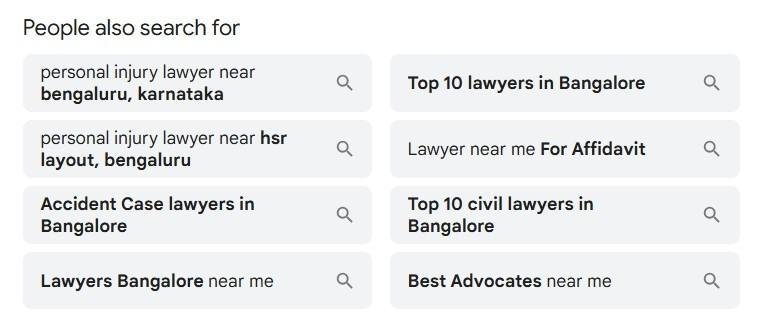
Not all legal search terms carry equal value. "Personal injury law" is informational and rarely converts; "personal injury lawyer near me" or "how much is my car accident claim worth" signals someone ready to speak with an attorney.
Why it matters: Ranking for high-volume but low-intent terms wastes resources; ranking for high-intent terms produces inquiries.
Implementation tip: Prioritize keyword research around consultation-ready phrases and injury- or issue-specific language rather than broad category terms.
3. Strengthen Local SEO
For most firms, local visibility drives more inquiries than national rankings ever will. This includes location pages, city-specific content, and citations across legal directories.
Why it matters: The majority of legal searches include or imply a location, and local pack visibility often outperforms organic results for click-through rate.
Implementation tip: If the firm has multiple offices, build a separate, uniquely written page for each location rather than duplicating the same content with a swapped city name.
4. Optimize Google Business Profile
A complete, actively managed Google Business Profile is often the single highest-leverage asset in local SEO for lawyers. It influences map pack rankings, click-through rate, and first impressions.
Why it matters: Many prospects call directly from the Business Profile without ever visiting the website.
Implementation tip: Keep categories accurate, respond to every review, add real office photos, and post regular updates about practice areas or case types handled.
5. Create Authoritative Legal Content
Blog content, FAQ pages, and legal explainers build topical authority and answer the research-stage questions that eventually lead to a consultation request.
Why it matters: Content demonstrates expertise, supports practice-area pages through internal linking, and captures informational searches earlier in the decision process.
Implementation tip: Write content that an attorney at the firm would actually stand behind, accurate, specific to the jurisdiction, and reviewed for compliance before publishing.
6. Improve Technical SEO
Technical SEO, including Site speed, mobile usability, clean URL structure, and proper indexing, is foundational. No amount of content will rank consistently on a slow or poorly structured site.
Why it matters: Technical issues silently cap how much of the content and authority work actually gets rewarded by search engines.
Implementation tip: Run a technical SEO audit covering Core Web Vitals, crawl errors, duplicate content, and mobile performance at least twice a year.
7. Earn High-Quality Legal Backlinks
Links from bar associations, legal directories, local news coverage, and industry publications signal authority in a way that generic guest posts cannot replicate.
Why it matters: In a competitive field like legal SEO, backlink authority is often the deciding factor between two firms with similarly strong on-page content.
Implementation tip: Pursue sponsorships, speaking engagements, and local press opportunities that naturally generate links, rather than relying solely on outreach campaigns.
8. Optimize for AI Search and Featured Snippets
AI Overviews, Perplexity, and similar tools increasingly answer "do I need a lawyer for X?" and "what happens if Y?" questions directly. Structuring content to be extractable, with clear headings, direct answers, and FAQ blocks, improves the odds of being cited in AI search engine optimisation.
Why it matters: Prospects are starting their research on AI tools before they ever reach a search engine results page.
Implementation tip: Lead each key section with a direct, concise answer before expanding into detail, and use schema markup where relevant.
9. Improve Conversion Paths
Ranking well is only half the outcome. Every page needs a clear, low-friction way to contact the firm, visible phone numbers, short intake forms, and click-to-call on mobile.
Why it matters: A page that ranks in position one but buries its contact information will still underperform a lower-ranking page with a clear call to action.
Implementation tip: Test form length and placement; longer intake forms often reduce completion rates for time-sensitive legal issues like accidents or arrests.
10. Measure SEO Performance Using Meaningful KPIs
Rankings and traffic are useful diagnostic metrics, but the metrics that matter to a managing partner are calls, form submissions, and signed cases attributable to organic search.
Why it matters: Without inquiry-level tracking, it's impossible to know whether SEO for lawyers is actually producing business results or just vanity metrics.
Implementation tip: Set up call tracking and form tracking through Google Analytics and connect it to intake data so marketing spend can be tied to actual case value.
How to Measure Qualified Inquiries from SEO
Generating more traffic is only valuable if it leads to real business opportunities. Law firms should evaluate SEO based on the quality of inquiries it produces, not just website visits or keyword rankings.
Qualified consultation: Track consultation requests that match your target practice areas, locations, and ideal client profile rather than counting every phone call or form submission.
Signed cases: Measure how many SEO-generated inquiries become paying clients. This provides the clearest picture of SEO's contribution to revenue and long-term firm growth.
Cost per qualified inquiry: Compare your monthly SEO investment with the number of qualified consultations or signed cases generated. This helps determine whether SEO is delivering a sustainable client acquisition cost compared with paid advertising.
By focusing on these business outcomes instead of vanity metrics, law firms can make better marketing decisions and understand the true return on their SEO investment.
Common SEO Mistakes Law Firms Should Avoid
Even firms that invest seriously in SEO for lawyers often lose ground to simple, avoidable mistakes:
-
Treating the homepage as the main landing page instead of building dedicated practice-area pages that match specific searcher intent.
-
Duplicating location pages by copying the same content and swapping the city name, which search engines quickly identify as thin content.
-
Ignoring Google Business Profile after initial setup, leaving reviews unanswered, and leaving information outdated.
-
Chasing keyword volume over intent, ranking for broad informational terms that rarely produce a consultation request.
-
Publishing content without compliance review risks language that conflicts with bar association advertising rules.
-
Measuring success by rankings alone, without tracking whether traffic converts into calls or signed cases.
-
Neglecting technical health, letting slow load times or mobile issues quietly suppress otherwise strong content.
How to Choose the Right SEO Partner for Your Law Firm
Not every agency that offers SEO for lawyers understands the legal industry's specific constraints and opportunities. A few questions help separate genuine legal SEO experience from generalist SEO applied to a law firm:
-
Do they understand bar association advertising rules in the relevant jurisdiction, or will the firm need to police every piece of content itself?
-
Do they build practice-area and location pages as a core deliverable, or treat content as an afterthought to technical work?
-
Can they show how past legal clients' inquiry volume changed, not just ranking screenshots?
-
Do they track calls and form submissions, or only impressions and clicks?
-
Do they explain their process in plain terms, including realistic timelines, rather than promising guaranteed rankings?
A capable partner should be able to walk through exactly how their approach to SEO for lawyers connects to consultation volume, not just search visibility.
Frequently Asked Questions
1. Is SEO worth it for lawyers?
For most firms, yes. Particularly those competing in markets where paid advertising costs are high. Organic visibility compounds over time and continues generating inquiries without a per-click cost, making it one of the more sustainable client acquisition channels available to law firms.
2. How long does legal SEO take to show results?
Most firms begin seeing measurable movement in rankings and traffic within three to six months, with stronger inquiry volume typically building over six to twelve months. Highly competitive practice areas and markets can take longer, especially where established firms have years of accumulated authority.
3. How much does SEO for lawyers cost?
Costs vary widely based on market competitiveness, number of practice areas and locations, and the scope of content and technical work required. Firms should expect legal SEO to be priced as an ongoing investment rather than a one-time project, given the sustained effort needed to compete for high-value legal terms.
4. Can SEO outperform Google Ads for law firms?
Over the long term, organic SEO often produces a lower cost per qualified inquiry than paid ads, since it does not require ongoing spend per click. However, the two channels work best together: paid ads for immediate volume and testing, organic SEO for sustainable, compounding growth.
5. What should law firms expect from an SEO agency?
Clear reporting tied to inquiries and case value, not just rankings; content that respects advertising compliance rules; dedicated practice-area and location pages; and a realistic, jargon-free explanation of timelines and strategy.
SEO for lawyers is not a shortcut, and it is not a substitute for a firm's reputation or the quality of its casework. What it does offer is a compounding, increasingly cost-efficient way to be visible to prospective clients at the exact moment they are searching for help — whether that search happens on Google, inside an AI assistant, or through a map pack result on a phone.
Firms that invest in dedicated practice-area pages, strong local signals, authoritative content, and clean technical performance consistently outperform competitors who treat their website as a digital brochure. The firms that win the next decade of client acquisition will be the ones that treat organic search as seriously as they treat their casework.
If your firm is ready to build an SEO for lawyers strategy that produces qualified consultations instead of just traffic, Eflot's legal SEO team can walk you through a practical, jurisdiction-aware plan built around your practice areas and markets. Get in touch to start with a free legal SEO assessment of your current website.
Digital Marketing services in Other Locations in India
Bangalore | Hyderabad | Chennai | Pune | Ahmedabad | Coimbatore | Mumbai | Kolkata | Patna | Amritsar | Indore | Kozhikode | Trivandrum | Jaipur | Nagpur | Gwalior | Dehradun | Noida | Vizag | Raipur | Agra | Gurgaon | Madurai | Udaipur | Thrissur |