







Neil Patel's Email Marketing Strategy: Why Sending More Emails Actually Works
How Neil Patel keeps 1.6M subscribers opening daily emails. Real test data on word count, subject lines, and segmentation, fully sourced.
The Annoyance That Started It
Neil Patel kept showing up in my inbox almost daily, sometimes twice before dinner. That broke the one rule every marketing book agrees on: don't email too often, or people unsubscribe, and your list shrinks.
So I looked closer.
The number that stopped me: Patel shared on LinkedIn in 2023 that his email list has about 1.6 million subscribers, and they keep opening his emails instead of leaving.
That gap between "should fail" and "actually works" is what hooked me.
What I did:
-
Subscribed and saved his emails
-
Compared his campaigns across different years
-
Read his interviews and published test results
-
Checked all of it against 2026 research from HubSpot, Forbes Advisor, and others
What I found: not luck, not a secret trick, just a small set of habits, tested repeatedly until they became almost boring. Habits most brands never bother to try.
Let's follow the clues.
Why Email Marketing Still Works in 2026
Before judging anything Patel did, I had to answer a simpler question. A skeptical friend kept asking: Does email even matter anymore in a world of short videos and AI chatbots?
The numbers gave a loud answer:
-
There are 4.48 billion email users worldwide right now, expected to reach 4.73 billion by 2026, per Forbes Advisor's 2026 report (based on Oberlo research).
-
People send 361.6 billion emails every day, a number projected to climb to 408.2 billion by 2027, according to The Radicati Group.
-
Email now ties with organic social media as the second most-used marketing channel, used by 40% of marketers, per HubSpot's 2026 State of Marketing Report.
-
For direct-to-consumer brands, email marketing was the single best channel for ROI in 2025, beating paid social and content marketing (HubSpot, 2025).
Patel makes a similar point on his own blog: almost 60% of email users check their inbox before anything else online. That figure comes from his own site, not an outside tracker, so I didn't fully trust it, but it pointed in the same direction as everything else.
Bottom line: Email isn't dead. It might be one of the liveliest channels out there. The real question was never whether email works; it's what Patel does differently.
Why Neil Patel Sends Emails So Often
The first thing I wanted to understand was the frequency. On paper, it looked reckless. Most marketers are scared of sending too much. Patel doesn't seem scared at all.
Here's what makes his habit look even stranger: most businesses send only 2 to 4 emails a month, according to Forbes Advisor's 2026 report. Patel beats that in a matter of days. So why would anyone take that risk?
The answer turned out to be a different idea of what "risk" even means. In a 2024 interview with GetResponse, Patel said something simple but sharp don't let your list sit quietly, because subscribers will forget why they signed up. Read that again, and the logic flips:
-
To most marketers, the danger is the annoyed reader who unsubscribes.
-
To Patel, the real danger is the silent, ignored list.
An unsubscribe costs almost nothing. A forgotten list costs everything, because those people quietly stop buying and stop trusting you, long before they ever hit "unsubscribe."
Eflot Insight: We rarely tell clients to copy Patel's near-daily pace. But the idea behind it holds for every account we manage: a quiet list fades faster than an active one annoys people. When we take over an email program, one of the first things we check is send frequency against how engaged the list actually is, not against some “once a week” rule.
The Ideal Email Length, According to Patel's Own Testing
That idea made me curious about the emails themselves. If he sent this often, were they long and packed with information, or short and quick to read? This is where things got genuinely useful, because Patel didn't just guess. He ran a real test. More than once. On his own audience.
In a 2023 LinkedIn post, he described running the same experiment six separate times across his whole list. Each email had just one link inside. The emails were split into five length groups. This was his own experiment, not an outside study, so I treated it as a strong internal clue rather than a universal law.
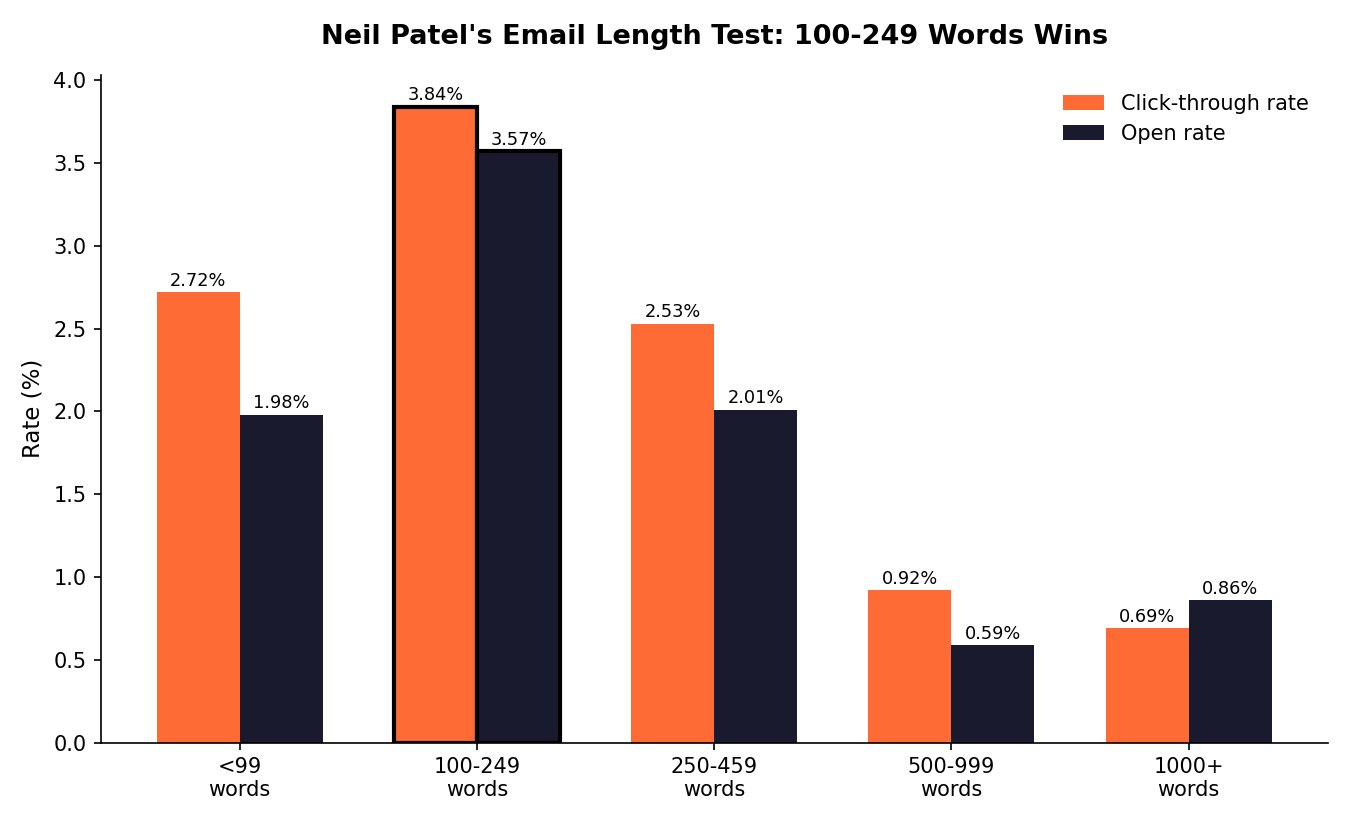
Look closely, and one thing stands out. The bars for emails between 100 and 249 words are the tallest — for both click-through rate and open rate. Once you pass 500 words, something sad happens: almost nobody clicks.
|
Length |
Click-through rate |
Open rate |
|
Under 99 words |
2.72% |
1.98% |
|
100 to 249 words |
3.84% |
3.57% |
|
250 to 459 words |
2.53% |
2.01% |
|
500 to 999 words |
0.92% |
0.59% |
|
1,000+ words |
0.69% |
0.86% |
There's a simple lesson hiding in that table. If an email needs a scroll bar, most people won't read it. They glance, decide it looks like homework, and close the tab. Short and useful beats long and thorough, at least in the inbox.
Note: These results come from Neil Patel's own email experiments on his subscriber base. While they provide useful direction, optimal email length and performance can vary depending on your audience, industry, and content strategy. Testing with your own subscribers is the most reliable approach.
Why Plain-Text Emails Beat Fancy Designs
That made me look closer at how the emails were built. I expected a polished marketing celebrity, I figured, to send beautiful, designed emails. He doesn't.
Patel's emails are mostly plain text. No bright colors, no big banners, no fancy layouts. He said as much on LinkedIn in 2023, calling it a deliberate choice tied to deliverability, whether your email lands in someone's main inbox instead of drowning in spam or the promotions tab.
The more I read, the smarter this choice looked:
-
Only 35% of email marketers actually design their emails to work well on phones, per Forbes Advisor's 2026 data (citing Litmus research).
-
Yet 41% of all email opens happen on a phone.
-
For Gmail users specifically, that jumps to 75% (same report, citing Mailbutler).
Plain text skips the whole problem. There's no fragile design to break or look messy on a small screen because there's no design at all. It's just words, and words always fit.
How Patel's Subject Lines Went From Fear to Benefit
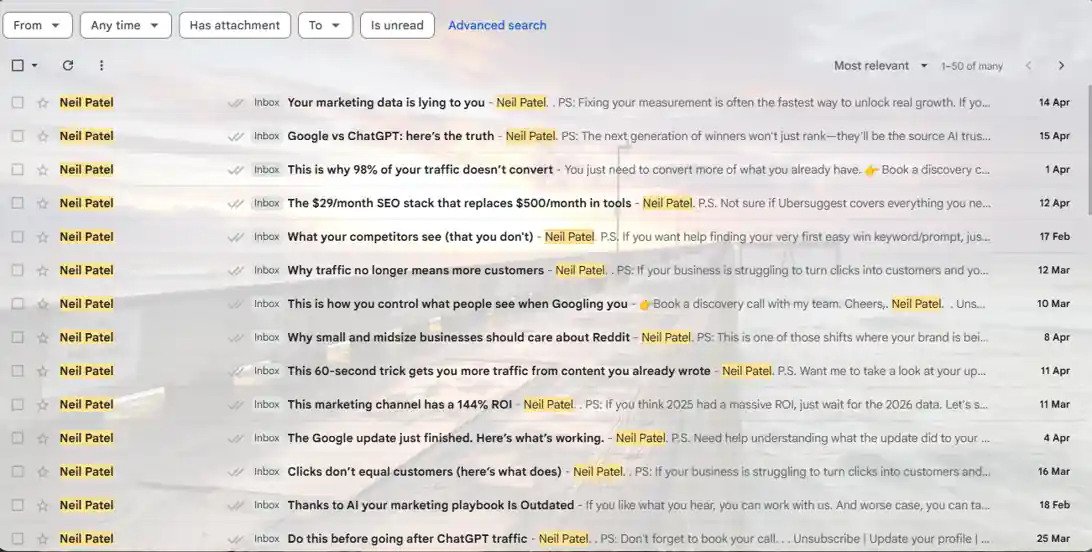
By now, I was hooked. So I did something slightly obsessive: I lined up his subject lines from two different years, 2024 and 2026, and read them side by side. The change in tone was so clear it felt like watching someone grow up.
In 2024, his subject lines leaned hard into fear and doubt. A few real examples:
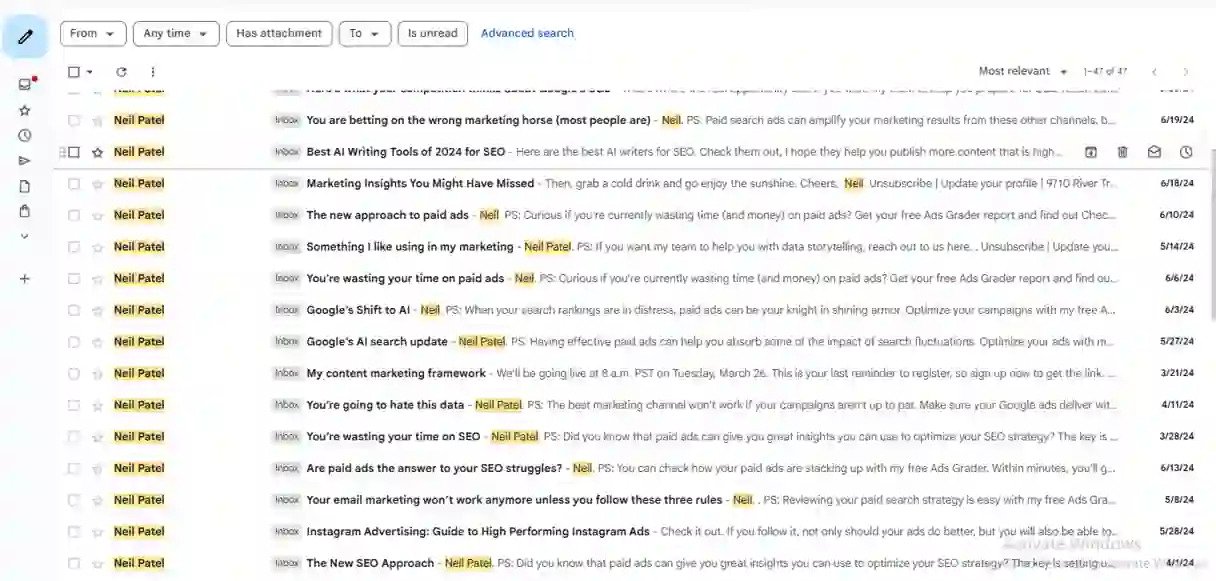
- “You are betting on the wrong marketing horse”
- “You're wasting your time on paid ads”
- "You're going to hate this data”
Notice the pattern. Each one pokes at something the reader might be doing wrong. It plants a small worry, and worry makes people click.
By 2026, the tone had flipped completely. The subject lines now lead with a clear, positive benefit instead of fear:
- “Pay once. Keep it for life.”
- “New marketing workflows that actually work”
- “AI SEO vs. Regular SEO”
But the more examples I collected, the more I noticed both styles shared one thing: they were short. No wasted words. One idea each. An independent teardown on Publicist.co studied one real Patel subject line, “The Fastest and Cheapest Way to Beat Your Competition,” and found it was exactly 55 characters long — tight and packed with a confident, benefit-led promise.
That matched wider, independent research too. Data from ActiveCampaign shows the best-performing subject lines usually fall between 4 and 7 words, or 41 to 50 characters — almost exactly where Patel's land. Separate research from Mailchimp warns that words like “free,” “help,” and “per cent off” can trigger spam filters. Patel's newer, benefit-focused lines mostly avoid them.
Eflot Insight: We track this same fear-to-benefit shift for our own clients. Fear-based subject lines can spike opens in the short term, but they tend to wear out a list faster. We usually test both angles early in a campaign, then let the data — not the assumption that “benefit-led always wins” — decide the long-term mix.
The PS Line as a Second Call to Action
Then a smaller pattern caught my eye — the kind most people would scroll right past. By 2026, almost every email in Patel's inbox ended with a PS line. And that PS line was visible right in the inbox preview, before anyone even opened the email. This is something I watched happen directly in his own emails, not a claim from an outside study.
- “PS: Want help building segments that actually move...”
- “PS Not sure which plan? [text continues]”
- “PS: Happy New Year's Eve! Here's to building momentum...”
Back in 2024, this barely showed up. It became a clear habit only by 2026. Why does one line at the bottom matter so much? Because people naturally skim to the end of things, even when they skip the middle. A good PS becomes a second, sneakier call to action — like a friendly nudge on the way out the door.
One Offer, Many Doors
That got me looking at where all these emails were actually sent to people. I found something clever. Back in 2024, a large chunk of Patel's subject lines pointed to the same place: a free tool called the “Ads Grader.” But the angle changed every time. One day, it was framed as “Are paid ads the answer to your SEO struggles?” Another day: “The new approach to paid ads.”
This isn't laziness dressed up as strategy. It is the strategy. Instead of betting everything on one perfect subject line, Patel built a dozen different doors that all led to the same room. If a reader ignores nine of his emails, he only needs the tenth one to catch their attention.
Speaking to What Readers Already Worry About
The 2026 emails showed one more move that was missing two years earlier. Patel started writing subject lines that stepped straight into a conversation his readers were already having in their own heads — especially about AI and search engines:
- "Google is keeping users inside AI search”
- “GEO vs AEO”
- “AI isn't the strategy. It's the assistant”
These lines aren't just trying to sell something. They cast Patel as the person explaining a confusing, slightly scary shift before anyone else does. And the instinct is backed by data. According to HubSpot's 2026 State of Marketing Report, nearly 24% of marketers are actively rethinking their SEO strategy because of generative AI tools like ChatGPT and Gemini, and more than 92% plan to optimise for both regular search engines and AI-powered search. Patel speaks directly into that anxiety — and only afterwards does he offer a hand.
Why Segmentation Multiplies Results
At this point, one question kept nagging at me: how does he send this often without wearing everyone out? The answer, according to Pepper.inc's independent breakdown of his methods, is that he doesn't send the same email to everyone. He uses “subscriber tags” — sorting people into groups based on what they care about — then writes different calls to action for each group instead of one giant message for the whole list.
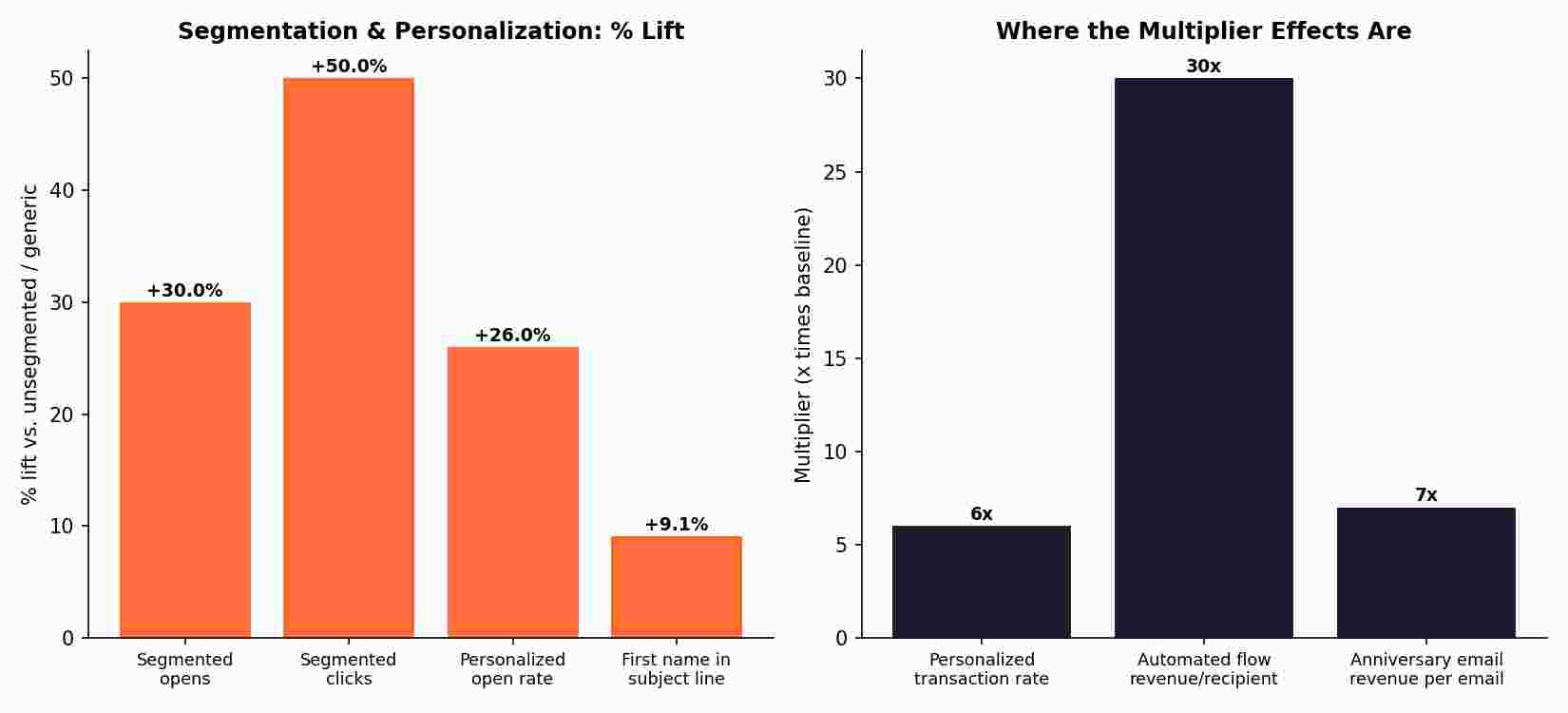
Independent research backs this up in a big way:
- Emails sent to a specific group of people, instead of everyone, get 30% more opens and 50% more clicks compared to emails sent to an entire unsorted list, according to HubSpot.
- 78% of marketers say sorting subscribers into groups is the single most effective thing they do in email marketing, based on that same HubSpot data.
- Personalised emails see a 26% jump in open rates, according to Forbes Advisor's 2026 report, citing Campaign Monitor.
- Personalised emails can drive purchases at a rate up to 6 times higher than generic emails, according to the same report, citing Experian.
- Something as small as adding a person's first name to a subject line lifts open rates by 9.1%, according to Forbes Advisor, citing Marketo.
- 79% of people say they'll only pay attention to an offer email if it actually reflects something they did before, like a past purchase or click, according to Forbes Advisor, citing McKinsey & Company.
Then I found the number that made me sit up. One case study from NP Digital, Patel's own agency, reported newsletter open rates as high as 99.42% when the content was written for one narrow group of people. Since that number comes from his own agency and not an outside auditor, I treated it as an extreme, unusual result rather than a typical one. But even heavily discounted, it shows how much force careful sorting can create.
Eflot Insight: Segmentation is consistently the highest-impact change we make when we take over an under-performing email program. Even splitting a list into two or three groups based on real behaviour, instead of guesswork, tends to move opens and clicks before any copywriting changes even kick in.
Why the Welcome Series Comes First
If segmentation was the engine, I wanted to know where Patel starts building it. According to a breakdown published on Sellbrite, which references Patel's own list of email automations every online store needs, the welcome series sits at the very top. Number one. Not an afterthought.
Patel's own website explains that every automated email sequence needs four things: a trigger that starts it, filters that decide who gets it, delays between messages, and a clear exit so people aren't stuck getting irrelevant emails forever.
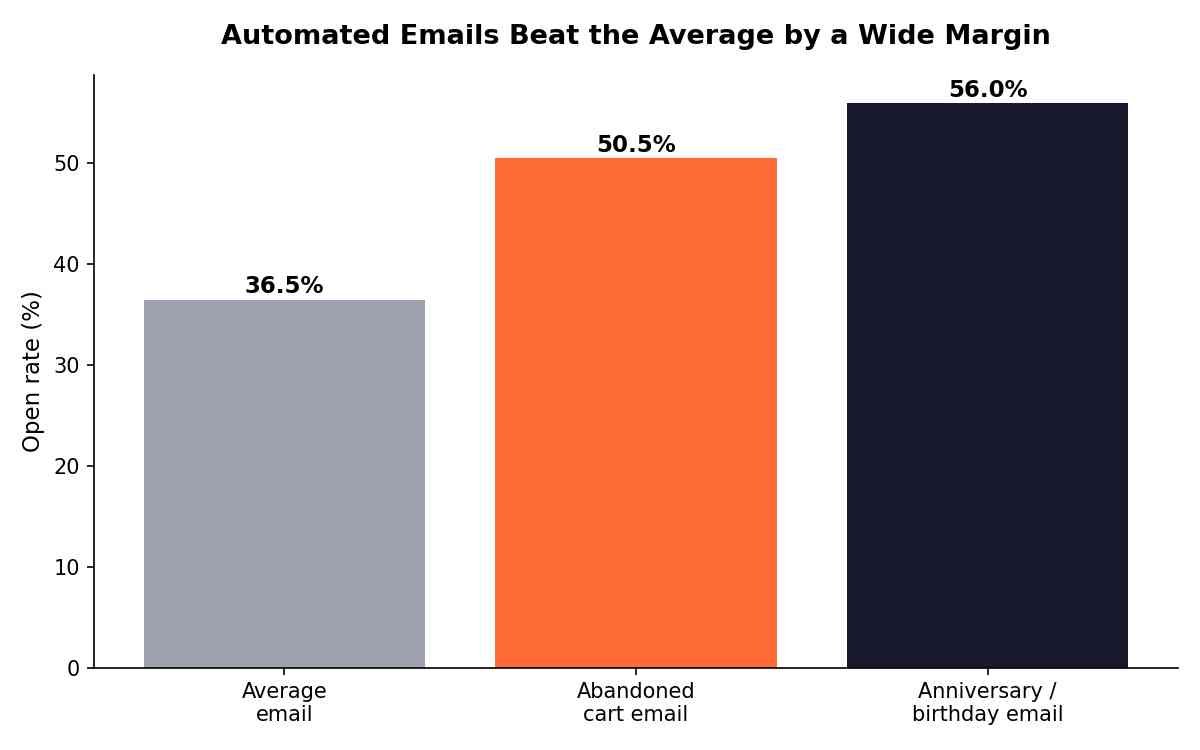
The wider, independent data shows exactly why automation deserves this much attention:
- Automated email sequences, like reminders about items left in a shopping cart, can generate up to 30 times more revenue per person compared to a normal one-time email blast, according to Forbes Advisor's 2026 report, citing Klaviyo.
- Abandoned cart reminder emails get opened 50.5% of the time — 15 percentage points higher than the average email, according to that same source.
- Birthday and anniversary emails get opened at more than triple the normal rate: 56% compared to just 17% for regular emails, according to Forbes Advisor, citing Experian. They also earn about 7 times more money per email sent — 66 cents compared to just 10 cents for a normal email.
Eflot Insight: A welcome series is usually the first automation we set up for new clients, for the same reason Patel puts it at the top of his list: it's the one email sequence every subscriber is guaranteed to see, at the exact moment their interest is highest.
Inside Patel's Webinar Funnel
Curiosity pulled me one layer deeper — into what actually happens after someone signs up for one of his webinars. A breakdown published by Emaildrips.com, an independent source, lays out the sequence. First, Patel tries to sell them directly on his fully paid program. If that doesn't work, he offers a cheaper trial, sometimes as low as one dollar. If that still doesn't work, he shifts gears completely and offers something more personal, like a coaching session — but only to people who fill out an application first.
Each step quietly filters out people who aren't interested, while raising the value of what's offered to the people who remain. No single email has to convince someone to buy everything all at once.
Where the Numbers Disagree, and Why That's Okay
The deeper I dug, the more I ran into a problem most marketing articles pretend doesn't exist: the numbers don't always agree. Trusted sources sometimes say different things, and smoothing that over wouldn't be honest.
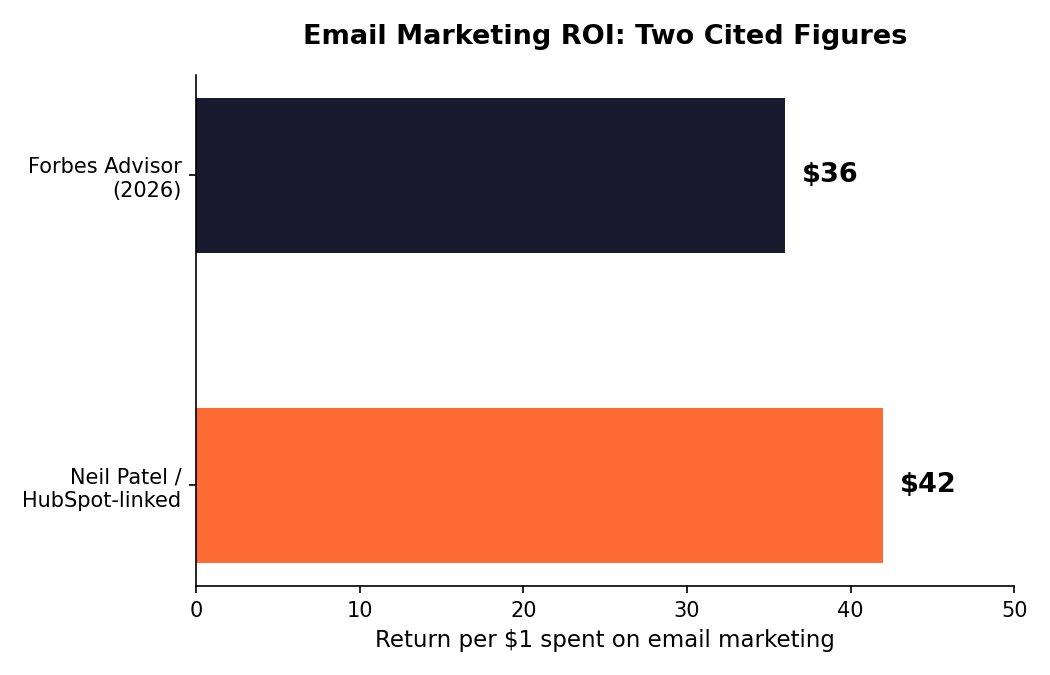
Take the return on investment. Independent research from Forbes Advisor's 2026 report, citing a company called Sender, puts the industry-average email marketing return at roughly $36 for every dollar spent. Patel's own blog claims a higher number: $42 for every dollar spent. Both numbers come from real research. The gap probably comes down to who was surveyed, when, and how each company measured things. The honest way to talk about this is to say the return sits somewhere between $36 and $42 for every dollar spent, instead of picking one number and pretending it's exact.
Click-through rates tell the same story. Forbes Advisor's 2026 report, citing Mailchimp, puts the average click-through rate across industries at 1.4%. HubSpot's data, shared separately on Patel's blog, says it's closer to 2.5%. Again, both are real numbers from real research. Neither one is a lie. They're just measuring slightly different things, at slightly different times.
Key Numbers at a Glance
The details above live where they matter most throughout this story. For anyone who wants the headline figures collected in one place, here they are, without the repeats.
|
Metric |
Figure |
Source |
|
Global email users (2026 est.) |
4.73 billion |
Forbes Advisor, citing Oberlo |
|
Emails sent worldwide per day |
361.6 billion |
Forbes Advisor, citing Radicati Group |
|
Average open rate |
36.5% |
Forbes Advisor, citing Sender |
|
Average click-through rate |
1.4%–2.5% |
Forbes Advisor (Mailchimp) / HubSpot |
|
Best email length |
100–249 words |
Patel's own 2023 LinkedIn test |
|
Segmented vs. unsorted opens/clicks |
+30% / +50% |
HubSpot |
|
Personalised email open-rate lift |
+26% |
Forbes Advisor, citing Campaign Monitor |
|
Abandoned cart email open rate |
50.5% |
Forbes Advisor, citing Klaviyo |
|
Email marketing ROI |
$36–$42 per $1 |
Forbes Advisor (Sender) / Patel's blog |
|
Gmail opens happening on mobile |
75% |
Forbes Advisor, citing Mailbutler |
What This Story Actually Teaches Us
Strip away every fancy word, and the whole investigation boils down to a short list of habits. None of them needs a huge budget or a secret trick.
|
The weak habit |
The stronger replacement |
|
Sending one big generic email a month |
Sending regularly, and sorting people by what they actually care about |
|
Writing long, detailed updates |
Keeping things between 100 and 249 words, with just one link |
|
Putting the call to action only in the middle |
Adding a second, softer call to action inside a PS line |
|
Selling a service directly, right away |
Explaining the problem first, then offering help |
|
Betting everything on one perfect subject line |
Reusing the same offer through many different subject line angles |
|
Skipping a welcome email entirely |
Building a welcome series as the very first automation |
None of this depends on guesswork. It just takes picking one email list, running the same length test Patel ran, and giving it four to six weeks to see what the open rates and click rates actually say. The data will tell you the truth — the same way it told Patel the truth, six separate times.
Where Eflot Fits Into This Story
For us at Eflot, this isn't just an interesting case study we read once and moved on from. It's part of how we think about Email Marketing Services for our own clients — whether that's a data science training brand like IABAC, a real estate platform like PropLilly, or a cybersecurity company like DigitDefence. We don't copy Patel's emails word for word. We borrow the discipline behind them, just like the callouts throughout this article describe: keep messages short and useful, sort subscribers by what they actually care about instead of blasting one message to everyone, test length and timing instead of guessing, and always let a second, softer call to action live quietly in the PS line.
Every client is different, so the segments and offers change. But the habit stays the same across every email program we build: test first, write second.
And that, in the end, answers the question I started with. Patel doesn't get away with sending too many emails despite breaking the rules. He gets away with it because he quietly replaced the rules with something more honest: repeated tests on his own list and the willingness to believe the results even when they surprised him.
Digital Marketing services in Other Locations in India
Bangalore | Hyderabad | Chennai | Pune | Ahmedabad | Coimbatore | Mumbai | Kolkata | Patna | Amritsar | Indore | Kozhikode | Trivandrum | Jaipur | Nagpur | Gwalior | Dehradun | Noida | Vizag | Raipur | Agra | Gurgaon | Madurai | Udaipur | Thrissur |