




How Zepto's 10-Min Delivery Strategy Creates Instant Demand
Explore Zepto marketing strategy and how instant delivery compresses intent to action, reduces friction, and drives conversions through real-time demand capture today now
A customer needing groceries tomorrow behaves very differently from one who needs them in 10 minutes.
That single shift changes how people search, decide, and buy.
There’s no browsing. No comparison. Just immediate action.
This is where Zepto's marketing strategy creates an advantage most brands struggle to replicate. By compressing delivery time, Zepto turns everyday needs into instant demand - right at the moment intent appears.
Understanding how this works goes beyond logistics. It’s about timing, behavior, and how Zepto marketing aligns product availability with real-time demand. Brands that get this right don’t chase conversions, they capture them as they happen.
Why Most Brands Struggle to Create Real Demand Today
When analyzing D2C and eCommerce funnels, one pattern consistently emerges:
Customers don’t reject the product - they delay the decision.
-
They add items to the cart
-
They open another tab
-
They plan to come back later
And in most cases, they don’t.
The intent exists. What’s missing is a reason to act now.
According to Google, 53% of mobile users leave a site if it takes more than 3 seconds to load. That points to a larger behavior - people expect speed across the entire experience, not just page load. When buying feels slow or requires effort, interest drops faster than most brands expect.
So brands compensate with more effort: more ads, more offers, more visibility.
That may drive short-term spikes. But it rarely sustains.
Because attention without urgency doesn’t convert.
The Core Pillars of Zepto Marketing Strategy
The Zepto marketing strategy is built on one idea: compress time between intent and fulfillment.
1. Time Compression as a Value Proposition
Customers don’t measure effort in money alone. They measure it in time.
A delayed purchase creates friction:
-
Planning effort
-
Waiting period
-
Re-evaluation
Zepto removes all three:
-
Planning effort is minimized: Commonly needed items are shown upfront, so users don’t have to search or overthink decisions.
-
Waiting period is compressed: 10-minute delivery reduces the gap between need and fulfillment.
-
Re-evaluation is eliminated: Speed reduces the window to compare alternatives or change decisions.
According to a McKinsey report, 71% of consumers expect personalized interactions, and 76% feel frustrated when brands fail to deliver.
This reflects a broader shift; customers now expect fast, consistent experiences across every touchpoint, and any delay or friction quickly breaks that expectation.
For your brand, this means simplifying and speeding up the journey will drive more repeat behavior than adding features.
2. Hyperlocal Infrastructure Supports the Promise
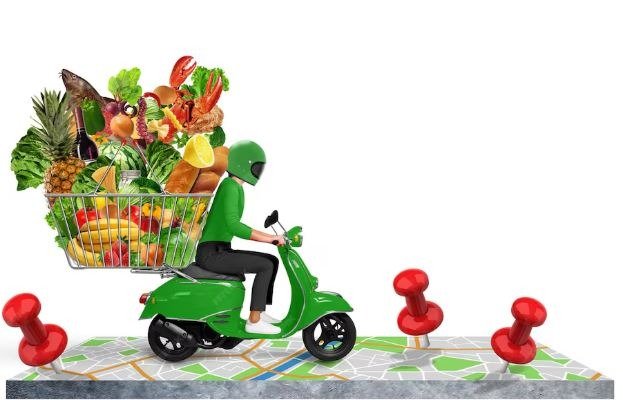
The 10-minute promise works because the backend is tightly controlled. Zepto doesn’t operate like a typical warehouse model.
-
Proximity makes speed possible: Orders are fulfilled from dark stores placed within a 2–3 km radius of high-demand zones. That distance is what makes a 10-minute window even possible.
-
Curated inventory reduces delays:
Inventory is not “broad” - it’s curated based on local demand patterns. What sells fast in one area is stocked there. This keeps picking time low and avoids delays. -
Lack of control breaks the promise:
Brands that try to offer fast delivery without this level of control often route orders from farther locations, face stockouts, and stretch delivery timelines.
That’s where the model breaks.
Because once a customer sees 25 minutes instead of 10, the urgency disappears - and with it, the reason to choose you again.
3. Messaging Consistency Across Channels
The message doesn’t change based on the platform - it repeats until it sticks.
Whether it’s an app notification, a paid campaign, or an in-app banner, the same idea shows up again and again: delivery in minutes.
-
Timed around real need moments: Push notifications are aligned with common need moments - late evenings, weekends, or during rain.
-
Speed leads every communication: Paid campaigns highlight speed in the first line, not buried in the copy. Creatives are built around urgency, not product variety.
-
Misalignment creates friction: When ads talk about speed but the app pushes discounts, users receive mixed signals and pause to think.
That pause is enough to lose the conversion.
Zepto avoids that. One message. Repeated across every touchpoint until it becomes the default expectation.
The 3 Demand Triggers Behind Zepto Marketing
1. Urgency Without Discounts
Most brands rely on urgency driven by pricing, discounts, limited-time offers, and coupons. It works, but only temporarily.
Zepto flips this model. Instead of price, the trigger is time.
-
Real-life triggers matter more than savings: Imagine it’s 10:30 PM and you’ve run out of milk or snacks. You’re not comparing prices, you’re trying to fix the problem fast.
-
Immediate need reduces decision friction: When urgency is tied to a real need, users don’t browse or compare. They choose the first option that feels fast and reliable.
-
Decision-making shifts from price to resolution: The focus moves from “What’s the best deal?” to “Who can solve this right now?”
This is the key shift. Urgency is not artificially created - it’s driven by context.
2. Habit Through Reliability
Urgency might get the first order, but it doesn’t guarantee the second.
What matters next is whether the experience holds up.
-
Expectation vs. reality defines trust: If delivery is promised in 10 minutes but arrives in 25, the next decision includes hesitation.
-
The second experience decides retention: The first builds interest. The second determines whether users return.
-
Predictability removes friction: Orders arrive on time, availability is reliable, and the flow feels familiar every time.
Over time, users stop evaluating alternatives.
That’s how habit builds, through consistent, predictable experiences.
3. Frictionless Decision-Making
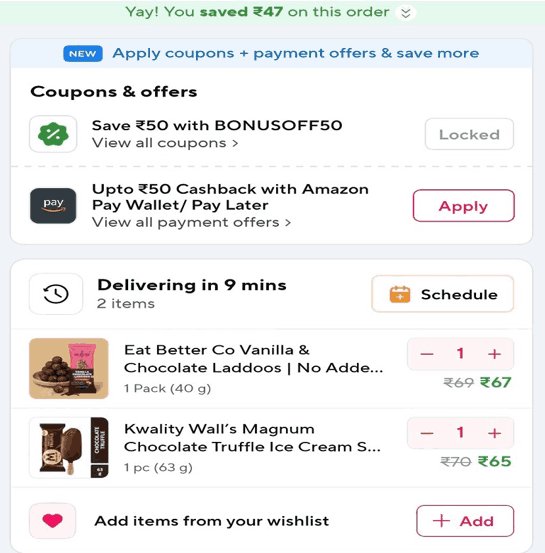
Even when users are ready to buy, too many choices can slow them down.
According to HubSpot, too many choices can lead to “choice paralysis,” where users struggle to make a decision and often end up not choosing at all. In practical terms, simplifying options helps users move forward instead of getting stuck.
-
More options lead to slower decisions: Users browse more, open multiple tabs, and delay the final action.
-
Interface guides the next step: Categories are tight, key items are easy to find, and checkout is quick.
-
Friction breaks momentum: Extra steps, unclear paths, or too many options slow users down and reduce conversions.
Zepto keeps the process focused. The user identifies the need, selects the product, and completes the purchase without unnecessary detours. When the path is clear, decisions happen faster.
Zepto Online Experience: Designed for Speed, Not Exploration
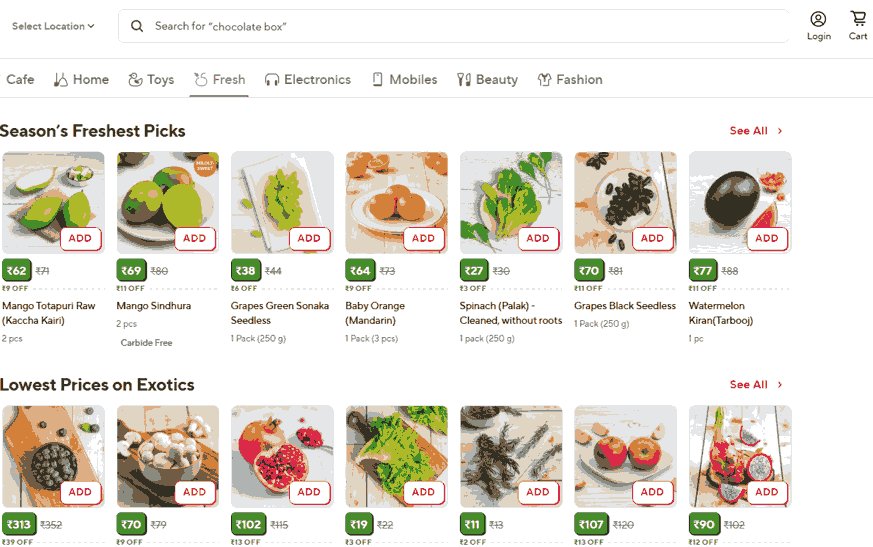
The zepto online experience is engineered for action.
From direct observation of the app, a few patterns stand out:
-
Homepage prioritizes essentials
-
Search is predictive and fast
-
Checkout requires minimal input
There’s very little that distracts users from completing the purchase.
Comparing this with traditional platforms, where users:
-
Scroll longer
-
Evaluate more
-
Delay decisions
Zepto reduces interaction steps to the minimum needed for purchase.
This aligns with a broader pattern we see across ecommerce marketing strategies, where shorter and clearer paths to action consistently lead to higher conversions.
How to Apply Zepto Marketing Strategy to Your Business
You don’t need a 10-minute delivery model to apply Zepto marketing. What matters is how you reduce the delay between intent and action.
-
Define Your “Speed Value” Clearly: Identify where you can reduce time - delivery, onboarding, response, or results, and make that your core message.
-
Build Urgency Around Real Situations: Tie your messaging to actual moments when your customer needs a solution, not just generic offers or timelines.
-
Simplify the Decision Path: Reduce choices, highlight key options, and make it obvious what the user should do next.
-
Align Your Promise With Delivery: If you position speed or convenience, your operations must consistently support it.
-
Remove Friction Across Touchpoints: Remove friction across touchpoints by ensuring the journey from ad to conversion feels seamless. A strong fusion of digital marketing and social media helps maintain consistency and keeps users moving without hesitation.
-
Reinforce the Same Message Everywhere: Keep your positioning consistent across campaigns, platforms, and user interactions.
The Real Lesson Behind Zepto Marketing (Most Brands Miss This)
Brands want growth. They build strategies, run campaigns, and invest in visibility.
But the real challenge isn’t creating a strategy—it’s making sure everything behind it supports the outcome.
-
Intent vs. experience gap: Marketing drives intent, but the experience slows it down.
-
Promise vs. journey mismatch: Messaging promises speed, but the journey adds steps.
-
Performance without scale: Campaigns perform, but conversions don’t grow consistently.
We’ve seen this across multiple funnels.
Traffic improves. Engagement increases. But the final action doesn’t happen.
That’s usually a sign of misalignment.
What works in models like Zepto is not just the idea, it’s the consistency behind it.
Every layer is built to reduce delay and make decisions easier.
If your goal is to create real demand and sustain it, the focus has to move beyond isolated efforts. You need a system where your marketing, user journey, and delivery experience are aligned to support the same outcome.
That’s where digital marketing support that connects strategy and execution becomes critical - bringing everything together in a way that delivers consistent outcomes.
Build Demand That Converts
At Eflot, we’ve worked with brands that bring in traffic but struggle to convert it into consistent results.
The issue is rarely visibility. It’s what happens after the click.
When the journey feels slow, unclear, or disconnected, intent drops before action happens.
Our approach combines:
-
Deep funnel analysis
-
Real user behaviour insights
-
Execution across performance and experience
If your current strategy brings visitors but not consistent conversions, it’s time to fix what’s breaking the journey after the click. Connect with the Eflot team and make your brand one that consistently turns intent into action.
What Zepto marketing strategy demonstrates isn’t just faster delivery - it’s a shift in how demand is created. Most brands try to drive growth by increasing visibility, offers, or campaigns, but real demand comes from reducing the gap between intent and action. When users can act immediately, there’s less hesitation, fewer comparisons, and higher conversions. That’s the real takeaway: it’s not about pushing harder, it’s about making decisions easier at the exact moment they matter.
Digital Marketing services in Other Locations in India
Bangalore | Hyderabad | Chennai | Pune | Ahmedabad | Coimbatore | Mumbai | Kolkata | Patna | Amritsar | Indore | Kozhikode | Trivandrum | Jaipur | Nagpur | Gwalior | Dehradun | Noida | Vizag | Raipur | Agra | Gurgaon | Madurai | Udaipur | Thrissur |