




















Topical Authority in SEO: Are You Building It the Right Way?
Build topical authority in SEO the right way with focused content, smart internal links, and expert insights that help your website rank higher online.

Ranking with isolated blog posts is becoming harder every year.
Google now prioritizes websites that demonstrate deep expertise across an entire subject, not just pages targeting single keywords.
That shift is why Topical Authority in SEO has become one of the most important long-term ranking strategies in 2026. Websites that consistently cover a topic in depth are more likely to earn search visibility, trust, and broader keyword rankings over time.
What is Topical Authority in SEO
Topical Authority in SEO means your website is seen as a reliable source on a specific topic. It is built when your content covers a subject in depth and connects related ideas in a clear structure.
Search engines look at topical relevance, content clusters, and semantic SEO to understand authority. When your site shows strong content depth and clear site structure, it becomes easier to rank higher.
In simple terms, if your website answers many questions about one topic, it gains trust over time.
Key Areas to Focus On
-
Focus on one core topic
-
Cover related subtopics in detail
-
Use clusters for structure
-
Improve internal linking between pages
-
Build strong content depth over time
According to Hubspot, Websites with well structured content clusters can improve organic traffic by up to 50% over time.
How to Build Strong Topical Authority
Building Topical Authority in SEO requires a structured approach, not random publishing.
Step 1: Choose a Clear Core Topic
Select one main subject and focus your entire content plan around it.
Example: Your core topic is SEO.
Step 2: Plan Your Content Strategy
Create a clear roadmap before writing content.
Example: You plan topics like keyword research, backlinks, and on-page SEO.
Step 3: Build Pillar Pages
Create one main detailed page that covers the full topic.
Example: You create a “Complete SEO Guide” page.
Step 4: Create Content Clusters
Write supporting articles that connect to your main page.
Example: You write separate posts on keyword research, backlinks, and site speed.
Step 5: Use Keyword Clustering
Group similar search terms into one content plan.
Example: SEO tips, how to rank on Google, Google ranking factors.
Step 6: Improve Content Depth
Explain topics fully so users get complete answers.
Example: You explain SEO step by step instead of just saying it helps with ranking.
Step 7: Strengthen Internal Linking
Connect all related pages to each other properly.
Example: Your keyword research blog links back to the SEO guide page.
How Search Engines Understand Topic Relevance
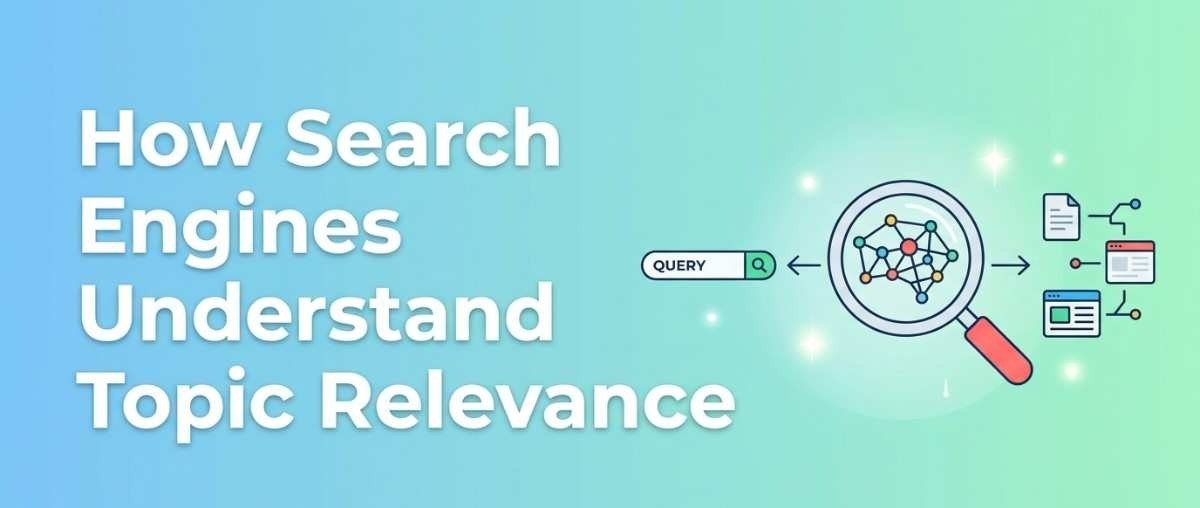
Search engines understand topic relevance by checking how deeply your content explains a subject beyond just keywords. They focus on meaning, context, and related terms to connect your page with the right topic.
-
Related keywords and context within content (Example: using SEO terms like ranking, keywords, and backlinks in one article)
-
Content depth and topic coverage (Example: writing a full guide that explains a topic from basic to advanced level)
-
Internal linking between related pages (Example: connecting SEO blog with keyword research and backlink pages)
-
User search intent match (Example: answering “how to rank on Google” with clear steps instead of theory)
When these signals work together, search engines understand your content better and show it for more related searches over time.
How to Audit Your Topical Authority in SEO Effectively
|
Audit Area |
What to Check |
Useful Tools |
|
Core Topic Coverage |
Whether your website fully covers one main subject |
Google Search Console, Ahrefs |
|
Content Clusters |
Whether related articles are grouped under main topics |
Screaming Frog, Sitebulb |
|
Internal Linking |
Whether pages are properly connected |
Screaming Frog, Ahrefs Site Audit |
|
Content Depth |
Whether the content gives complete and detailed answers |
Surfer SEO, Clearscope |
|
Search Intent Match |
Whether the content matches what users are searching for |
Google Search Console, Semrush |
|
Keyword Consistency |
Whether related terms are used naturally across content |
Semrush, Ahrefs Keywords Explorer |
How Eflot Builds Structured SEO Systems
Eflot, the top seo agency, follows a structured approach to build SEO systems that improve clarity, relevance, and long-term search visibility.
-
Core Topic Architecture: Eflot defines a single core theme and builds a structured SEO system around it for a clear search focus
-
Content Cluster Development: Related topics are grouped into strategic clusters to strengthen topical relevance and authority
-
Pillar Page Strategy: Effective pillar pages are created to support and connect all supporting content assets
-
Internal Linking Framework: A structured linking system is implemented to improve crawlability and topic connection across pages
-
Intent-Driven Content Depth: Content is developed based on search intent with detailed coverage to improve relevance and ranking potential
FAQs
1. What is topical authority in SEO?
Topical authority means your website is recognized as a trusted source for one subject. It is built by covering a topic in depth with well-structured, connected content.
2. Why is topical authority important for rankings?
Search engines prioritize websites that demonstrate strong expertise in a topic. This improves visibility across multiple related searches and increases ranking potential.
3. How do you build topical authority?
Start with a clear core topic and expand into related subtopics. Make sure of strong internal linking and structured content across all pages.
4. What are content clusters in SEO?
Content clusters are organized groups of related pages around one main topic. They improve topic clarity and help search engines understand content relationships.
5. How can you measure topical authority?
Review keyword coverage, content depth, and internal linking strength. Use tools like Google Search Console and Ahrefs to track performance and topic growth.
Topical authority in SEO grows when content covers a subject in depth with clear structure and strong internal connections. Over time, this helps search engines understand expertise and improves visibility across related searches. A structured approach with focused topics, content clusters, and consistent expansion creates long-term organic growth and stronger search presence.
Digital Marketing services in Other Locations in India
Bangalore | Hyderabad | Chennai | Pune | Ahmedabad | Coimbatore | Mumbai | Kolkata | Patna | Amritsar | Indore | Kozhikode | Trivandrum | Jaipur | Nagpur | Gwalior | Dehradun | Noida | Vizag | Raipur | Agra | Gurgaon | Madurai | Udaipur | Thrissur |