












Identify Top Customers and Personalize with AI Insights
Identify high-intent customers with AI segmentation. Analyze behaviour patterns, improve conversions, and connect with the audience that truly matters most online.
Are you targeting the wrong niche and wasting time, budget, and effort on people who aren’t ready to buy?
You run ads. You post content. You optimize your website.
Yet, sales barely move.
Visitors browse. They click. They leave.
High traffic looks good, but does it mean real buyers are engaging?
Here’s why it happens:
-
Most businesses focus on page views or broad demographics.
-
They speak to everyone, not the people who actually buy.
The solution?
-
Study behaviour patterns.
-
Segment your audience into meaningful groups.
-
Use AI customer segmentation tools to reach high-intent customers.
Do this, and every campaign, email, and message starts producing results.
In fact, when you stop trying to market to “everyone,” and start focusing on the right 20%, your efforts become much more efficient and revenue‑driving.
Reasons Businesses Struggle to Identify Their Customers
Think you truly know your audience? Many brands believe they do, until the numbers tell a different story.
Why do campaigns often fail, even with a higher number of traffic? Let’s break it down:
-
Are assumptions blocking real insight?
Marketing often focuses on age, city, or gender. But today’s buyers move across platforms, compare options, return after a few days, and seek reassurance. Surface-level profiles miss these patterns.
-
Does broad targeting blur your message?
Targeting everyone feels safe, but the message gets lost. Budgets are spread thin. Website Traffic looks good, but conversions don’t follow.
-
Are customer journeys too scattered?
A buyer may move like this: Instagram → Product Page → Google Search → YouTube → Website → Cart → Email → Purchase. Tracking all of this manually is overwhelming. This is where AI customer segmentation tools step in; they connect all these touchpoints.
-
Is data just numbers on a screen?
Reports show activity. AI highlights trends. Seeing metrics isn’t enough; you need to understand the story they tell.
The question isn’t “Who visits my site?”
It’s “Who is ready to take action, and why?”
The answer lies in behaviour patterns, not assumptions.
How Segmentation Shapes Better Messaging Across All Channels
Customer Segmentation isn’t just a technical exercise.
It changes how a business communicates across every platform.
1. Different segments need different tones
A repeat visitor shouldn’t see the same message as someone visiting for the first time.
A cart abandoner needs reassurance, not an introductory offer.
2. Email campaigns become more precise
Instead of sending one message to everyone, segmentation creates groups like:
-
deal hunters
-
repeat buyers
-
first-time visitors
-
high-interest browsers
-
loyal customers
This leads to higher opens, stronger clicks, and fewer unsubscribes.
3. Social content becomes sharper
Not every follower is your target audience.
With AI-powered customer segmentation, your social media campaigns can focus on groups formed through real behaviour signals, reaching the people who actually matter.
4. Ads stop wasting money on uninterested groups
When segments like “high-value buyers” or “high-intent visitors” appear in your system, ad budgets finally begin to go where they matter.
The Role of Behavioural Data in Predicting Customer Intent
Behaviour gives a more accurate picture of a buyer’s mindset than any demographic detail.
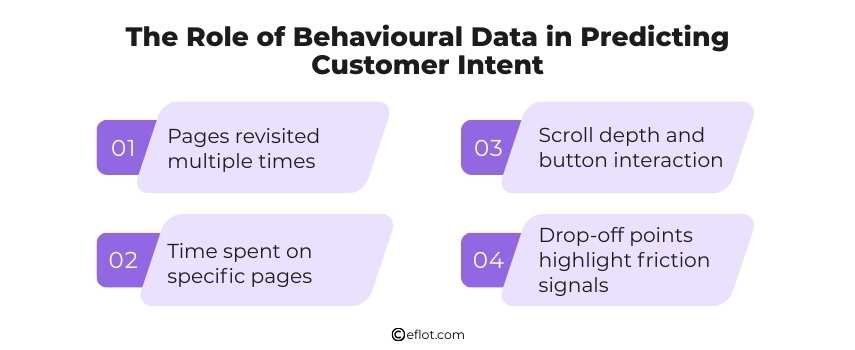
1. Pages revisited multiple times
Repeated visits to the same product or service page show growing interest.
2. Time spent on specific pages
Longer sessions often indicate curiosity or comparison.
3. Scroll depth and button interaction
How far a person scrolls, what they click, and how long they pause reveals where they are mentally in the buying journey.
4. Drop-off points highlight friction signals
AI maps where users hesitate or step away, helping businesses address the exact barriers that interrupt conversions.
Over time, this behaviour helps AI predict:
-
Who is likely to buy soon
-
Who needs information
-
Who is price-sensitive
-
Who is almost ready
-
Who wants a nudge
-
Who will return later
This is where AI customer segmentation tools display their strength, by identifying intent without guesswork.
The Gap Between Website Traffic and Actual Buying Intent
|
Observation |
Insight |
|
Traffic ≠ Sales |
High visitor numbers don’t reflect actual buying behaviour; traffic without action is noise. |
|
Not All Visitors Buy |
Some browse casually, compare options, or come from unrelated searches. |
|
Bots & Irrelevant Clicks |
AI shows that a portion of traffic carries no value, inflating numbers. |
|
Viral Content ≠ Buyers |
Popular posts may drive curiosity clicks, but audiences often don’t convert. |
|
Buyers vs Information Seekers |
Behaviour differs; raw traffic metrics can’t reveal intent. |
|
Segmentation Reveals Intent |
Customer Segmentation and AI customer segmentation tools highlight high-intent visitors. |
Tools That Help You Understand Your Audience Better
Here are powerful tools businesses use to study behaviour and build meaningful segments.
1. Google Analytics - Behaviour Tracking
Shows top pages, drop-off paths, visit flow, device types, and engagement patterns.
Helps you understand which actions matter and which pages discourage interest.
2. Hotjar - Heatmaps and Interaction Footprints
Reveals how users scroll, click, hover, or avoid certain sections.
Makes friction points easier to identify.
3. Mixpanel - Event-Level Behaviour Mapping
Tracks actions such as button clicks, form starts, video plays, and page interactions.
Useful for deep behavioural Customer Segmentation.
4. HubSpot - CRM + Segment-Based Communication
Captures user journeys, email activity, deal stages, and contact behaviour.
Automates messages based on segment triggers.
5. MoEngage / WebEngage - Predictive Insights + Engagement
Used widely by Indian brands.
Identifies who may convert soon, who may drop, and who needs re-engagement.
6. Firebase Analytics - App Behaviour Data
Great for brands with mobile apps.
Shows where users hesitate, stop, or return inside the app journey.
7. AI-Powered Segmentation Platforms
Tools like:
-
Insider
-
Klaviyo
-
Optimove
-
Segment
These platforms form groups based on interest patterns, repeat actions, session behaviour, and frequency.
This is where AI customer segmentation tools play a major role, especially when businesses want to study micro-behaviours.
Understanding your audience goes beyond traffic and demographics. Focus on behaviour and intent to connect with the customers who actually take action.
Digital Marketing services in Other Locations in India
Bangalore | Hyderabad | Chennai | Pune | Ahmedabad | Coimbatore | Mumbai | Kolkata | Patna | Amritsar | Indore | Kozhikode | Trivandrum | Jaipur | Nagpur | Gwalior | Dehradun | Noida | Vizag | Raipur | Agra | Gurgaon | Madurai | Udaipur | Thrissur |