










Common PPC Mistakes and Ways to Fix Them
Struggling PPC results despite high spend? Fix intent, messaging, targeting, and reviews to turn clicks into real conversions with structured PPC services today.
Too Many Metrics, But Lacking the Right Direction for Outcomes in PPC?
Campaign dashboards are filled with clicks, impressions, and engagement data, yet teams struggle to identify which actions truly drive conversions. Without clear priorities, optimization decisions become confusing, slow, and often fail to improve measurable business results.
Why PPC Campaigns Fail Despite High Spend?
PPC campaigns fail not because money is missing, but because structure and focus are weak. Spend increases, but results stay flat when campaigns are built without clear intent or flow.
Common reasons include:
-
Ads appear to users who are not ready to act
-
Keywords attract curiosity clicks instead of decision-focused searches
-
Ad promises do not match landing page content
Another issue is speed. Campaigns are launched quickly, but not reviewed deeply. Ads continue running even when signals show poor engagement.
As spend grows, these small gaps become expensive problems.
This is where disciplined PPC Services matter. They bring direction, review, and correction before losses grow further.
Common PPC Mistakes That Reduce Engagement
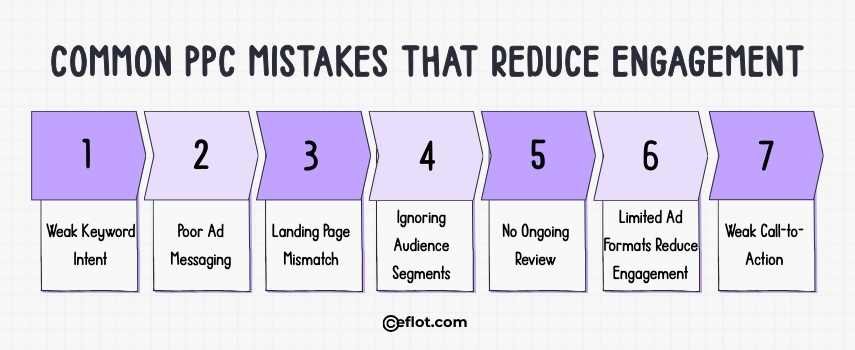
1. Weak Keyword Intent
Many PPC campaigns chase volume instead of relevance. High-traffic keywords look attractive, but they often pull users who are only browsing.
Results:
-
Clicks without form fills
-
High bounce rates
-
Low lead quality
Example: Assume a SaaS company targets the keyword “project management” alone. Consider that this may attract casual searchers rather than decision-makers looking for enterprise software.
Tip: Intent-focused keywords bring fewer clicks, but stronger action. Focus on long-tail keywords that align with user needs.
2. Poor Ad Messaging
Ad copy that sounds generic blends into the feed. Users see hundreds of ads daily. If a message does not clearly connect to their problem, they move on.
Results:
-
Low click-through rates
-
Short session times
-
No recall of the brand
Example: Assume an e-commerce brand uses “Buy our products now!” as an ad copy. Consider that users may ignore it because it doesn’t clearly highlight benefits or solve a specific problem.
Tip: Clear, focused messaging performs better than clever wording. Highlight solutions and benefits.
3. Landing Page Mismatch
Paid Ads may perform well, but landing pages break momentum. Users expect continuity between ad and page.
Signs of mismatch:
-
Long text blocks
-
Slow loading time
-
Unclear headlines
Example:
Assume a PPC ad promises “Free eBook on Marketing Trends.” Consider that if the landing page is just a generic homepage with no download form, user interest will drop immediately.
Tip: Ensure landing pages reflect the ad promise. Short copy, clear headlines, and fast load times improve conversions.
4. Ignoring Audience Segments
One message does not fit every user. New visitors, returning users, and warm leads behave differently.
Results:
-
Irrelevant ad experiences
-
Lower engagement
-
Missed conversion chances
Example: Assume a returning visitor has already downloaded a guide. Consider that showing the same “Sign up for our free guide” ad may not engage them effectively compared to offering a product demo.
Tip: Segment audiences and create messages tailored to each group. Personalization increases engagement.
5. No Ongoing Review
PPC campaigns are not “set and forget.” Without regular checks, ads lose relevance.
Signs:
-
Rising cost per click
-
Falling engagement
-
Old keywords still running
Example: Assume a campaign still runs last year’s seasonal promotions. Consider that while it may attract clicks, it won’t generate meaningful leads, wasting budget.
Tip: Schedule weekly or monthly reviews to pause underperforming ads, update keywords, and refresh messaging.
6. Limited Ad Formats Reduce Engagement
Using only one type of ad or default placements limits reach and engagement.
Results:
-
Ads may appear in irrelevant locations
-
Lower visibility in high-value feeds
-
Missed engagement opportunities
Example: Assume a brand runs only text ads on search networks. Consider that potential users on social platforms may never see the message, reducing overall engagement.
Tip: Test multiple formats like carousel, video, display and optimize placements for audience behavior.
7. Weak Call-to-Action (CTA)
Even relevant ads fail without a compelling CTA.
Results:
-
Users click but do not complete forms
-
Leads remain passive
-
Low ROI
Example: Assume an ad uses “Learn More” as its CTA on a pricing page. Consider that “Get Your Free Quote Today” could generate stronger user action.
Tip: Use action-oriented, benefit-focused CTAs that guide the user to the next step.
How These PPC Mistakes Impact Campaign Results?
Let’s speak honestly.
You launch ads.
Clicks start coming in.
Spend goes up.
But leads remain unchanged.
This usually means PPC Mistakes are quietly blocking progress.
Here’s how it plays out over time:
-
Campaign data becomes difficult to trust
-
Reports show activity, but not outcomes
-
Teams lose confidence in PPC Services
You may even pause campaigns, assuming paid ads “don’t work.”
In reality, the system is working just in the wrong direction.
Poor intent targeting brings the wrong users.
Weak messaging fails to hold attention.
Landing pages do not guide action.
When these issues repeat daily, budgets disappear without growth.
Fixing these mistakes does not require more spend. It requires better structure, clearer intent, and consistent review.
Top Ways PPC Services Fix Performance Gaps
PPC Services focus on fixing direction, not pushing budgets.
They start by tightening the foundation.
How PPC Services Improve Results:
|
Area |
What Changes |
|
Keyword Selection |
Focus shifts to intent-driven searches |
|
Ad Copy |
Messages align with user needs |
|
Targeting |
Audiences grouped by behavior |
|
Landing Pages |
Content matches ad promise |
|
Budget Control |
Spend moves to high-response ads |
This approach improves engagement without increasing risk.
Ongoing Campaign Support:
Beyond setup, PPC Services bring consistency.
This includes:
-
Regular performance checks
-
Search term reviews to remove waste
-
Ad testing to refine messaging
-
Clear reports for decision-making
Small corrections made early prevent large losses later.
Control Over Spend:
Instead of spending evenly across all ads, PPC Services shift focus.
Budgets move toward:
-
Ads with better engagement
-
Keywords showing intent
-
Audiences responding consistently
With the support of a digital marketing agency, campaigns stay optimized for maximum results. Digital marketing agency expertise ensures every PPC action drives meaningful engagement and conversions.
PPC results do not improve by spending more. They improve by fixing what blocks engagement. Avoid repeated PPC Mistakes, review campaigns often, and apply structured PPC Services. That’s how paid campaigns regain focus, control, and steady performance.
Digital Marketing services in Other Locations in India
Bangalore | Hyderabad | Chennai | Pune | Ahmedabad | Coimbatore | Mumbai | Kolkata | Patna | Amritsar | Indore | Kozhikode | Trivandrum | Jaipur | Nagpur | Gwalior | Dehradun | Noida | Vizag | Raipur | Agra | Gurgaon | Madurai | Udaipur | Thrissur |