



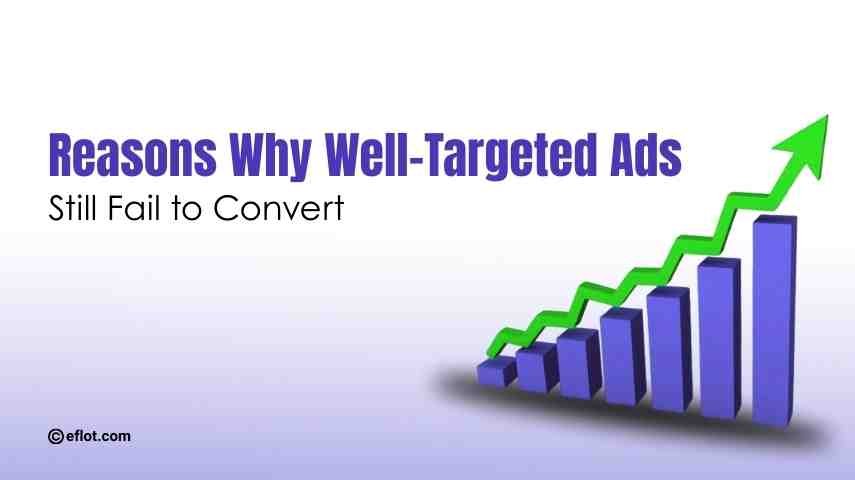
Reasons Why Well-Targeted Ads Still Fail to Convert
Fix low conversions in social media ads with professional support to review targeting, creatives, landing pages, timing, and performance tracking.
You did everything right in your campaign setup. Every checkbox ticked.
You picked the right audience. Choose the right platform and set aside a solid budget.
And still nothing moves.
No leads. No calls. No real ROI.
That’s the uncomfortable reality many businesses face today while running social media ads. On paper, campaigns look perfect. In practice, results quietly disappoint. Businesses don’t lose money because ads don’t work anymore. They lose money because something critical breaks after the targeting step.
Why Targeting Alone Is No Longer Enough
Here’s the truth most advertisers don’t want to hear.
Targeting is no longer your advantage. It’s the baseline.
Every business today has access to similar interests, behaviors, job titles, and locations. Platforms have democratized targeting. That means success no longer depends on who you target but on what happens next.
Billions are spent on social media services every year, yet a large percentage of businesses report poor returns from their social media ads. The issue rarely lies in the audience selection. It lies in the social media optimization, messaging, and funnel that follows the click.
When ads fail, the problem usually lies beneath the surface.
The Real Reasons Well-Targeted Ads Don’t Convert
Before fixing performance, you need to understand what’s silently killing conversions.
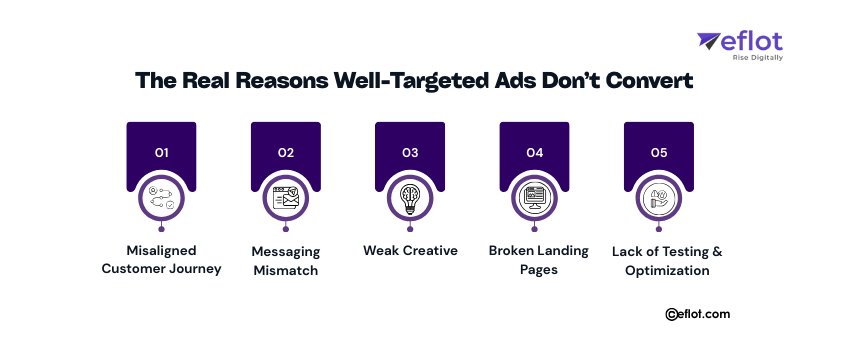
1. The Customer Journey Is Misaligned
One of the most common mistakes is treating every audience as “ready to buy.”
They’re not.
B2B buyers go through long research cycles. Local customers need reassurance and proximity-based trust. When ads jump straight to demos, pricing, or hard sells, resistance builds instantly.
Real-world data shows that campaigns aligned with funnel stages, awareness, consideration, and conversion perform dramatically better than single-touch ads. Retargeted audiences, for example, convert significantly more often than cold ones.
Targeting the right people at the wrong stage leads to wasted spend.
2. Messaging Fails to Match User Intent
People don’t open social platforms to buy.
They scroll to learn, escape, or stay curious.
When social media ads interrupt instead of aligning with that mindset, users disengage. This is why feature-heavy copy, generic promises, and polished marketing language often fail.
Common messaging problems include:
-
Talking about features instead of outcomes
-
Using vague value propositions
-
Ignoring emotional relevance
Even perfectly targeted campaigns fail when the message doesn’t reflect what the user is already thinking. Optimizing social media services messaging is critical.
3. Weak Creative Loses the Scroll Battle
Attention is rented for seconds at best.
Low-quality visuals, repetitive creatives, or stock-style designs disappear instantly in crowded feeds. Studies consistently show that ads with strong visuals, clear hooks, and emotional relevance outperform generic creatives.
Without a compelling visual and message, your social media ads, like Facebook Ads or paid advertising campaigns, never even earn a click, no matter how accurate the targeting is.
4. Clicks Lead to Broken Landing Pages
Ads don’t convert. Landing pages do.
And this is where many campaigns collapse.
Common issues include:
-
Slow loading speeds (especially on mobile)
-
Mismatch between ad promise and page content
-
Too many CTAs and distractions
-
Missing trust signals
Even a one-second delay in page load can significantly reduce conversions. When users feel confused or overwhelmed after clicking, they exit quietly.
5. No Testing, No Optimization, No Growth
Running the same ads repeatedly without testing is one of the fastest ways to kill performance.
Creative sets in quickly. Engagement drops. Costs rise.
Yet many businesses focus only on impressions or clicks, instead of metrics that matter:
-
Cost per qualified lead
-
Funnel drop-off points
-
Lead-to-sale conversion rates
Without continuous testing, even well-built social media ads will level.
How to Fix Well-Targeted Ads That Still Fail to Convert
If targeting isn’t the issue, then fixing conversions requires system-level thinking.
This is where results actually change.
Fix the Funnel Before Increasing the Budget
When performance dips, businesses panic.
Social media ads spend more. launch new ads. Blame the platform.
But the real fix is structure. Effective campaigns recognize that:
-
Cold audiences need education
-
Warm audiences need proof
-
Hot audiences need clarity
Using the Facebook Ads Guide to awareness stages consistently improves results without increasing spend.
Rewrite Ads for Humans, Not Algorithms
Algorithms deliver impressions.
Humans decide whether to trust you.
High-performing ads:
-
Call out a specific pain
-
Use simple, everyday language`Aa
-
Focus on outcomes, not capabilities
If your ad copy could belong to any competitor, it’s already losing.
Adapt Messaging for Each Platform
One message does not work everywhere.
People scroll LinkedIn differently from Instagram. Local audiences respond differently from B2B decision-makers.
Effective social media ads adapt the tone while keeping the core value intact:
-
Emotional and relatable on Instagram
-
Authority-driven and data-backed on LinkedIn
-
Urgent and proximity-focused for local campaigns
Ignoring platform behavior burns budgets fast.
Optimize the Post-Click Experience
This is where conversions are earned or lost.
A conversion-ready landing page needs:
-
One clear message
-
One primary action
-
Fast load speed
-
Testimonials or social proof
-
Minimal form fields
In many campaigns, optimizing the landing page yields better results than rewriting the ad itself.
Fight Creative tiredness proactively
Even great ads stop working.
Not because they’re bad but because audiences have seen them too often.
Smart advertisers:
-
Rotate creatives every 10–14 days
-
Test new hooks, not just new visuals
-
Change angles without changing offers
Static creatives silently drain social media ads budgets over time.
Align Ads With Real Business Metrics
Clicks don’t equal revenue.
Leads don’t equal sales.
High-performing teams measure:
-
Cost per qualified lead
-
Conversion rates by funnel stage
-
Lead-to-sale timelines
When paid advertising campaigns are aligned with real outcomes, optimization becomes intentional, not reactive.
Why Well-Targeted Ads Still Fail Without Strategy
Targeting gets attention. Strategy earns conversions.
Even technically perfect campaigns fail when ads are treated as isolated tactics instead of systems. Without messaging hierarchy, funnel logic, and Social Media optimization plans, performance stagnates.
Ads don’t fail because platforms are crowded. They fail because execution stops at targeting.
Conversion Is a System, Not a Setting
Well-targeted ads are no longer enough.
What converts today is:
-
Intent-driven messaging
-
Funnel-based journeys
-
Optimized experiences
-
Continuous testing
Businesses that fix these layers stop gambling with social media ads and start building predictable growth engines.
And that’s the real difference between running ads and running a system that compounds over time.
Partnering with a Digital Marketing Agency helps bring structure to what most campaigns miss: clear messaging, funnel alignment, and consistent optimization. A professional Digital Marketing Agency doesn’t just run ads; it builds systems that guide prospects from curiosity to confidence.
For B2B services and SaaS brands, lead generation improves when marketing explains the problem clearly, educates without pressure, and builds trust step by step. When buyers understand what you solve and why it matters, conversions stop feeling forced and start happening naturally.
That’s when ads stop spending. And start scaling.
Digital Marketing services in Other Locations in India
Bangalore | Hyderabad | Chennai | Pune | Ahmedabad | Coimbatore | Mumbai | Kolkata | Patna | Amritsar | Indore | Kozhikode | Trivandrum | Jaipur | Nagpur | Gwalior | Dehradun | Noida | Vizag | Raipur | Agra | Gurgaon | Madurai | Udaipur | Thrissur |