









Fix Low CTR With AI Advertising
AI advertising improves CTR by optimizing targeting, creative, and bidding in real time, helping businesses increase engagement and helps to reduce CPC.
Low click-through rate is one of the clearest warning signs in paid media. Impressions may look healthy inside your dashboard, yet traffic stays flat and cost per acquisition keeps rising. When ads fail to attract clicks, platforms interpret that as weak relevance. The result is lower Quality Score, higher CPC, and reduced visibility.
Businesses searching for solutions to low CTR usually want three things: clarity on why performance dropped, practical methods to recover engagement, and a scalable strategy that prevents the issue from repeating. A performance-focused AI digital marketing agency addresses all three by building campaigns around predictive intelligence rather than guesswork.
Let’s discuss how AI advertising improves CTR across search, social, and programmatic channels while protecting long-term profitability.
What Causes Low CTR in Paid Campaigns
CTR declines when relevance weakens. That relevance can break down at multiple levels - keyword targeting, audience segmentation, creative messaging, or landing page alignment.
On platforms like Google Ads, engagement signals heavily influence ad rank. If users frequently skip your ads, the system lowers placement priority and increases costs. On Meta Ads, declining interaction reduces delivery efficiency and raises CPM pressure.
Common root causes include:
-
Targeting audiences that are too broad or outdated
-
Using static creative without rotation
-
Messaging that fails to match user intent
-
Delayed optimization cycles
-
Poor alignment between ad copy and landing experience
Industry benchmarks vary by sector, but Google Search ads often average between 3% and 6% CTR, while display campaigns typically fall below 1%. If campaigns consistently perform below these ranges, structural adjustments are required.
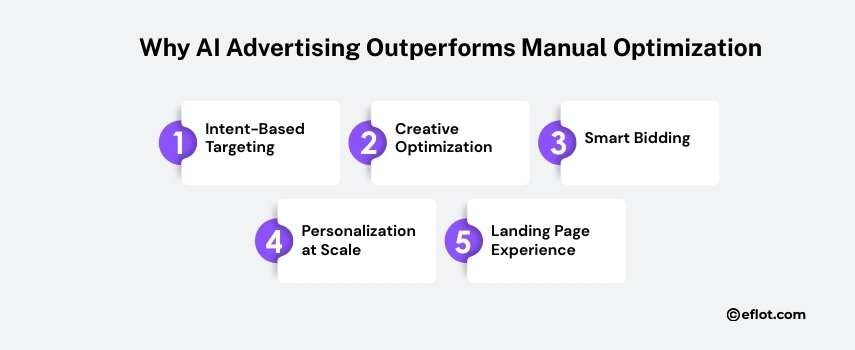
Why AI Advertising Outperforms Manual Optimization
Advertising auctions process thousands of contextual signals in milliseconds. Device type, location, browsing history, time of day, engagement behavior, and purchase probability all influence whether a user clicks.
Manual campaign management cannot evaluate these variables at scale. Even strong marketing teams face data limitations when managing multiple campaigns across platforms.
An advanced ai digital marketing agency uses machine learning models to analyze these signals continuously. Instead of reacting weekly or monthly, AI systems adjust targeting, bidding, and creative distribution in real time. That speed creates measurable engagement improvements.
Intent-Based Targeting: Reaching Users Ready to Engage
Traditional segmentation relies on demographics and basic interest categories. AI-driven targeting goes deeper by modeling behavioral intent.
Machine learning clusters audiences based on actions such as:
-
Recent high-intent search queries
-
Engagement with competitor content
-
Depth of website interaction
-
Repeat visits within short timeframes
When campaigns focus on users already demonstrating purchase intent, CTR naturally increases because the message aligns with current demand.
On platforms like Google Marketing Platform, advanced audience signals integrate first-party data with predictive modeling. This approach reduces wasted impressions and strengthens click probability.
Creative Optimization Through Predictive Testing
Creative fatigue is one of the most overlooked CTR killers. Even high-performing ads decline after repeated exposure.
AI-powered systems evaluate headline performance, call-to-action engagement, visual response patterns, and device-level interaction trends. Instead of running limited A/B tests, machine learning rotates multiple asset combinations simultaneously and prioritizes those generating higher engagement.
For example, responsive ad formats dynamically assemble headlines and descriptions based on predicted click likelihood. Over time, lower-performing combinations receive fewer impressions, while stronger variants gain distribution.
This continuous refinement maintains freshness and protects CTR stability.
Smart Bidding That Supports Engagement
Ad placement influences click behavior. Top positions typically generate stronger CTR, but aggressive bidding without intelligence can inflate costs.
Personalization at Scale Improves Click Behavior
Generic messaging produces average results. Personalized messaging aligned with the user stage in the funnel drives stronger interaction.
AI integrates CRM data, browsing patterns, and engagement signals to tailor copy dynamically. A first-time visitor may see educational messaging, while a returning visitor sees trust indicators or a conversion-focused offer.
Studies from McKinsey show that personalization strategies can increase marketing ROI by 10–20%. In paid media campaigns, this lift often appears first in CTR improvements before impacting conversion rate.
A structured ai advertising framework ensures personalization operates efficiently across thousands of impressions.
Aligning Ads With Landing Page Experience
CTR performance connects closely with post-click experience. If users bounce immediately, advertising platforms detect poor engagement and reduce ad rank over time.
AI-driven analytics examine user flow, scroll depth, and interaction behavior to ensure landing content matches ad messaging. When alignment improves, platforms reward campaigns with stronger visibility.
An experienced AI digital marketing agency integrates paid traffic optimization with landing page data, ensuring message continuity from impression to conversion.
Emerging Trends Strengthening CTR Strategy
Modern advertising requires alignment with platform innovation.
Performance Max campaigns within Google Ads use automation to distribute ads across Search, Display, YouTube, Gmail, and Discover. The system reallocates budget toward placements generating stronger engagement signals.
Short-form video, optimized using AI-driven engagement data, often improves click performance when hooks capture attention within the first few seconds.
First-party data modeling has become critical as privacy regulations reshape targeting strategies. AI leverages owned behavioral data to maintain targeting accuracy and sustain CTR performance.
Predictive lifetime value modeling also allows campaigns to prioritize high-value audience segments, improving engagement quality.
Measuring Real CTR Improvement
Effective ai advertising does more than increase clicks. It strengthens overall campaign health.
Signs of sustainable CTR improvement include:
-
Rising Quality Score
-
Stable or reduced CPC
-
Higher Impression Share
-
Improved conversion rate
-
Better return on ad spend
If CTR rises while acquisition cost remains controlled, campaign structure is functioning efficiently.
When to Partner With an AI Digital Marketing Agency
Organizations often seek expert support when campaign scaling reduces efficiency or internal teams lack advanced automation capabilities, especially when evaluating an AI Marketing Agency vs Traditional Marketing Agency to determine which approach can deliver better scalability and performance.
A specialized ai digital marketing agency provides:
-
Advanced predictive modeling
-
Continuous creative experimentation
-
Cross-platform data integration
-
Automated bidding precision
-
Structured performance reporting
These capabilities accelerate engagement recovery and create long-term campaign stability.
If low CTR is limiting your paid media results, partnering with a data-driven ai digital marketing agency can transform campaign efficiency and unlock scalable performance growth.
Connect with the right team to evaluate your campaign metrics and implement an intelligent optimization strategy designed to convert impressions and CTR into measurable business growth.
Frequently Asked Questions
1. What is CTR in digital advertising?
CTR (Click-Through Rate) is the percentage of people who click on your ad after seeing it. It is calculated as:
Clicks ÷ Impressions × 100
For example, if 50 people click an ad out of 2,000 views, the CTR is 2.5%.
On platforms like Google Ads and Meta Ads, CTR shows how relevant and engaging your ad is. A higher CTR usually means better targeting, stronger messaging, and improved ad performance.
2. How does an AI digital marketing agency improve CTR faster than in-house teams?
An experienced AI digital marketing agency uses machine learning systems that analyze thousands of contextual signals in real time. These include device behavior, audience engagement trends, conversion probability, and auction dynamics.
Unlike manual optimization, AI-driven systems continuously test creative combinations, adjust bids dynamically, and refine audience clusters automatically. This accelerates engagement improvements and reduces the lag between performance decline and correction.
3. Can AI advertising improve CTR without increasing ad spend?
Yes. Effective ai advertising focuses on improving relevance rather than simply increasing budget. By targeting high-intent audience segments, optimizing creative combinations, and deploying predictive bidding strategies, AI systems can increase click probability per impression.
When relevance improves, platforms reward campaigns with better ad positioning and potentially lower cost per click. The result is higher CTR with controlled or optimized spend.
4. How long does it take to see CTR improvement after implementing AI advertising?
Initial engagement improvements may appear within a few weeks once predictive bidding and creative optimization frameworks are active. However, sustainable performance stabilization usually requires 30–60 days of continuous data learning.
AI systems become more accurate as they collect behavioral signals. A reliable ai digital marketing agency structures campaigns with phased optimization cycles to ensure improvements are consistent rather than temporary spikes.
5. Is AI advertising suitable for small and mid-sized businesses?
Yes. AI-driven campaign management benefits businesses of all sizes, especially those seeking scalable performance without expanding internal resources. Even moderate ad budgets can gain efficiency when targeting precision, personalization, and bidding intelligence improve.
For small and mid-sized businesses, partnering with a specialized ai digital marketing agency allows access to predictive tools and automation frameworks that would otherwise require significant internal investment.
Digital Marketing services in Other Locations in India
Bangalore | Hyderabad | Chennai | Pune | Ahmedabad | Coimbatore | Mumbai | Kolkata | Patna | Amritsar | Indore | Kozhikode | Trivandrum | Jaipur | Nagpur | Gwalior | Dehradun | Noida | Vizag | Raipur | Agra | Gurgaon | Madurai | Udaipur | Thrissur |