
























What Is Google’s Algorithm and How It Affect Rankings?
Discover how Google's algorithm impacts your website rankings and why understanding it is essential for boosting organic traffic and staying competitive.

As a digital marketing specialist, I’ve worked with numerous businesses to help them achieve better visibility and ranking on search engines. One of the most important aspects of improving online visibility is understanding Google’s algorithm and how it affects your website’s rankings. Google’s algorithm is the backbone of search engine optimization (SEO), determining how websites rank in search results. But what exactly is Google’s algorithm, and how does it influence search rankings?
For anyone involved in digital marketing, understanding how Google’s algorithm works is essential to ensuring your site doesn’t fall behind in search results. Google constantly updates its algorithm, making it even more important for businesses and website owners to stay on top of the changes. As someone who has worked closely with businesses across different industries, I can say that those who understand the Google algorithm and how it works are better equipped to drive organic traffic and improve their website rankings. Here, I share the details of Google's algorithm, its role in ranking websites, and how you can optimize your site to meet these algorithmic changes.
What Is the Google Algorithm?
At its core, Google's algorithm is a complex set of rules and criteria that search engines use to evaluate and rank websites. Every time you search for something on Google, the algorithm is responsible for determining which web pages appear first in the search results. The goal of the algorithm is to deliver the most relevant and useful results for each query, based on a variety of factors such as content relevance, page speed, backlinks, and user experience.
Google’s algorithm isn’t just one entity, it’s a series of updates and adjustments designed to improve the quality of search results. Google has developed multiple algorithms over time, including Panda, Penguin, Hummingbird, and RankBrain. These updates continuously refine the search process and take into account different aspects of a website's performance and relevance. For example, while Panda focused on content quality, Penguin dealt with the manipulation of backlinks, and RankBrain focused on understanding natural language queries.
How Does the Google Algorithm Affect Rankings?
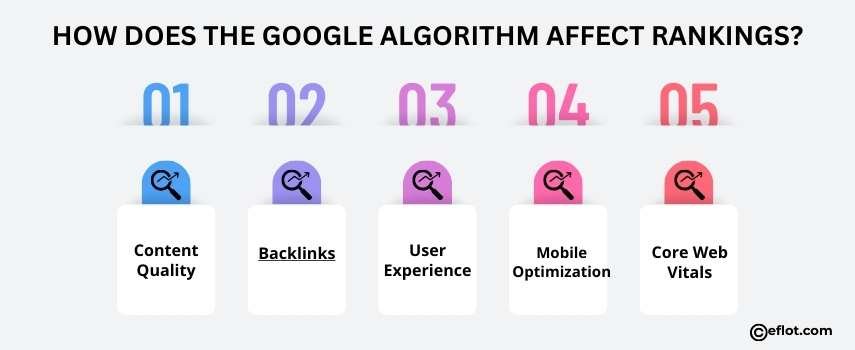
The impact of Google's algorithm on rankings cannot be overstated. If your website fails to align with the ranking criteria set out by the algorithm, you risk falling behind competitors, which means lower visibility in search results. On the other hand, when your website meets or exceeds the standards set by the algorithm, it can boost your rankings and bring in a higher volume of organic traffic.
The algorithm assesses numerous factors, including:
-
Content Quality: Google prioritizes high-quality, relevant content that answers users' queries comprehensively. Websites with well-written, informative content tend to rank higher than those with thin, irrelevant, or spammy content.
-
Backlinks: A website’s backlink profile is another important ranking factor. Quality backlinks from authoritative websites signal to Google that your content is trustworthy and valuable, thereby improving your ranking.
-
User Experience (UX): Google emphasizes websites that provide a positive user experience. This includes factors such as page load speed, mobile-friendliness, and easy navigation. Websites that offer a seamless experience tend to rank better.
-
Mobile Optimization: Since more and more users are browsing the internet via mobile devices, Google’s algorithm favors websites that are optimized for mobile use. A mobile-friendly website is crucial for maintaining or improving rankings.
-
Core Web Vitals: These are user-centric metrics related to speed, responsiveness, and visual stability. Core Web Vitals is now a ranking factor for Google, meaning websites that load quickly, respond promptly to user actions, and have stable visuals will perform better in search results.
Google Algorithm Updates and Their Impact
One of the most notable aspects of Google’s algorithm is that it evolves frequently. Each update can affect how websites are ranked, and businesses must stay updated with these changes to maintain their rankings. Let's take a look at two recent updates that have impacted rankings and websites' visibility.
Here are three key points about Google Algorithm Updates and Their Impact:
-
Frequent Algorithm Changes: Google’s algorithm is constantly evolving with updates happening regularly throughout the year. These changes are designed to improve the quality of search results and provide a better user experience. Businesses must stay informed about these updates and adapt their strategies to maintain or improve their rankings.
-
Impact on Search Rankings: Each update can significantly affect the ranking of websites, either boosting or lowering them in search results. For example, an update that favors mobile-friendly sites may improve the rankings of businesses with responsive websites, while penalizing sites that aren’t optimized for mobile devices.
-
Need for Continuous Optimization: Given the frequency and complexity of Google’s updates, businesses must continuously optimize their websites. This involves ensuring that their content remains relevant, their SEO strategies are up to date, and their user experience is aligned with the latest algorithm changes to stay competitive in search results.
How to Optimize Your Website for Google’s Algorithm
Now that we understand how Google’s algorithm works and how it affects rankings, it’s crucial to know how to optimize your website for success. Here are some tips to ensure your site aligns with the algorithm's ranking criteria:
-
Focus on High-Quality Content: Always prioritize quality over quantity. Google values informative, original, and well-structured content that provides value to users. Keep content fresh and up-to-date to stay competitive.
-
Implement Proper SEO Practices: Ensure that your website’s technical SEO is in top shape. This includes optimizing meta tags, using the right keywords, improving your site’s loading speed, and making it mobile-friendly.
-
Improve User Experience: Invest in your website's user experience by ensuring it’s easy to navigate, fast to load, and mobile-optimized. Google prioritizes websites that provide a seamless experience.
-
Optimize for Featured Snippets: Featured snippets are a great way to rank at the top of the search results. Structure your content with clear answers to common queries, and use bullet points or tables for better visibility.
-
Build Quality Backlinks: Focus on building backlinks from reputable sources. Google views backlinks as a vote of confidence, and acquiring high-quality links will improve your website's authority.
Case Studies
Case Study1:
HubSpot, one of the most recognized brands in inbound marketing, found itself adjusting to Google's Core Web Vitals update, which became a ranking factor in 2021. The update emphasized the importance of user experience, specifically page loading times, interactivity, and visual stability.
-
Implementation: HubSpot's team focused on improving their site’s loading speed, particularly for mobile users. They optimized images, streamlined their code, and employed lazy loading techniques to make their pages load faster.
-
Outcome: As a result of these changes, HubSpot saw improvements in its rankings for various high-traffic keywords. The company was able to maintain its competitive position in the search results, and its organic traffic continued to grow, demonstrating the importance of aligning with Google’s Core Web Vitals.
Case Study 2:
Etsy, the popular e-commerce platform for handmade and vintage goods, faced challenges when Google rolled out the BERT (Bidirectional Encoder Representations from Transformers) update in late 2019. The BERT update focused on understanding the context of words in a sentence, allowing Google to better understand natural language queries and improve search results.
-
Implementation: Etsy’s team quickly realized the importance of optimizing their content to align with natural language processing. They focused on creating more conversational, user-friendly content, particularly for product descriptions.
-
Outcome: After implementing these changes, Etsy saw significant improvements in its organic traffic, particularly from long-tail keyword searches. Etsy’s visibility for specific product queries improved, leading to higher conversions and sales.
Google’s algorithm is a powerful force that dictates how websites are ranked and displayed in search results. Whether you’re an e-commerce site, a blog, or a service provider, understanding what is the Google algorithm and how it works is essential for driving traffic and maintaining your online presence. By aligning your website with Google's ranking criteria, you can ensure that your business continues to grow and attract organic traffic. So, take action to optimize your website for Google’s algorithm. With the right strategies in place, you can improve your website's ranking, attract more visitors, and ultimately drive more conversions.
Digital Marketing services in Other Locations in India
Bangalore | Hyderabad | Chennai | Pune | Ahmedabad | Coimbatore | Mumbai | Kolkata | Patna | Amritsar | Indore | Kozhikode | Trivandrum | Jaipur | Nagpur | Gwalior | Dehradun | Noida | Vizag | Raipur | Agra | Gurgaon | Madurai | Udaipur | Thrissur |