






















What Are SEO Tools? Key Tips for Choosing the Right Ones
Learn about SEO tools and choose the right ones for your website's optimization. Key tips to improve rankings and performance.

Mastering search engine optimization (SEO) is essential for organizations looking to improve their online visibility. However, attaining higher ranks and increasing organic traffic is not an easy task. Here's where SEO tools come in. They simplify difficult operations such as keyword research, competitor analysis, and performance tracking, allowing companies to remain competitive and visible online. What are SEO tools? They are valuable resources enabling businesses to optimize their websites and increase search engine results.
As a digital marketing consultant with years of experience, I've witnessed personally how the correct SEO tools can improve a company's online performance. From tiny businesses to large companies, choosing the correct tools is crucial for creating strategy and delivering demonstrable results.
Understanding What SEO Tools Are
SEO tools are software solutions designed to help businesses optimize their websites for search engines like Google, Bing, and Yahoo. They provide insights into website performance, audience behavior, and the effectiveness of SEO strategies. From identifying the best keywords to tracking search rankings, these tools serve as a compass, guiding businesses toward achieving their digital marketing objectives.
Why Are SEO Tools Essential?
-
They automate time-consuming tasks, such as data collection and analysis.
-
Provide actionable insights to improve website visibility.
-
Help monitor and enhance on-page and off-page SEO elements.
-
Enable tracking of competitors’ strategies to identify opportunities.
Types of SEO Tools and Their Functions
SEO tools come in various categories, each serving a unique purpose. Here’s a breakdown:
-
Keyword Research Tools: Help identify high-volume and low-competition keywords relevant to your business. These tools also suggest related search terms and help analyze search intent.
-
Competitor Analysis Tools: Provide insights into competitors' keyword strategies, traffic sources, and backlink profiles. Understanding competitor tactics can reveal untapped opportunities.
-
On-Page SEO Tools: Function: Analyze and optimize content elements like meta titles, descriptions, and header tags. They also check for broken links and improve internal linking strategies.
-
Backlink Analysis Tools: Monitor the quality and quantity of backlinks pointing to your website. Backlinks are critical for improving domain authority and search rankings.
-
Rank Tracking Tools: Help monitor your website’s position for target keywords on search engine results pages (SERPs). Tracking rank changes is essential for evaluating the effectiveness of your SEO strategies.
-
Technical SEO Tools: Identify and fix technical issues such as crawl errors, duplicate content, and site speed, which impact SEO performance.
Benefits of Using SEO Tools
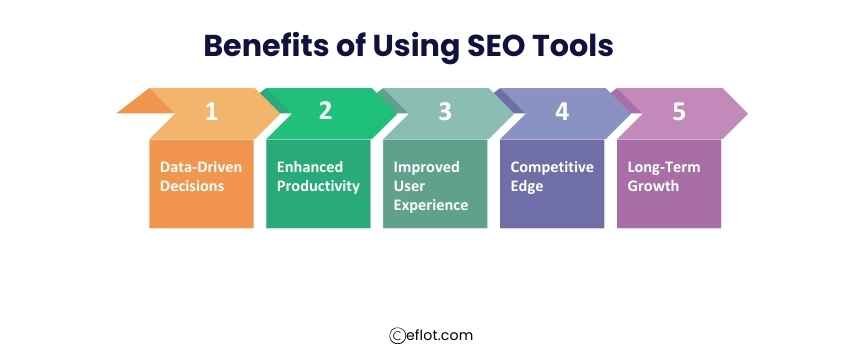
The advantages of incorporating SEO tools into your digital marketing strategy are immense:
-
Data-Driven Decisions: SEO tools provide accurate insights that guide your strategies, ensuring you focus on areas with the highest ROI potential.
-
Enhanced Productivity: By automating repetitive tasks like keyword tracking and website audits, SEO tools save time and allow marketers to focus on creative strategies.
-
Improved User Experience: Tools help optimize website speed, mobile compatibility, and content quality, enhancing the overall user experience.
-
Competitive Edge: By analyzing competitors, businesses can stay ahead in the race by adopting proven tactics and identifying gaps in their strategies.
-
Long-Term Growth: Consistent use of SEO tools ensures steady growth in organic traffic and search rankings, translating into sustainable success.
Tips for Choosing the Right SEO Tools for Your Business
Selecting the right SEO tools can feel overwhelming, given the plethora of options. Here’s how to simplify the process:
-
Define Your Goals: Are you looking to improve keyword rankings, build backlinks, or monitor competitor performance? Understanding your specific goals will help you narrow down tools that cater to your needs.
-
Set a Budget: Decide how much you’re willing to invest in AI SEO tools. Free options like Google Search Console and Ubersuggest offer excellent basic features, while premium tools like Ahrefs and SEMrush provide advanced capabilities.
-
Evaluate Features: Look for tools that offer features aligned with your objectives. For example, if content optimization is a priority, tools like Yoast SEO or Surfer SEO are great options.
-
Ease of Use: Opt for user-friendly tools with intuitive dashboards and easy-to-understand analytics, especially if your team is new to SEO.
-
Scalability: Choose tools that can grow with your business. As your website and SEO need to expand, you’ll require tools that can handle increased data and provide advanced insights.
Case Studies:
Case study 1
AbeBooks, a global online marketplace for books, wanted to improve its organic search traffic and sales, especially as its SEO performance had been stagnant due to highly competitive search terms in the book industry. While AbeBooks had a well-established website with a large inventory of books, its organic traffic was not reaching its potential, and they were struggling to keep up with larger competitors.
Challenge:
The primary challenge was the website’s low visibility on search engines for relevant and profitable keywords. AbeBooks' SEO strategy had become outdated, and the content lacked optimization for search engines, resulting in missed opportunities for ranking higher in search results.
Solution:
AbeBooks partnered with a digital marketing agency to overhaul its SEO strategy. They started by conducting keyword research using tools like Google Keyword Planner and SEMrush to discover high-traffic keywords with lower competition. The agency used these insights to optimize existing product pages, blog content, and metadata. They also focused on improving internal linking, ensuring that search engines could easily crawl the site and better understand its structure. Additionally, they implemented a backlink strategy using Ahrefs to increase the site’s domain authority. The result was a 30% increase in organic traffic and a noticeable rise in sales conversions over the next six months, proving that the strategic use of SEO tools helped them regain visibility in a competitive industry.
Case study 2
Tata Motors, one of India’s largest automobile manufacturers, wanted to enhance its online presence in local search results. The company was struggling to attract foot traffic to its dealerships and increase customer engagement through its website. Despite having a strong national presence, local search visibility was a major gap in their SEO efforts.
Challenge:
The primary issue was that Tata Motors' dealership locations were not optimized for local searches. resulting in missed opportunities to attract potential customers through localized queries such as "buy a car in [city name]." Additionally, their Google My Business profiles were incomplete, and the website lacked location-specific content, which led to lower engagement rates and fewer in-store visits.
Solution:
To address the local SEO issue, Tata Motors worked with an SEO agency to refine its local optimization strategy using tools like Google My Business and Moz Local. The agency ensured that all dealership locations were listed and optimized for local search queries. They used SEMrush to conduct a competitive analysis and identify the best keywords for local markets, creating landing pages that targeted specific cities and regions with tailored content. The team also ensured that each dealership’s Google My Business profile was complete with accurate details, photos, and customer reviews. After implementing these changes, Tata Motors saw a 50% increase in local search visibility and a significant boost in foot traffic to their dealerships. By using local SEO tools, the company successfully enhanced its presence in key markets and attracted more local customers.
SEO tools are valuable assets in the current digital marketplace. They simplify difficult processes while also providing insights that lead to more informed, data-driven decisions. By understanding what are SEO tools and selecting ones tailored to your business needs, you can enhance your website’s visibility, improve user experience, and achieve long-term growth. With a strategic approach to using SEO tools, businesses can outpace competitors and maximize their digital marketing ROI. So, start exploring the tools available and invest in those that align with your goals because the right tools, combined with the right strategy, can transform your online presence into a powerhouse of growth.
Digital Marketing services in Other Locations in India
Bangalore | Hyderabad | Chennai | Pune | Ahmedabad | Coimbatore | Mumbai | Kolkata | Patna | Amritsar | Indore | Kozhikode | Trivandrum | Jaipur | Nagpur | Gwalior | Dehradun | Noida | Vizag | Raipur | Agra | Gurgaon | Madurai | Udaipur | Thrissur |