

























Ultimate Technical SEO Checklist for Higher Rankings
Get a comprehensive technical SEO checklist to improve rankings. Optimize site speed, mobile usability, crawlability, and indexation effectively.

When it comes to getting higher search rankings, having a solid Technical SEO Checklist is essential. Think of technical SEO as the foundation of your site, without it, all other SEO efforts can fall flat. A well-optimized site structure makes it easy for search engines to crawl, understand, and index your content, which is key for improving your visibility. With the right technical tweaks, you can make your website faster, more secure, and user-friendly all factors that search engines love.
I’m excited to share my ultimate Technical SEO Checklist with you. I’ll share with you practical steps to optimize your website’s back end, covering everything from improving page speed to setting up XML sitemaps and fixing common crawl errors. These are simple but powerful changes you can make to see real improvements in rankings and traffic.
Understanding Technical SEO
Technical SEO involves making backend improvements to a website so search engines can crawl, index, and interpret the site efficiently. While content and keywords are crucial for visibility, technical SEO is the foundation for a successful SEO strategy. Without a solid technical structure, search engines may struggle to understand your content, reducing your chances of achieving high rankings.
The Importance of Technical SEO for Higher Rankings
Technical SEO directly affects a website's crawlability, indexability, speed, security, and overall usability. Effective technical SEO:
-
Enhances user experience.
-
Facilitates faster page loading times.
-
Improves mobile usability.
-
Boosts website security.
Each of these factors contributes to better search engine rankings, helping your site attract more visitors and convert more leads.
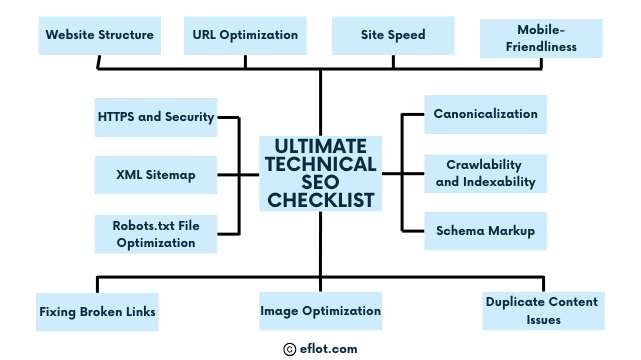
Ultimate Technical SEO Checklist
1. Website Structure
A clear website structure is crucial for both users and search engines. Organize content into logical, easily navigable categories to enhance user experience and crawl efficiency.
Steps to Optimize Website Structure:
-
Use a hierarchical site structure that’s easy to navigate.
-
Implement breadcrumb navigation to guide users and search engines.
-
Create a silo structure by grouping similar content for deeper, organized pages.
2. URL Optimization
SEO-friendly URLs improve user experience and aid search engines in identifying relevant pages.
Tips for URL Optimization:
-
Keep URLs short and descriptive.
-
Use hyphens to separate words.
-
Avoid special characters and capital letters.
3. Site Speed
Page load time affects both user experience and rankings, as search engines prioritize faster sites.
Site Speed Optimization Strategies:
-
Use browser caching for faster loading on repeat visits.
-
Minify CSS, JavaScript, and HTML files.
-
Enable lazy loading for images and videos.
-
Use a Content Delivery Network (CDN) to distribute content globally.
4. Mobile-Friendliness
A mobile-responsive site is essential as search engines now prioritize mobile indexing.
Mobile Optimization Tips:
-
Ensure responsive design for a seamless experience on any device.
-
Avoid pop-ups that hinder mobile usability.
-
Use Google's Mobile-Friendly Test to verify mobile compatibility.
5. HTTPS and Security
Security is essential for user trust and ranking, as Google favors secure sites.
HTTPS Implementation Steps:
-
Acquire an SSL certificate.
-
Redirect HTTP URLs to HTTPS.
-
Update canonical tags and internal links to HTTPS.
6. XML Sitemap
An XML sitemap helps search engines discover your site structure, ensuring that important pages are indexed.
XML Sitemap Checklist:
-
Create an XML sitemap using tools like Yoast SEO or Screaming Frog.
-
Include only indexable pages.
-
Submit the sitemap to Google Search Console and Bing Webmaster Tools.
7. Robots.txt File Optimization
The robots.txt file informs search engines which parts of your site to crawl and which to ignore.
Steps to Optimize Robots.txt:
-
Use robots.txt to block non-essential pages (e.g., admin, login pages).
-
Test the robots.txt file in Google Search Console to avoid accidental blocking of important pages.
8. Canonicalization
Canonical tags prevent duplicate content issues by telling search engines the primary version of a page.
Canonicalization Best Practices:
-
Use canonical tags for pages with similar content.
-
Consolidate duplicate pages to a single canonical URL.
-
Verify that each page has a unique, relevant canonical tag.
9. Crawlability and Indexability
Ensure that search engines can efficiently crawl and index your website to improve your visibility.
Crawlability and Indexability Checklist:
-
Remove no-index tags from essential pages.
-
Verify site crawl status in Google Search Console.
-
Use internal linking to help search engines find and prioritize important pages.
10. Schema Markup
Structured data, or schema markup, helps search engines understand your content and display rich snippets in search results.
Schema Markup Tips:
-
Implement schema for articles, products, reviews, and other relevant content.
-
Use tools like Google's Structured Data Markup Helper.
-
Validate schema with the Rich Results Test.
11. Fixing Broken Links
Broken links affect user experience and hurt your website's credibility with search engines.
Broken Link Resolution Steps:
-
Use tools like Ahrefs or Broken Link Checker to identify dead links.
-
Replace broken links with working URLs or redirect them appropriately.
-
Regularly audit your site for new broken links.
12. Image Optimization
Images impact page speed, making optimization essential for both user experience and SEO.
Image Optimization Techniques:
-
Compress images using tools like TinyPNG or ImageOptim.
-
Use descriptive file names and alt tags for all images.
-
Implement WebP format for a lighter, faster alternative to JPEGs and PNGs.
13. Duplicate Content Issues
Duplicate content confuses search engines and can lower rankings.
Steps to Prevent Duplicate Content:
-
Avoid publishing the same content on multiple pages.
-
Use canonical tags for pages with similar content.
-
Regularly check for duplicates using tools like Siteliner.
Additional Technical SEO Tips
-
Use Structured Headings: Proper heading structure (H1-H6) improves readability and SEO.
-
Optimize 404 Pages: Custom 404 pages keep visitors engaged and provide redirection options.
-
Internal Linking Strategy: Use internal links to pass link equity and improve user navigation.
-
Regularly Update Content: Fresh content signals relevance to search engines.
-
Monitor Core Web Vitals: Use Google’s Core Web Vitals report to check site performance in terms of speed, interactivity, and stability.
FAQs
What is technical SEO?
Technical SEO is the process of optimizing a website's backend structure and elements so search engines can easily crawl, index, and rank the site.
How often should I audit my technical SEO?
Performing an audit every three to six months helps identify and address any new issues, ensuring your site remains optimized for search engines.
Why is mobile-friendliness important in SEO?
Search engines prioritize mobile-optimized websites due to the growing number of mobile users. Mobile-friendly sites improve user experience, leading to higher engagement and ranking potential.
What are Core Web Vitals?
Core Web Vitals are metrics that measure website speed, interactivity, and stability. These are important for both user experience and search engine rankings.
A well-executed technical SEO strategy is foundational to higher rankings and increased organic traffic. By following this checklist and regularly auditing your site, you improve not only search engine visibility but also user experience and engagement. Technical SEO demands consistent attention, but the results of higher rankings, more traffic, and better user interactions are well worth the effort. Start implementing these tips today, and watch your website’s performance rise.
Digital Marketing services in Other Locations in India
Bangalore | Hyderabad | Chennai | Pune | Ahmedabad | Coimbatore | Mumbai | Kolkata | Patna | Amritsar | Indore | Kozhikode | Trivandrum | Jaipur | Nagpur | Gwalior | Dehradun | Noida | Vizag | Raipur | Agra | Gurgaon | Madurai | Udaipur | Thrissur |