






AI-Driven Digital Marketing: What Actually Works in 2026
Learn how AI-driven digital marketing works in 2026 with simple strategies that improve ads, content, and SEO to grow your business faster and smarter using AI tool.
Almost every business I talk to says the same thing: “Yes, we’ve tried AI tools." We tested ChatGPT for captions, used an AI image generator once, automated a few emails, and then hit a wall. Results are inconsistent, the content feels flat, and nobody knows what to do next.
Most teams don’t have an AI problem. They have a clarity problem. AI-driven digital marketing is not about using more tools. It’s about making better decisions before execution starts, where data, content, targeting, and measurement work together, with AI handling the heavy lifting at each stage.
What Is AI-Driven Digital Marketing?
AI-driven digital marketing is the use of machine learning and automation to make better marketing decisions, not just faster content.
It’s the difference between the following:
-
Using AI to write a blog post
-
Using AI to decide which blog to write, for whom, and when
The financial impact is real. According to McKinsey, companies investing in AI in marketing and sales are seeing 3–15% revenue uplift and 10–20% improvement in sales ROI.
The 5 Pillars of AI-Driven Digital Marketing
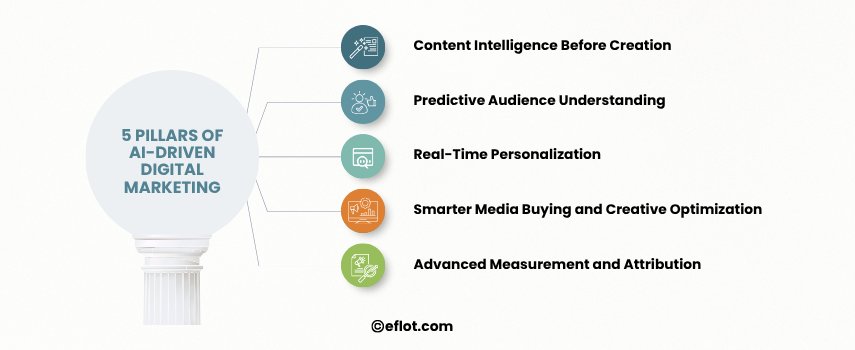
1. Content Intelligence Before Creation
Effective content no longer starts with writing; it starts with understanding what to create and why.
AI helps decode what users are actually searching for, how their intent is shifting, and where competitors are missing opportunities. Instead of producing content at scale, teams can focus on topics that are more likely to drive qualified traffic and conversions.
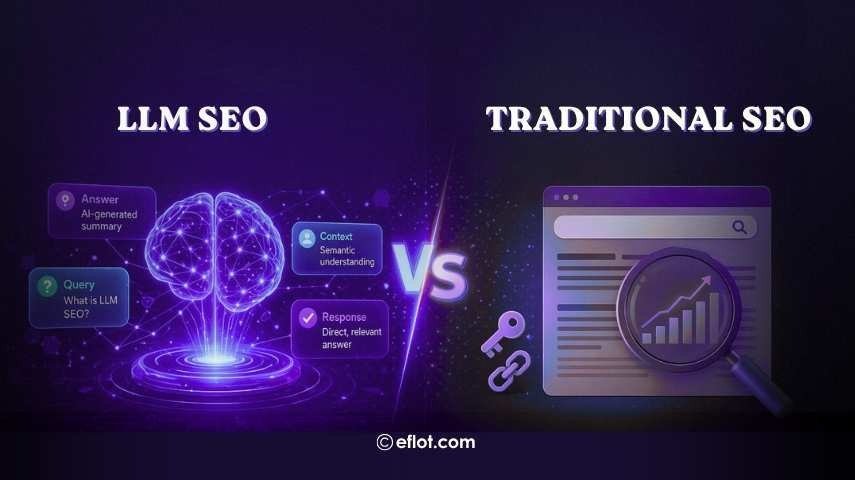
This is where advanced AI SEO services create real impact. They don’t just optimize content after publishing; they guide content direction from the start. From uncovering long-tail opportunities to aligning with conversational queries, the focus shifts from volume to precision.
Key focus areas:
-
Search intent mapping
-
Topic clustering based on conversion potential
-
Identifying emerging trends before they peak
Once the content direction is clear, the next step is to ensure it reaches the right audience at the right time.
2. Predictive Audience Understanding
Knowing your audience is no longer enough; anticipating their next move is where the advantage lies.
AI analyzes behavioral signals such as browsing patterns, time spent on pages, and interaction depth. This allows marketers to understand where a user stands in their decision journey without relying on assumptions.
Instead of broad targeting, campaigns become more precise. Messaging aligns with intent, not just demographics.
What improves here:
-
Lead qualification accuracy
-
Timing of outreach
-
Relevance of messaging across channels
This becomes especially important in environments like AI voice search, where queries are more conversational and intent-driven rather than keyword-based.
Once the right audience is identified, the next challenge is delivering experiences that feel relevant to each individual.
3. Real-Time Personalization
Users no longer respond to generic messaging. They expect experiences that reflect their behavior and intent.
AI enables this without requiring large teams or complex manual workflows.
Content, emails, and landing pages can dynamically adapt based on how users interact with your brand. A visitor arriving from a search query behaves differently from someone coming through a paid campaign, and the experience should reflect that.
This is also where AI branding becomes more consistent. Instead of fragmented messaging across platforms, it helps maintain a unified tone and positioning while still adapting to different audience segments.
Execution examples:
-
Adaptive website content based on traffic source
-
Behavior-triggered email sequences
-
Personalized recommendations across platforms
With personalization in place, the next layer is scaling visibility and performance through paid channels.
4. Smarter Media Buying and Creative Optimization
Paid media has moved from manual control to algorithm-driven execution. Success now depends less on micromanaging campaigns and more on the quality of inputs provided.
AI evaluates performance signals in real time, adjusting bids, placements, and audience targeting continuously. However, the system is only as effective as the data and creative assets it receives.
Many campaigns underperform not because of poor targeting, but because they rely on limited creative variations.
High-performing teams approach this differently. They test multiple angles, formats, and messaging variations from the start, allowing the system to learn faster and optimize better.
What matters most:
-
Diversity in creative assets
-
Clean and structured first-party data
-
Clearly defined campaign objectives
Once campaigns are running, the final step is understanding what is actually driving results.
5. Advanced Measurement and Attribution
Without accurate measurement, even well-executed strategies can lead to poor decisions.
Traditional attribution models often give credit to the final interaction, ignoring the influence of earlier touchpoints. This creates a distorted view of performance.
AI improves this by analyzing the full customer journey and assigning value based on actual contribution. It identifies which channels initiate interest, which ones nurture it, and which ones convert it.
Core improvements:
-
Multi-touch attribution insights
-
Better visibility into channel performance
-
Data-backed budget allocation decisions
When combined with campaign data, this creates a continuous feedback loop where each decision becomes more informed over time.
Manual vs AI-Driven Paid Media
|
Category |
Manual Campaigns |
AI-Driven Campaigns |
|
Bidding |
Fixed |
Real-time optimization |
|
Creative Testing |
2-3 Variants |
10-20 Variants |
|
Targeting |
Demographics |
Behavioral + predictive |
|
Optimization |
Periodic |
Continuous |
|
Time Investment |
High |
Lower |
|
Best For |
Control |
Scaling |
Analytics, Attribution, and AI-Driven Reporting
This is the most ignored and most important pillar.
-
The attribution problem: A prospect sees a LinkedIn post → clicks a Google ad a week later → reads a blog → converts via direct. Old last-click attribution gives 100% credit to direct. That's wrong.
-
What AI attribution does: Distributes credit based on actual influence and how each touchpoint moved the prospect forward.
What changes when you fix attribution:
-
Budget allocation shifts significantly
-
One Eflot client shifted 30% of ad spend once the real picture emerged
-
LinkedIn content that looked low-performing on last-click was the first meaningful touchpoint for 40% of closed deals
-
Bottom line: If you're using last-click attribution in 2026, you're making budget decisions on incomplete information.
The Real Barriers to AI Adoption
1. Data Privacy Concerns
40% of marketers say data privacy is a major challenge
-
Build first-party data
-
Focus on owned channels (email, CRM)
2. Lack of Expertise
About 35% of teams struggle due to a lack of AI knowledge.
-
You don’t need data scientists.
-
You need strategic marketers.
Invest in thinking, not just tools.
3. Unclear ROI
Around 25% of teams doubt the ROI from AI investments.
-
Start with one use case.
-
Measure impact
-
Scale based on results
What Good AI-Driven Digital Marketing Looks Like in 2026
Teams doing this right:
-
They use AI to find content opportunities before creating content
-
They run predictive lead scoring, so sales contacts the right people at the right time
-
Their paid campaigns receive clear first-party data and different creative output.
-
Their attribution model is multi-touch, not last-click
-
Their team understands why the AI made a recommendation, not just that they do what it recommended
That last point matters most. If your team treats AI as a black box, you'll repeat the same mistakes faster. AI-driven digital marketing should raise the quality of your decisions, not replace the thinking behind them.
One Thing You Can Do Today
-
Open Google Analytics, Google Ads, or your analytics platform.
-
Switch from last-click to a data-driven attribution view.
-
Look at which channels gain credit and which ones lose it.
That single view will tell you more about where your marketing is actually working than any AI tool you can buy.
AI is not here to replace your marketing; it's here to make every decision you take sharper, faster, and more informed. The brands winning in 2026 are not the ones with the most tools; they're the ones with the clearest strategy behind those tools. Start small, measure honestly, and build a system that compounds over time. That's the only way AI-driven digital marketing actually works.
If you want help building a full AI-driven digital marketing strategy covering content, targeting, paid media, and attribution, talk to the team at Eflot. We've done this work across industries and can show you exactly where AI creates the most leverage for your situation.
Digital Marketing services in Other Locations in India
Bangalore | Hyderabad | Chennai | Pune | Ahmedabad | Coimbatore | Mumbai | Kolkata | Patna | Amritsar | Indore | Kozhikode | Trivandrum | Jaipur | Nagpur | Gwalior | Dehradun | Noida | Vizag | Raipur | Agra | Gurgaon | Madurai | Udaipur | Thrissur |