























Improve Website Traffic with AI Voice Search Optimization
Learn how AI-driven voice search optimization can improve website traffic, enhance user experience, and boost your online visibility.

Imagine asking your smartphone, "Where's the nearest coffee shop?" and instantly receiving a list of options with directions. This seamless experience is powered by voice search, a technology that's quickly transforming how we access information online. In fact, as of 2025, over 20.5% of global internet users utilize voice search, with over 1 billion voice searches conducted monthly. This shift towards voice-driven queries presents a significant opportunity for businesses to enhance their online visibility and attract more traffic.
However, to capitalize on this trend, it's essential to optimize your website for voice search. Traditional SEO methods often fall short in addressing the nuances of voice queries, which tend to be more conversational and context-specific. Enter AI-powered voice search optimization, a strategy that uses artificial intelligence to understand and respond to natural language queries effectively. By adopting this approach, businesses can ensure their content aligns with how users speak, improving their chances of appearing in voice search results and ultimately driving more organic traffic.
What is Voice Search Optimization?
Voice search optimization means preparing your website to appear in search results when users search through voice commands instead of typing. Unlike typed queries, which are usually short and direct, voice queries are longer, conversational, and often framed as questions.
For example:
-
Typed search: “best coffee shop Bangalore”
-
Voice search: “Which is the best coffee shop near me in Bangalore?”
What Makes AI Voice Search Optimization Different?
While regular SEO focuses on keywords and links, AI voice search optimization focuses on understanding how people talk. AI uses technologies like:
-
Natural Language Processing (NLP): To understand human speech patterns.
-
Machine Learning: To analyze and predict search behavior.
-
Predictive Analytics: To deliver results before users even complete their questions.
This makes it possible for websites to provide accurate answers to voice queries and gain more traffic.
Importance of Voice Search Optimization
Optimizing your website for voice search is important for businesses today because:
-
Increases visibility: Voice searches often show answers from the top of search results. Optimizing for them helps your business get seen by more people.
-
Attracts local customers: Many voice searches are about nearby businesses, like “coffee shops near me.” This helps local businesses get more customers.
-
Better for mobile users: Most voice searches happen on phones. Making your site mobile-friendly improves user experience and overall search rankings.
-
Improves user experience: Voice search users want fast answers. Clear and easy-to-read content keeps visitors on your site longer and makes them more likely to return.
-
Builds trust and authority: Being the answer to a voice search makes your brand look like an expert, which builds credibility with customers.
-
Matches how people search today: People are using voice more than typing. Optimizing for it helps your business keep up with changing habits.
-
Targets specific queries: Voice searches are often full questions, not just keywords. Optimizing for these helps you reach people who are ready to take action.
Why Voice Search Matters for Website Traffic
Businesses cannot afford to ignore voice search anymore. Let’s look at why it is important:
-
Growing Usage of Voice Search: Studies show that billions of voice searches happen every month across the globe. With more people using smart speakers, smartphones, and voice assistants, this number will only increase.
-
Conversational Queries Bring More Specific Traffic: When users ask questions through voice, they are more detailed. For example, “What are the best running shoes for women under 3000 in India?” brings highly targeted traffic compared to just “running shoes.”
-
Boost for Local Businesses: A majority of voice searches are local in nature. People say things like, “Find a plumber near me” or “Which is the best digital marketing Agency in Bangalore?” Optimizing for these searches can bring immediate local traffic and customers.
-
Better Engagement and Visibility: Websites that appear as answers in voice search often take the top spot in results. This not only improves traffic but also builds trust and credibility with users.
By applying AI voice search optimization, websites can capture this growing audience and direct more users to their content.
The Role of AI in Voice Search Optimization
Artificial intelligence is the backbone of voice search optimization. Without AI, it would not be possible for systems like Alexa or Google Assistant to process human speech and deliver accurate results. Here’s how AI makes voice search possible:
-
Natural Language Processing (NLP): AI understands the meaning of words, the tone of voice, and even regional accents. This allows it to accurately interpret user intent.
-
AI Algorithms: They analyze billions of voice queries to detect patterns and provide the most relevant answers.
-
Predictive Search: AI can predict what users are going to say next. For example, if you ask, “Where is the nearest…,” AI can predict you might be looking for a restaurant, gas station, or hospital depending on your location.
-
Personalization: AI provides results based on user preferences, past searches, and location.
Together, these features make AI voice search optimization powerful and effective in boosting website traffic.
Strategies to Improve Website Traffic via AI Voice Search Optimization
Now that we know why voice search is important, let’s explore strategies to implement it effectively.
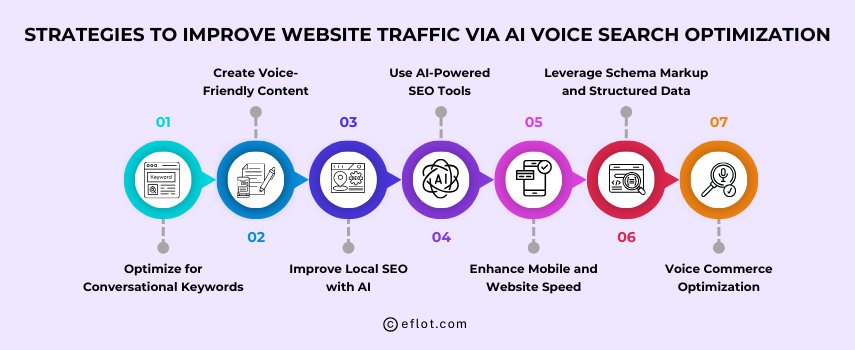
a) Optimize for Conversational Keywords
-
Voice searches are natural and conversational, so your keywords should reflect that.
-
Instead of short keywords like “digital marketing Agency,” focus on long-tail queries like “Which is the best digital marketing Agency in Bangalore for Small Businesses?”
-
Use AI-powered keyword research tools to identify trending voice search queries.
b) Create Voice-Friendly Content
-
Write content in a way that answers common questions directly.
-
Use FAQ sections on your website. For example, “How can I improve website traffic using voice search optimization?”
-
Keep sentences short, clear, and conversational.
c) Improve Local SEO with AI
-
Claim your Google Business Profile and keep it updated.
-
Add details like business hours, reviews, directions, and contact numbers.
-
AI tools can help track what local customers are searching for, so you can optimize your content accordingly.
d) Use AI-Powered SEO Tools
-
Tools like SEMrush, Surfer SEO, and ChatGPT-powered SEO platforms help identify voice-friendly keywords.
-
They analyze search trends and generate optimized content suggestions.
-
AI tools also help with competitor analysis to stay ahead.
e) Enhance Mobile and Website Speed
-
Most voice searches happen on mobile devices. If your website loads slowly, users will leave quickly.
-
Use AI-driven performance tools to improve Core Web Vitals like loading time, interactivity, and stability.
-
Ensure your website is fully mobile-responsive.
f) Leverage Schema Markup and Structured Data
-
Schema markup helps search engines understand your content better.
-
With AI, you can generate schema codes for FAQs, reviews, products, and services.
-
This increases the chance of being selected as the featured voice answer.
g) Voice Commerce Optimization
-
E-commerce websites can benefit greatly from voice search.
-
Optimize product descriptions for voice queries.
-
For example, instead of targeting “best headphones,” target “What are the best wireless headphones under 5000 with noise cancellation?”
-
AI can predict user preferences and help businesses target products better.
Benefits of AI Voice Search Optimization
Implementing AI voice search optimization brings multiple benefits for businesses and websites. Here’s a detailed look:
-
Increased Organic Traffic: By matching conversational queries, your website attracts more visitors. People are searching in natural, complete sentences, and if your content answers these questions directly, it gets noticed more by search engines.
-
Higher Visibility: Being chosen as a voice search result boosts your brand’s authority. Voice assistants often read out answers from top-ranking websites, so appearing there increases your reach and recognition.
-
Improved User Experience: AI ensures users find accurate answers quickly. When users get what they are looking for without extra clicks, they are more satisfied and likely to return.
-
Competitive Advantage: Not all businesses are optimizing for voice search. By being among the first to implement AI voice search optimization, you stay ahead of competitors and capture more traffic.
-
Better Conversion Rates: Voice search users usually have a higher intent to act. For example, someone searching “Order pizza near me now” is ready to buy, so optimizing for voice search can increase sales or leads.
-
Enhanced Local Reach: Many voice searches are location-based. Optimizing for local queries, like “best coffee shop near me,” helps local businesses attract nearby customers instantly.
-
Cost-Effective Marketing: AI voice search optimization can bring targeted traffic without spending heavily on paid ads. Organic traffic from voice search is highly relevant and often easier to convert.
-
Improved Mobile Traffic: Most voice searches happen on mobile devices. Optimizing your website for voice search also improves mobile usability, which benefits SEO and user experience simultaneously.
Common Mistakes to Avoid
Optimizing your website for voice search is different from traditional SEO. Many businesses make mistakes that prevent them from getting the full benefits of AI voice search optimization. Here are the most common mistakes to avoid:
-
Using Robotic or Stiff Language: Voice searches are conversational. Writing content that is too formal or keyword-stuffed makes it hard for AI assistants to pick up your answers. Always use natural, simple, and conversational language.
-
Ignoring Local SEO: Many voice searches are location-based, like “restaurants near me” or “digital marketing services in Bangalore.” Not optimizing your business for local search can make you miss out on valuable nearby traffic.
-
Neglecting Mobile Optimization: Most voice searches are done on mobile devices. If your website is not mobile-friendly or takes too long to load, users will leave before even finding your content.
-
Skipping Structured Data or Schema Markup: Structured data helps AI understand your content better. Without it, your website is less likely to be featured in voice search results or rich snippets.
-
Focusing Only on Short Keywords: Voice searches are usually longer and question-based. Targeting only short keywords like “SEO service” instead of conversational queries like “Which is the best SEO service in Bangalore?” reduces your chances of appearing in voice results.
-
Not Creating FAQ or Voice-Friendly Content: Voice assistants prefer clear and concise answers. If your website doesn’t have FAQs or content that directly answers common questions, AI may not select your site as the top answer.
Future of AI Voice Search Optimization
The future of voice search looks promising and businesses must prepare for it now.
-
More Smart Devices: Voice assistants are becoming part of everyday life through smart TVs, refrigerators, and cars. This will increase the number of voice searches.
-
Growth of Voice Commerce: E-commerce through voice commands, also called “voice commerce,” is expected to grow fastly. People will increasingly buy products just by speaking to their devices.
-
Smarter AI Algorithms: AI will continue to evolve, making voice search even more accurate and personalized. Businesses that adapt early will benefit most.
-
Voice as a Primary Search Method: In the near future, many users may prefer voice search over typing, making AI voice search optimization a critical part of SEO strategies.
Voice search is becoming a major way people find information online, and businesses that adapt can gain a significant advantage. By using AI voice search optimization, websites can better understand conversational queries, provide accurate answers, and appear in top voice search results. This not only increases website traffic but also improves user experience, local visibility, and conversions. Adopting AI-driven voice search strategies today ensures your business stays competitive and ready for the future of online search.
Digital Marketing services in Other Locations in India
Bangalore | Hyderabad | Chennai | Pune | Ahmedabad | Coimbatore | Mumbai | Kolkata | Patna | Amritsar | Indore | Kozhikode | Trivandrum | Jaipur | Nagpur | Gwalior | Dehradun | Noida | Vizag | Raipur | Agra | Gurgaon | Madurai | Udaipur | Thrissur |