























Technical SEO Audit Framework Used by Top SEO Experts
Learn how top SEO experts use a proven technical SEO audit framework to fix site issues, improve crawlability, boost rankings, and support digital marketing growth.

Search engines do not rank websites based on content alone. A website must also work properly in the background so search engines can read and understand it. Even a good-looking site can lose visibility if there are technical problems. This is why Technical SEO is important in Digital Marketing.
Top SEO experts use a clear Technical SEO audit framework to find and fix hidden issues that affect rankings. When handled by a skilled Digital Marketing Agency, these fixes improve SEO Services and help websites grow steadily in search results.
The Role of Technical SEO in Search Visibility
Technical SEO helps search engines understand website structure, content relationships, and performance quality. It directly impacts how pages appear and rank in search results. Without it, SEO efforts remain incomplete.
Search visibility improves when technical elements support crawling, indexing, and user experience together.
-
Crawl Efficiency: Technical SEO ensures search bots crawl pages smoothly. Fewer errors mean better visibility.
-
Index Control: Audits help decide which pages should appear in search results. This improves ranking focus.
-
User Experience Signals: Search engines measure speed and usability. Better experience leads to better rankings.
-
Mobile Optimization: Mobile-friendly sites rank higher in search results. Technical SEO fixes mobile issues.
-
Content Discoverability: Good structure helps search engines find new content faster. This supports SEO growth.
How Expert-Led Audits Differ From Basic Checks
Basic SEO checks rely mostly on tools and automated reports. Expert-led audits go deeper and connect technical issues with business outcomes. This makes them more valuable for long-term SEO Services.
Experts prioritize fixes that directly impact traffic, rankings, and conversions.
-
Strategic Analysis: Experts analyze why issues occur, not just what the issue is. This leads to smarter fixes.
-
Priority-Based Fixes: Issues are ranked based on SEO impact. Critical problems are fixed first.
-
Manual Validation: Experts manually verify tool data for accuracy. This avoids misleading conclusions.
-
Business Alignment: Audits align Technical SEO with Digital Marketing goals. SEO supports revenue growth.
-
Actionable Recommendations: Experts provide clear steps for developers and marketers. Execution becomes easier.
Understanding the Goals of a Technical SEO Audit
A Technical SEO audit aims to strengthen the website’s backend for better performance. It ensures that all SEO Services work on a stable foundation. The focus is long-term growth, not short-term fixes. Clear goals help businesses measure SEO success effectively.
-
Improve Crawlability: Search engines should access all important pages easily. This boosts ranking potential.
-
Enhance Indexing: Only relevant pages should be indexed. This improves content authority.
-
Boost Performance: Speed and stability improvements support better user experience. Rankings improve naturally.
-
Support Content SEO: Technical SEO helps content rank better. It improves discoverability.
-
Ensure Scalability: Websites must handle growth without SEO issues. Audits prepare sites for expansion.
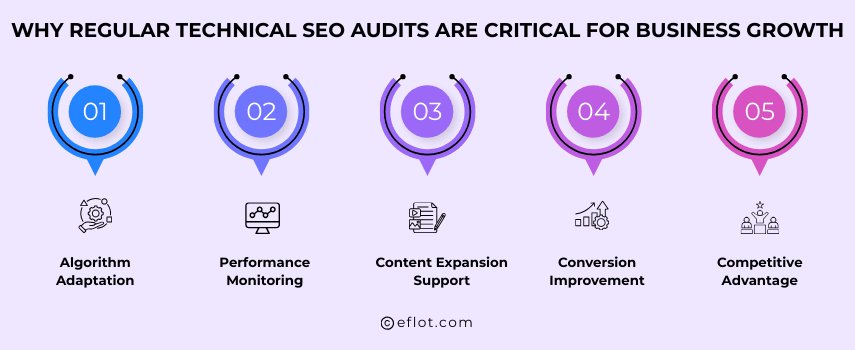
Why Regular Technical SEO Audits Are Critical for Business Growth
Search engines and websites are always changing, so businesses need regular Technical SEO audits to stay visible and competitive. Without consistent audits, websites can develop hidden issues that slow traffic and hurt rankings. In fact, over 53% of all website traffic now comes from organic search, showing how important SEO is for online success.
-
Algorithm Adaptation: Audits help websites stay compliant with updates. This protects rankings.
-
Performance Monitoring: Issues are fixed before they affect traffic. Growth remains stable.
-
Content Expansion Support: New pages stay technically optimized. SEO strength increases.
-
Conversion Improvement: Better performance improves user trust. Leads and sales increase.
-
Competitive Advantage: Technically clean websites outperform competitors. Visibility improves faster.
Core Technical SEO Audit Frameworks
Core Technical SEO audit frameworks help experts check the overall health of a website and fix issues that affect rankings. These frameworks are used by every professional Digital Marketing Agency to ensure websites are search-engine friendly, fast, secure, and easy to crawl. Strong Technical SEO supports all SEO Services and improves long-term performance in Digital Marketing.
-
Crawlability & Indexation Framework: This framework checks whether search engines can access and index important pages properly. It focuses on crawl errors, blocked URLs, XML sitemaps, robots.txt rules, and removing unnecessary indexed pages that waste crawl budget.
-
Website Architecture & Internal Linking Framework: This framework analyzes how pages are structured and connected within the site. A clean hierarchy, logical URLs, and strong internal links help search engines understand content importance and distribute ranking authority effectively.
-
Page Experience & Core Web Vitals Framework: This framework measures website performance and user experience. It focuses on page speed, mobile usability, visual stability, and interactivity to ensure users get a smooth experience that supports better SEO rankings.
-
On-Page Technical Elements Framework: This framework reviews technical on-page factors such as title tags, meta descriptions, header structure, canonical tags, and pagination setup. Proper optimization helps search engines interpret page relevance correctly.
-
Rendering & JavaScript SEO Framework: This framework checks whether search engines can see and render content properly on JavaScript-heavy websites. It ensures important content loads correctly and is accessible to search engines during crawling.
-
Duplicate Content Control Framework: This framework identifies and fixes duplicate content issues caused by multiple URLs, parameters, or incorrect canonical tags. Controlling duplication helps consolidate authority and improve indexing accuracy.
-
Site Speed & Performance Optimization Framework: This framework focuses on improving load time and technical performance. It includes server response checks, image optimization, code cleanup, and hosting evaluation to support faster page delivery.
-
Security & HTTPS Framework: This framework ensures the website is secure and trusted by search engines. It checks HTTPS implementation, SSL certificates, mixed content issues, and proper redirects to protect SEO value.
-
Structured Data & Schema Framework: This framework reviews structured data implementation to help search engines understand content better. Proper schema improves search appearance through rich results and increases click-through rates.
-
International & Multilingual SEO Framework: This framework supports websites targeting multiple countries or languages. It ensures correct hreflang usage, region-specific URLs, and duplication control across different markets.
Tools and Data Sources Used in Expert Technical SEO Audits
Expert Technical SEO audits are based on real data, not guesswork. A professional Digital Marketing Agency uses trusted tools and data sources to identify technical issues that affect search visibility. These tools help experts understand how search engines see and interact with a website.
The tools and data sources allow SEO Services teams to make accurate decisions and recommend fixes that actually improve rankings and performance.
-
Google Search Console: This tool shows how Google crawls, indexes, and ranks a website. It helps identify crawl errors, indexing problems, and performance issues.
-
Website Crawling Tools: Crawlers scan the website like a search engine bot. They help find broken links, redirect issues, missing tags, and duplicate content.
-
Page Speed & Performance Tools: These tools measure loading speed and user experience. They help improve Core Web Vitals and overall Technical SEO performance.
-
Log File Data: Log files show how search engine bots crawl a website. Experts use this data to optimize crawl budget and page priority.
-
Analytics Platforms: Analytics data helps connect technical issues with traffic and user behavior. This supports better Digital Marketing decisions.
Technical SEO Audit vs SEO Health Check: Key Differences
Many businesses confuse a Technical SEO audit with a basic SEO health check. While both are useful, they are not the same. A professional audit goes much deeper and supports long-term SEO Services.
Understanding the difference helps businesses choose the right approach for sustainable Digital Marketing growth.
-
Depth of Analysis: A health check highlights surface-level issues, while a Technical SEO audit deeply analyzes structure, crawling, and performance.
-
Strategic Focus: Audits focus on business impact and ranking improvement. Health checks mainly focus on tool-based scores.
-
Issue Prioritization: Expert audits rank issues based on SEO impact. Health checks usually list issues without priority.
-
Actionable Recommendations: Audits provide clear steps for developers and marketers. Health checks offer limited guidance.
-
Long-Term Value: Technical SEO audits support long-term growth. Health checks are useful for quick reviews only.
Common Technical SEO Issues Found During Expert Audits
During expert-led audits, certain Technical SEO issues appear repeatedly across websites. These issues often go unnoticed without professional SEO Services. Fixing them leads to better rankings and performance.
-
Crawl Errors: Broken pages and server errors block search engines. This reduces index coverage and rankings.
-
Slow Page Speed: Heavy pages and poor optimization increase load time. This hurts both SEO and user experience.
-
Duplicate Content: Multiple URLs showing the same content confuse search engines. Rankings and authority get diluted.
-
Incorrect Canonical Tags: Wrong canonical usage causes indexing problems. Important pages may not rank.
-
Mobile Usability Issues: Poor mobile experience affects mobile-first indexing. Traffic drops significantly.
Turning Audit Insights into an Actionable SEO Roadmap
A Technical SEO audit is valuable only when insights are turned into action. Experts convert audit findings into a clear roadmap that supports SEO Services and Digital Marketing goals.
This roadmap helps teams fix issues step by step without confusion.
-
Issue Prioritization: Problems are ranked based on SEO impact. High-impact issues are fixed first.
-
Quick Wins Identification: Simple fixes that deliver fast results are addressed early. This improves performance quickly.
-
Long-Term Technical Fixes: Complex issues are planned over time. This ensures stable Technical SEO growth.
-
Team Coordination: SEO, developers, and content teams work together. Execution becomes smoother.
-
Performance Tracking: Fixes are monitored using SEO data. Improvements are measured clearly.
How Often Should a Technical SEO Audit Be Performed?
The frequency of Technical SEO audits depends on website size, growth, and activity. Regular audits help businesses stay competitive in Digital Marketing and protect SEO Services investments. Consistent audits prevent unexpected ranking drops.
-
Small Websites: A Technical SEO audit every 6 months is sufficient. It helps maintain stable performance.
-
Growing Business Websites: Audits every 3 to 4 months are recommended. New content and changes need monitoring.
-
Large or E-commerce websites: Quarterly audits are ideal due to frequent updates. Technical issues appear more often.
-
Website Redesign or Migration: Audits should be done before and after launch. This prevents SEO losses.
-
After Algorithm Updates: Audits help identify impact and recovery steps. Rankings stay protected.
A Technical SEO audit framework used by top SEO experts helps keep a website healthy and easy for search engines to understand. It finds and fixes technical problems related to crawling, speed, structure, and security. When handled by a skilled Digital Marketing Agency, these audits strengthen SEO Services, improve rankings, and support a better user experience. Regular Technical SEO audits help maintain steady traffic and long-term online growth.
Digital Marketing services in Other Locations in India
Bangalore | Hyderabad | Chennai | Pune | Ahmedabad | Coimbatore | Mumbai | Kolkata | Patna | Amritsar | Indore | Kozhikode | Trivandrum | Jaipur | Nagpur | Gwalior | Dehradun | Noida | Vizag | Raipur | Agra | Gurgaon | Madurai | Udaipur | Thrissur |