
















LLMO: How to Rank in AI-Driven Search?
Learn what LLMO is, how AI-driven search works, and how to optimize content for ChatGPT and Perplexity by improving clarity, structure, and user intent.
Nowadays Gen Z and Gen Alpha often ask ChatGPT before making any decisions.
They don’t rely only on Google or Microsoft Edge anymore. AI tools like ChatGPT and Perplexity AI are now their main source of answers.
If your website is not ready for LLMO, you could lose many potential users.
What Is LLMO and Its Role in AI-driven search
LLMO stands for Large Language Model Optimization.
It is the practice of structuring content so AI systems can:
-
Understand the topic clearly
-
Identify useful information
-
Trust the source
-
Reuse the content in answers
AI-driven search does not work like traditional search engines.
Instead of ranking pages and asking users to choose, AI systems:
-
Read multiple sources
-
Combine information
-
Present a single response
LLMO helps your content become part of that response.
Its role is to make your website:
-
Easy to interpret
-
Clear in meaning
-
Reliable in explanation
If AI systems cannot clearly understand your content, they skip it.
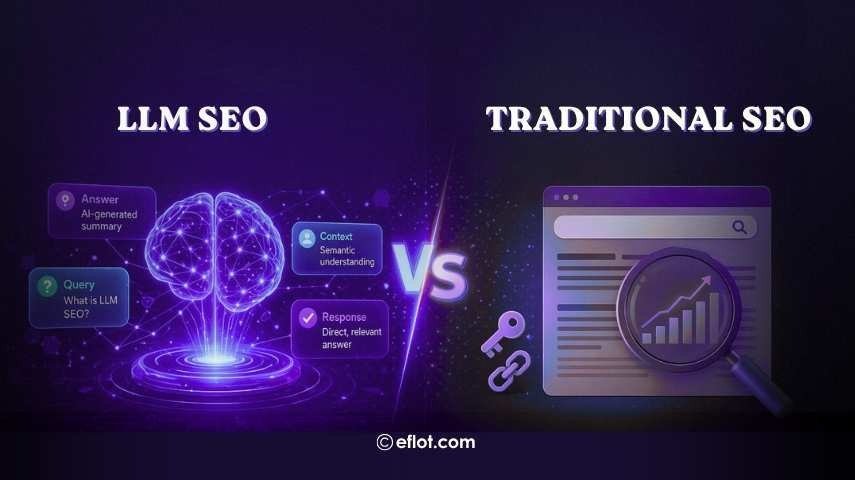
LLMO vs. Traditional Search
Traditional SEO and LLMO follow different logic.
Below is a clear comparison.
|
Aspect |
Traditional Search |
LLMO (AI-Driven Search) |
|
Primary Goal |
Rank pages |
Provide accurate answers |
|
Result Format |
List of links |
Generated responses |
|
Focus Area |
Keywords and backlinks |
Meaning and clarity |
|
Content Use |
User clicks and reads |
AI summarizes and reuses |
|
Structure Importance |
Helpful |
Required |
|
Role of Intent |
Query matching |
Intent interpretation |
|
Page Authority |
Strong factor |
Supporting factor |
|
Writing Style |
Optimized for ranking |
Written for explanation |
|
Technical Impact |
Indexing and speed |
Parsing and clarity |
|
Measurement |
Rankings and traffic |
AI visibility and references |
Traditional search rewards position. LLMO rewards understanding.
A page can rank well and still be ignored by AI systems if it lacks clarity.
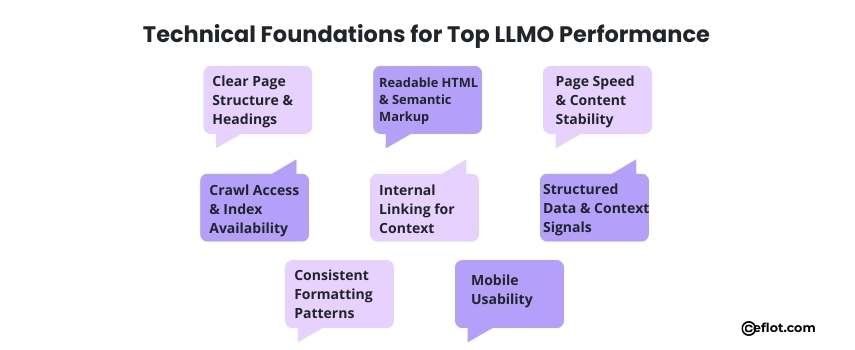
Technical Foundations for Top LLMO Performance
LLMO depends heavily on technical quality. AI systems prefer content that is clean, accessible, and organized.
Below are the key technical foundations that support LLMO.
1. Clear Page Structure and Headings
AI systems rely on structure to follow content flow.
Best practices include:
-
One clear H1
-
Logical H2 and H3 usage
-
Each section covering one idea
Random or inconsistent headings confuse interpretation.
Clear structure helps AI systems map the topic correctly.
2. Readable HTML and Semantic Markup
Clean code improves machine readability.
Helpful elements:
-
Semantic tags (header, main, section)
-
Minimal clutter
-
No hidden or misleading elements
Messy markup increases noise and reduces clarity.
3. Page Speed and Content Stability
Speed affects both users and AI systems.
Problems caused by slow pages:
-
Delayed content visibility
-
Partial rendering
-
Interrupted crawling
For LLMO:
-
Main content should appear early
-
Layout should remain stable
-
No sudden shifts
Stable pages are easier to process.
4. Crawl Access and Index Availability
If AI systems cannot access a page, it cannot be used.
Important checks:
-
Robots.txt allows crawling
-
No unintended no-index tags
-
XML sitemaps include key pages
Blocked or hidden content is ignored.
5. Internal Linking for Context
Internal links help define relationships.
They guide AI systems to understand:
-
Topic clusters
-
Supporting content
-
Page importance
Good internal linking uses:
-
Clear anchor text
-
Logical connections
-
Limited but meaningful links
6. Structured Data and Context Signals
Structured data helps clarify meaning.
It supports:
-
Definitions
-
FAQs
-
How-to steps
-
Entity relationships
When structured data matches visible content, interpretation improves.
7. Consistent Formatting Patterns
AI systems process consistency well.
Helpful formatting includes:
-
Short paragraphs
-
Bullet points
-
Clear definitions
-
Examples where needed
Inconsistent formatting weakens comprehension.
8. Mobile Usability
AI-driven search reflects mobile behavior.
Mobile-friendly pages:
-
Display correctly
-
Load smoothly
-
Avoid horizontal scrolling
Poor mobile experience sends negative signals.
How User Intent and Experience Improve LLMO Rankings
AI Systems Learn From User Behavior
Modern AI systems continuously learn from how users interact with content. They observe patterns such as:
-
What questions users ask repeatedly
-
Which answers fully satisfy user needs
-
Which sources are referenced or reused over time
This behavior helps AI models identify content that delivers real value.
Content That Matches User Intent Performs Better
Content ranks higher in LLMO when it aligns closely with what users are actually looking for. High-performing content:
-
Answers the question directly
-
Avoids unnecessary filler or fluff
-
Uses simple, clear language
When users find what they need quickly, AI systems recognize the content as helpful and reliable.
User Experience Signals Quality
A strong user experience supports LLMO because it makes information easier to consume. Effective UI/UX includes:
-
Clear answers that reduce confusion
-
Logical structure that improves understanding
-
Relevant sections that save time
Good structure helps both users and AI systems interpret the content efficiently.
Common Mistakes That Affect LLMO Performance
-
Writing for Keywords Instead of Clarity: Content filled with keywords but lacking clear explanation confuses AI systems. LLMO favors meaning and understanding over repetition.
-
Long Paragraphs Without Structure: Large blocks of text are hard for AI to interpret correctly. Short sections and clear formatting improve content reading.
-
Repeating Ideas Without Value: Saying the same point in different ways adds noise, not insight. AI systems prefer direct answers with clear purpose.
-
Mixing Unrelated Topics on One Page: Covering multiple subjects weakens topic focus. LLMO works better when each page addresses one clear intent.
-
Ignoring Factual Accuracy: Inconsistent or outdated facts reduce trust. AI systems avoid content that feels unreliable.
-
Relying Only on Traditional SEO Methods: Website Ranking signals alone are no longer enough. AI-driven search rewards explanation and clarity, not just optimization.
LLMO improves when content matches real user intent and delivers clear answers. Simple structure and strong user experience help AI systems trust and reuse your content.
Digital Marketing services in Other Locations in India
Bangalore | Hyderabad | Chennai | Pune | Ahmedabad | Coimbatore | Mumbai | Kolkata | Patna | Amritsar | Indore | Kozhikode | Trivandrum | Jaipur | Nagpur | Gwalior | Dehradun | Noida | Vizag | Raipur | Agra | Gurgaon | Madurai | Udaipur | Thrissur |