























How to Write Plagiarism-Free Content?
Learn effective strategies to write original content, avoid plagiarism, and improve writing quality using practical techniques and tools.
Rewriting Other Blogs or Posts? That’s Not SEO, That’s a Shortcut to Getting Penalized.
Taking content from other blogs, changing a few words, and combining it into a new post isn’t original content, and it won’t help your website rank.
In fact, it often leads to poor results: no traffic, no leads, and no visibility. Even worse, Google may penalize your site without notice.
Why? Because reworded content without original ideas still counts as plagiarism.
Search engines today are smarter than ever. They can easily identify content that lacks originality or adds little value.
Truly effective, plagiarism-free content isn’t about changing words, it’s about offering new insights, real value, and clear, trustworthy information for your audience.
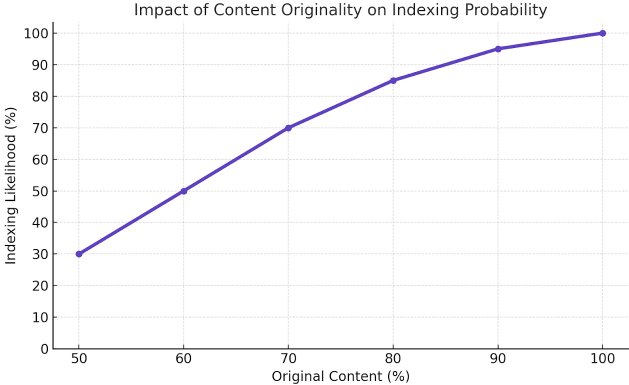
In fact, duplicate content should be less than 30% of a page, meaning at least 70% must be original. If duplication exceeds this limit, Google may filter your page out of search results or decide not to index it.
What Is Plagiarism-Free Content?
Plagiarism-free content is material written in your own words, based on your understanding or supported by proper citations when needed.
It reflects your original expression, thought process, and structure, even when it is inspired by research or external sources.
The following actions do not qualify as plagiarism-free:
-
Rewriting existing content with minor edits
-
Rearranging sentences from published articles
-
Using AI-generated text without human review
-
Copying statistics or quotes without attribution
Genuinely original content builds long-term credibility, while copied or poorly reworded content can damage your online presence.
Why Google Penalizes “Rewritten” Content?
Rewriting existing blog posts may seem like a shortcut, but it’s one of the easiest things for Google’s algorithms to detect. And when it happens, your content can suffer, even if you haven’t directly copied anything.
Here’s what you risk:
-
Sudden drops in search rankings
-
Your pages getting skipped or ignored by Google’s crawlers
-
Being labeled as thin, low-value content
-
Never reaching the first page, no matter how good your keywords or SEO setup is
If your strategy is built on rephrasing what others have already published, you're not creating value, you're just recycling. Google’s focus is clear: reward content that is original, helpful, and created for users, not just search engines.
The real path to visibility and traffic? Share fresh insights, offer real solutions, and write with purpose. That’s what sets strong content apart.
Tips for Plagiarism-Free Content That Earns Google’s Trust
If you want your content to rank well on Google and build trust with your readers, it needs to be original, useful, and clearly written. Google looks for Experience, Expertise, Authoritativeness, and Trust (E-E-A-T).
Here’s how to write content that meets those standards, without rewriting or copying others.
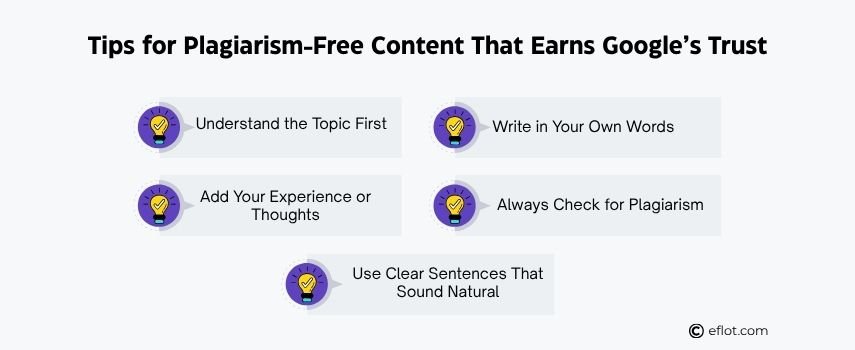
1. Understand the Topic First
Don’t just read one or two blog posts and reword them. Take time to really understand the topic.
Look at:
-
Forums where real people ask questions
-
Industry reports and trusted websites
-
YouTube videos, interviews, or even podcasts
Find what others are missing; that’s where you can add your unique view.
Tip: Learn first, then write. Don’t collect words, collect real knowledge.
2. Write in Your Own Words
Don’t try to copy and rephrase. Instead, explain the topic as if a friend asked you directly.
Ask yourself:
-
How would I say this in a message or voice call?
-
What’s the easiest way to explain this clearly?
Then turn that into a blog with helpful headings and simple language.
3. Add Your Experience or Thoughts
Google prefers content that shows you’ve used or worked with the topic. That’s called Experience and Expertise.
You can do this by:
-
Sharing a short story or example
-
Describing a problem you faced and how you solved it
-
Giving your honest opinion or tips
Even if your answer is simple, it helps your readers, and that’s what Google wants.
4. Always Check for Plagiarism
Before publishing, use a trusted plagiarism checker to ensure your content is unique and properly attributed. Even unintentional duplication can impact performance.
Recommended Tools:
- Plagiarismly – Conducts in-depth detection and offers detailed reports
-
Grammarly – Fast and user-friendly with grammar support
-
Turnitin – Widely used in academic institutions
-
Scribbr – Strong for research-based content
-
PlagiarismCheck.org – Provides detailed similarity breakdowns
-
QuillBot – Combines rewriting features with plagiarism detection
Regular checks help maintain originality and support long-term credibility with search engines and readers.
5. Use Clear Sentences That Sound Natural
Google prefers content that’s easy to understand and pleasant to read. One simple way to do this is by using clear sentence structures.
Use mostly active voice; it’s direct, simple, and easier for people to follow. However, incorporating some passive voice adds variety and balance, which sounds more natural to human readers.
Examples:
-
Active voice (direct): "Check your article before you publish it."
-
Passive voice (softer): "The article should be checked before being published."
Other easy changes that improve clarity:
-
Use simple words instead of complex ones
→ "Use" instead of "Utilize"
→ "Help" instead of "Assist"
-
Break long sentences into shorter ones
-
Avoid jargon unless your audience knows it
-
Use lists, bullet points, and headings to organize your thoughts
Use the 4C Formula to Make Your Content Easy and Effective
Writing original content is just the starting point; keeping readers interested is what drives results.
Here’s a simple 4C framework to guide every piece you create:
-
Clear – Use straightforward language. Say exactly what you mean.
-
Concise – Remove unnecessary words or repeated points. Every line should add value.
-
Credible – Support your ideas with examples, data, or real-life insights to build trust.
-
Conversational – Write as if you’re speaking to someone, naturally, not formally or stiff.
When you follow this structure, your content becomes easier to read, more trustworthy, and far more likely to connect with real people. And when that happens, readers are more likely to stay longer, share your content, or take the next step.
How Plagiarism-Free Content Improves SEO Rankings
Search engines like Google prioritize original, helpful content. When your content is plagiarism-free, it shows that you’ve provided something new, which makes it more likely to rank higher.
Here’s how plagiarism-free content supports SEO:
-
Better Indexing: Unique content is indexed more quickly and thoroughly by search engines.
-
Lower Bounce Rate: Original writing keeps users engaged for longer, reducing bounce rate —a key SEO signal.
-
Improved Authority: When readers find your content trustworthy, it attracts backlinks, increasing your site’s domain authority.
-
Avoids Penalties: Google’s algorithm can detect duplicated or lightly reworded content and may lower its ranking or remove it from results.
-
Better Keyword Optimization: Writing your content allows natural placement of keywords, which helps search performance.
FAQs
What is plagiarism-free content?
Plagiarism-free content is original writing that uses your own words and ideas. It doesn’t copy text or structure from other sources and includes proper citations if references are used.
How much duplicate content is allowed for SEO?
To avoid SEO penalties, at least 70% of your content should be original. Duplicate content should not exceed 30% of a page, or Google may choose not to index it.
Can I use AI to create plagiarism-free content?
Yes, AI tools can help generate ideas or drafts, but the final content must be rewritten, checked, and refined by a human to ensure originality and avoid duplication.
Which are the best plagiarism checkers?
The most reliable tools include Grammarly, Turnitin, Scribbr, PlagiarismCheck.org, and QuillBot. These tools detect copied content and help ensure your writing is original.
Why does Google penalize rewritten content?
Google penalizes rewritten or spun content because it often lacks originality. Rewording existing posts without adding new value is still considered duplicate content.
Creating original content is key to growing your presence and reaching more people. Copying or rewriting won’t improve your ranking and can cause problems. Focus on sharing your unique ideas clearly and simply, and always check for plagiarism. This builds trust, attracts more visitors, and supports your business success.
Want content that ranks and builds trust?
Get plagiarism-free content that works.
Email: [email protected]
Digital Marketing services in Other Locations in India
Bangalore | Hyderabad | Chennai | Pune | Ahmedabad | Coimbatore | Mumbai | Kolkata | Patna | Amritsar | Indore | Kozhikode | Trivandrum | Jaipur | Nagpur | Gwalior | Dehradun | Noida | Vizag | Raipur | Agra | Gurgaon | Madurai | Udaipur | Thrissur |