

















How AI Automation Improves SEO and Content Strategy
Explore how AI automation tools improve SEO through smarter keyword research, technical audits, content optimization, and scalable performance tracking.
Ranking consistently in search results requires more than publishing content. It demands continuous keyword analysis, technical precision, competitor monitoring, and performance measurement. AI automation tools help marketing teams manage this complexity efficiently. By systemizing repetitive tasks and enhancing data insights, AI automation supports stronger SEO execution, provided it is guided by clear objectives and human expertise.
What Are AI Automation Tools in SEO and How Do They Work?
AI automation tools in SEO use machine learning, natural language processing, and data modelling to automate repetitive tasks, analyse large datasets, and generate optimization insights.
In practical terms, these tools:
-
Process vast keyword datasets in seconds
-
Identify search intent patterns
-
Detect technical website issues
-
Analyse competitor content
-
Recommend content optimizations
-
Automate reporting workflows
Unlike basic rule-based automation, modern AI automation platforms learn from data patterns and improve recommendations over time. For example, AI-driven SEO platforms analyse SERP volatility, content structure, backlink signals, and user behaviour metrics to guide strategic decisions.
According to industry reports from sources such as HubSpot and BrightEdge, organic search continues to drive over 50% of trackable website traffic across industries. This makes scalable, data-driven AI SEO services critical for sustained growth.
Why Businesses Are Using AI Automation for SEO and Content Growth
Businesses adopt AI automation for one core reason: scale with precision.
Modern SEO involves:
-
Thousands of keywords
-
Continuous algorithm updates
-
Large content libraries
-
Technical website complexity
-
Cross-channel performance tracking
Manual processes cannot keep pace with this scale. AI automation helps organizations:
-
Reduce time spent on repetitive analysis
-
Improve forecasting accuracy
-
Prioritize high-impact opportunities
-
Maintain technical health
-
Increase publishing velocity
For marketing leaders, this translates into improved ROI and more predictable organic performance.
How to Automate Your SEO Strategy Using AI Automation Tools
Automation works best when implemented systematically. Below is a structured approach.
Automating Keyword Research and Topic Clustering
AI tools analyze search queries, related entities, competitor rankings, and SERP features to identify high-opportunity keywords. Advanced platforms cluster keywords based on semantic similarity, helping content teams build topical authority rather than isolated blog posts.
This approach aligns with Google's preference for comprehensive topic coverage.
AI-Powered Technical SEO Audits
Technical audits traditionally require manual crawling and spreadsheet analysis. AI automation tools:
-
Crawl websites at scale
-
Detect broken links
-
Identify duplicate content
-
Highlight indexation issues
-
Analyze Core Web Vitals
Automated alerts allow teams to resolve issues before they impact rankings.
Content Brief Generation and Optimization
AI-powered SEO tools generate structured content briefs based on:
-
Top-ranking page analysis
-
Keyword frequency benchmarks
-
Entity coverage
-
Recommended word count ranges
-
Heading structures
Writers can then apply expertise and brand voice while ensuring search alignment.
Automated Rank Tracking and Reporting
Instead of manual tracking, AI automation tools:
-
Monitor keyword rankings daily
-
Detect volatility patterns
-
Compare competitor shifts
-
Generate automated reports for stakeholders
This improves transparency and speeds up decision-making.
Workflow Automation for Content Teams
AI automation integrates with CMS platforms, project management tools, and analytics dashboards. Teams can automate:
-
Content approvals
-
Publishing schedules
-
Internal linking updates
-
Performance notifications
This reduces operational friction.
Proven Strategies to Improve SEO Performance with AI Automation
Implementing tools alone does not guarantee results. Strategy determines impact.
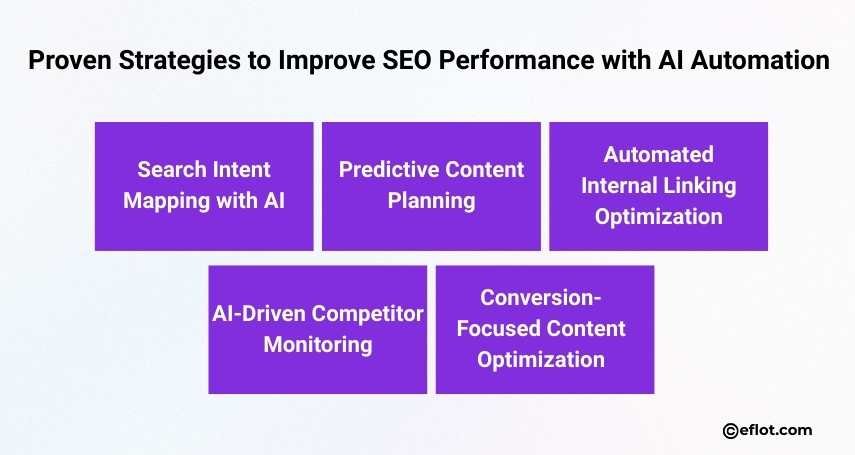
1. Search Intent Mapping with AI: AI systems categorize keywords by informational, transactional, navigational, or commercial intent. Aligning content structure with intent increases engagement and dwell time.
2. Predictive Content Planning: Some AI tools analyse historical performance and search trends to forecast emerging topics. This supports proactive content development.
3. Automated Internal Linking Optimization: Internal linking influences crawlability and authority distribution. AI tools identify linking gaps and suggest contextually relevant anchor placements.
4. AI-Driven Competitor Monitoring: Continuous competitor analysis helps teams detect new content strategies, keyword expansions, and backlink growth. Automated alerts allow faster response.
5. Conversion-Focused Content Optimization: Advanced AI tools analyse engagement signals, scroll depth, and user interaction data to recommend structural improvements that enhance conversion rates.
Best AI Automation Tools for SEO and Content Strategy
AI Tools for Keyword and SERP Research
-
SEMrush - Keyword intelligence, competitor tracking, AI-assisted optimization features.
-
Ahrefs - Backlink analysis, keyword difficulty modeling, SERP analysis.
-
Moz Pro - Keyword suggestions and ranking insights.
AI Tools for Technical SEO Automation
-
Screaming Frog SEO Spider - Website crawling and technical audits.
-
Sitebulb - Visual technical analysis.
-
DeepCrawl (Lumar) - Enterprise-level site health monitoring.
AI Tools for Content Optimization
-
Surfer SEO - Real-time content scoring based on SERP data.
-
Clearscope - Content relevance and keyword coverage analysis.
-
MarketMuse - Topic modeling and content planning.
AI Tools for Workflow and Reporting Automation
-
Google Looker Studio - Automated dashboards.
-
HubSpot Marketing Hub - Integrated reporting and automation.
-
Zapier - Workflow automation across marketing platforms.
Each organization should evaluate tools based on integration compatibility, scalability, data transparency, and budget alignment.
Advantages and Limitations of AI Automation in SEO
Advantages
1. Time Savings & Efficiency: AI automation reduces manual workload by automating repetitive tasks such as rank tracking, audits, and data pulls.
2. Improved Accuracy: Automated systems provide consistent data tracking and analysis without human transcription errors.
3. Scalability: Teams can manage SEO for large sites or multiple domains without proportional increases in resources.
4. Data-Backed Decisions: AI analyzes massive datasets faster than humans, helping teams prioritize high-impact opportunities.
Disadvantages
1. Lack of Human Creativity: AI recommendations must be paired with editorial judgment to avoid generic content.
2. Over-Reliance Risks: Too much automation with no oversight can miss subtle shifts in search trends or penalize over-optimized content.
3. Potential Costs and Learning Curve: Advanced AI tools can require investment and expertise to adopt effectively.
4. Contextual Nuance Limitations: Some SEO tasks like brand voice or nuanced topic positioning, still require human strategy.
Common Mistakes When Implementing AI Automation Tools
Many organizations struggle because of implementation errors:
-
Deploying tools without defined KPIs
-
Ignoring technical SEO fundamentals
-
Treating AI output as final content
-
Failing to train teams properly
-
Overlooking data governance
Successful adoption requires clear governance, measurable objectives, and ongoing evaluation.
Future Trends in AI Automation for SEO
Search Generative Experience (SGE): Google’s generative search results are influencing content structure strategies.
Entity-Based Optimization: AI tools increasingly focus on entity relationships rather than simple keywords.
Predictive SEO Modeling: Forecasting performance based on algorithm patterns and search behaviour.
AI + Human Hybrid Models: Top-performing brands combine automation with editorial expertise.
Staying updated ensures continued competitive relevance.
AI automation tools provide result-oriented advantages when aligned with strategic planning and governance. Organizations that define clear objectives, maintain data quality, and integrate AI into workflows achieve stronger search visibility and sustainable growth with tools in content marketing.
Automation amplifies capability. Strategy determines results.
AI automation tools are accelerating SEO workflows by handling repetitive, data-intensive tasks while improving accuracy and scalability. Used strategically, paired with human oversight and creative direction, they help teams prioritize content that aligns with search intent, uncover opportunities faster, and maintain technical health across large sites.
However, these tools are most effective when they support human strategy, not replace it entirely.
AI automation tools are a powerful addition to modern SEO and content strategy. By automating routine tasks, surfacing data-driven insights, and scaling execution without sacrificing quality, organisations can improve search performance more efficiently. However, the greatest results come from AI automation + human expertise, where automated output is reviewed, refined, and strategically applied.
Invest in AI automation tools thoughtfully, measure their impact regularly, and use them to support strategic decisions, not substitute them.
When aligned with a strategic AI-driven digital marketing agency, these automation insights empower businesses to act with clarity, accelerating search performance, strengthening content relevance, and driving sustained organic growth.
Frequently Asked Questions
1. Are AI automation tools safe for SEO?
Yes, when used with human review. Search engines reward quality and relevance, not whether AI was involved.
2. Can AI replace SEO experts?
No. AI improves efficiency, but strategy, positioning, and quality control still require human expertise.
3. What SEO tasks can AI automate?
Keyword research, seo audits, content optimization suggestions, competitor analysis, and reporting.
4. Do AI tools improve rankings instantly?
No. They speed up execution, but rankings depend on content quality, authority, and algorithm updates.
5. How should businesses choose an AI automation tool?
Focus on goal alignment, integration capability, scalability, and clarity in how recommendations are generated.
Digital Marketing services in Other Locations in India
Bangalore | Hyderabad | Chennai | Pune | Ahmedabad | Coimbatore | Mumbai | Kolkata | Patna | Amritsar | Indore | Kozhikode | Trivandrum | Jaipur | Nagpur | Gwalior | Dehradun | Noida | Vizag | Raipur | Agra | Gurgaon | Madurai | Udaipur | Thrissur |