














How Digital Marketing and E-commerce Work Together for Sales
Learn how digital marketing and e-commerce collaborate to boost sales by improving customer engagement, brand visibility, and online conversions.

When people want to buy something today, the first place they look is online. They search on Google, scroll through social media, and click on ads before making a decision. If a business sells online but does not promote its products properly, customers may never find it
Digital Marketing brings the right visitors to an E-commerce store. The E-commerce website then helps turn those visitors into buyers. When both work together, businesses get more visibility, better sales, and steady growth.
Understanding Digital Marketing in E-commerce
Digital Marketing plays a key role in helping E-commerce businesses reach the right audience online. It connects brands with customers through search engines, social media, and ads. Without digital marketing, even the best E-commerce stores struggle to get sales.
-
Online Visibility: Digital Marketing helps E-commerce stores appear on search engines and social platforms. This increases brand awareness and attracts potential buyers.
-
Targeted Audience Reach: Marketing campaigns focus on users already interested in products. This improves traffic quality and conversion chances.
-
Customer Engagement: Social media and email marketing keep customers connected with brands. Regular engagement builds trust and loyalty.
-
Sales Funnel Support: Digital Marketing guides users from awareness to purchase. Each stage is supported with relevant content and offers.
-
Data-Driven Decisions: Campaign performance is tracked using analytics tools. This helps improve future marketing strategies.
Role of E-commerce Platforms in Sales Growth
E-commerce platforms act as the foundation for online sales and customer experience. They store products, manage payments, and handle orders smoothly. A strong platform supports Digital Marketing efforts effectively.
-
Product Display: E-commerce platforms showcase products with images and descriptions. This helps customers understand and trust the product.
-
Smooth Checkout Process: Easy checkout reduces cart abandonment. Faster payments lead to higher completed sales.
-
Mobile Optimization: Platforms are optimized for mobile users. This supports growing mobile shopping trends.
-
Secure Transactions: Payment security builds customer confidence. Trust improves repeat purchases.
-
Inventory Management: Platforms track stock in real time. This avoids order delays and cancellations.
How Digital Marketing Drives Traffic to E-commerce Stores
Digital Marketing brings the right users to E-commerce websites. It ensures products reach people who are already searching online. Traffic quality matters more than traffic quantity.
-
SEO Traffic: Search engine optimization brings organic visitors. These users usually have strong buying intent.
-
Paid Advertising: Ads provide instant visibility for products. They help generate quick sales results.
-
Social Media Marketing: Platforms like Facebook, Instagram, and TikTok drive brand awareness and clicks, especially among users discovering products. Over 97% of online consumers access social media at least once a month, making it important for E-commerce discovery.
-
Email Campaigns: Emails bring repeat visitors to the store. They help promote offers and new launches.
-
Content Marketing: Blogs and guides attract interested users. Informative content builds trust before purchase.
Digital Marketing Strategies to Improve E-commerce Sales
The right Digital Marketing strategies turn visitors into paying customers. Digital Marketing Services focus on conversion and retention. These strategies work best when managed by a Digital Marketing Agency.
-
Conversion Rate Optimization: Landing pages are improved for better sales. Small changes can increase conversions.
-
Retargeting Ads: Ads target users who visited but didn’t buy. This increases chances of completing purchases.
-
Personalized Marketing: Campaigns are tailored based on user behavior. Personalization improves engagement and sales.
-
Influencer Marketing: Influencers promote products to trusted audiences. This increases credibility and reach.
-
Email Automation: Automated emails recover abandoned carts. They encourage customers to return and buy.
Benefits of Combining Digital Marketing and E-commerce
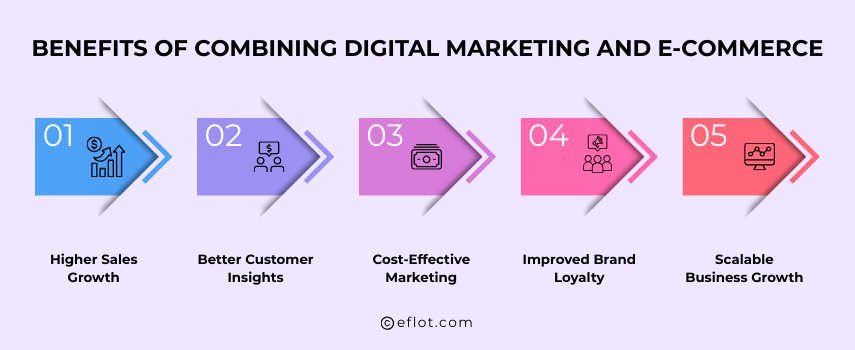
When Digital Marketing and E-commerce work together, sales growth becomes consistent. Marketing brings traffic while E-commerce converts it. This combination creates a strong online business model.
-
Higher Sales Growth: Targeted traffic leads to more conversions. Revenue increases steadily over time.
-
Better Customer Insights: Data shows customer preferences and behavior. This helps improve product offerings.
-
Cost-Effective Marketing: Digital campaigns reduce traditional advertising costs. ROI becomes more measurable.
-
Improved Brand Loyalty: Regular engagement builds long-term relationships. Loyal customers buy repeatedly.
-
Scalable Business Growth: Campaigns can scale easily with demand. Growth becomes predictable and manageable.
Role of AI and Automation in E-commerce Marketing
AI and automation are changing how E-commerce businesses do Digital Marketing. They help brands understand customer behavior, run smarter campaigns, and save time. With the support of a Digital Marketing Agency, AI tools make marketing faster and more accurate.
-
Customer Behavior Analysis: AI studies user actions like clicks, searches, and purchases. This helps businesses understand what customers really want.
-
Personalized Product Recommendations: AI shows products based on user interests and past behavior. This improves user experience and increases sales.
-
Automated Email Marketing: Automation sends cart reminders, offers, and follow-ups automatically. This keeps customers engaged without manual effort.
-
Smart Advertising Campaigns: AI optimizes ads by adjusting budgets and targeting. Digital Marketing Services use this to improve ad performance.
-
Chatbots and Customer Support: AI chatbots answer customer questions instantly. This improves satisfaction and reduces support workload.
-
Inventory and Demand Forecasting: AI predicts product demand accurately. E-commerce businesses avoid stock shortages and overstocking issues.
Common Mistakes Businesses Make
Many businesses fail to align Digital Marketing with their E-commerce goals. These mistakes reduce sales potential. Avoiding them improves overall performance.
-
Ignoring Website Optimization: Traffic is wasted on poorly designed sites. Users leave without buying.
-
No Clear Marketing Strategy: Random campaigns bring low-quality traffic. Sales performance becomes unstable.
-
Overdependence on Ads: Relying only on paid ads increases costs. Organic growth is often ignored.
-
Poor Mobile Experience: Mobile users face navigation issues. This leads to lost sales opportunities.
-
Lack of Analytics Tracking: Performance data is not analyzed properly. Growth decisions become guesswork.
How Businesses Can Improve Sales Using Both Together
Businesses should align Digital Marketing Services with E-commerce goals. This creates a smooth sales journey for customers. A Digital Marketing Agency can manage this integration effectively.
-
Unified Strategy Planning: Marketing and sales goals should match. This improves campaign efficiency.
-
Customer-Centric Approach: Focus on user needs and experience. Happy users convert faster.
-
Optimized Sales Funnel: Each stage guides users clearly. This reduces drop-offs.
-
Continuous Testing: Ads and pages are tested regularly. Improvements increase sales performance.
-
Professional Support: Agencies provide expertise and tools. This ensures consistent growth.
Measuring Success in Digital Marketing and E-commerce
Measuring performance is important to know what works and what doesn’t. Digital Marketing and E-commerce success depends on data and analysis. A Digital Marketing Agency uses tracking tools to improve results continuously.
-
Website Traffic Analysis: Traffic data shows how users find the website. This helps improve Digital Marketing strategies.
-
Conversion Rate Tracking: Conversion rates show how many visitors become customers. Higher rates mean better E-commerce performance.
-
Sales and Revenue Metrics: Revenue tracking shows campaign effectiveness. It helps businesses understand ROI clearly.
-
Customer Acquisition Cost (CAC): CAC measures how much it costs to get a customer. Lower costs indicate efficient marketing efforts.
-
Customer Retention and Repeat Sales: Repeat purchase data shows customer loyalty. Retention is cheaper than acquiring new users.
-
Campaign Performance Reporting: Reports track ad clicks, engagement, and sales. Digital Marketing Services use these insights to optimize campaigns.
Future of Digital Marketing and E-commerce Integration
The future of E-commerce depends heavily on advanced Digital Marketing. Technology will make shopping more personalized and automated. Businesses must adapt to stay competitive.
-
AI-Powered Marketing: AI predicts customer behavior accurately. Campaigns become more effective.
-
Personalized Shopping Experience: Users see relevant products instantly. This improves conversion rates.
-
Voice and Visual Search: Search behavior is changing fastly. E-commerce stores must adapt.
-
Omnichannel Selling: Brands sell across multiple platforms. Customer experience remains consistent.
-
Marketing Automation Growth: Automated tools save time and costs. Scaling becomes easier.
Digital Marketing helps bring the right people to an E-commerce store through search engines, ads, and social media. The E-commerce website then turns these visitors into customers with an easy shopping experience. When both work together, businesses get better traffic and more sales. This combination also helps build customer trust and repeat purchases. Overall, it supports steady and long-term online growth.
Digital Marketing services in Other Locations in India
Bangalore | Hyderabad | Chennai | Pune | Ahmedabad | Coimbatore | Mumbai | Kolkata | Patna | Amritsar | Indore | Kozhikode | Trivandrum | Jaipur | Nagpur | Gwalior | Dehradun | Noida | Vizag | Raipur | Agra | Gurgaon | Madurai | Udaipur | Thrissur |