














How a High-Converting Landing Page Boosts Business Growth
Discover how a well-designed landing page can drive leads, improve conversions, and support consistent business growth.
Many businesses invest significant resources in paid advertising, content marketing, and social media campaigns, yet often neglect a crucial element: the landing page. When the landing page is ineffective, even the most well-crafted marketing strategies can fail to produce meaningful results.
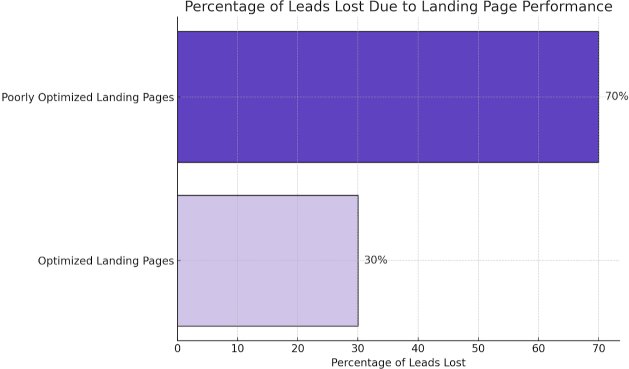
Studies suggest that poorly optimized landing pages contribute to over 70% of lost leads across digital campaigns, highlighting the direct impact on overall conversion performance.
What Is a Landing Page?
“A Focused Page With a Single Objective”
A landing page is a web page created with the primary goal of encouraging a specific action. This action may include subscribing to a newsletter, downloading a resource, requesting a product demonstration, or completing a purchase.
Unlike a homepage that presents multiple links and diverse content, a landing page is designed to minimize distractions and direct visitors toward one clear and focused call to action (CTA).
Key Elements of a High-Converting Landing Page
Achieving a high conversion rate on a landing page requires deliberate design, precise messaging, and a well-organized structure. The objective is clear: to convert visitors into leads or customers efficiently, minimizing friction.
-
Focused Objective
Each effective landing page is centered around a singular goal, whether it be scheduling a consultation, downloading a resource, or initiating a trial. The content and layout should consistently guide the visitor toward this defined outcome without ambiguity.
-
Concise and Compelling Headline
The headline must clearly communicate the page’s purpose and its value proposition. It should answer:
-
What is this page offering?
-
Why is it relevant to the visitor?
Clarity and directness take precedence over creativity to enhance comprehension and engagement.
-
A Powerful Call-to-Action (CTA)
The CTA should be visually distinct and employ clear, directive language such as:
-
“Start Free Trial”
-
“Request a Proposal”
-
“Download the Guide”
This element must convey urgency and guide the visitor toward immediate action.
-
Credibility Through Social Proof
Incorporating testimonials, client logos, user reviews, or quantitative data helps foster trust and mitigate skepticism. Even brief endorsements from satisfied customers can have a significant impact on decision-making.
-
Clean and Intuitive Design
A streamlined layout with ample white space, minimal text, and purposeful visuals reduces cognitive load. The design should intuitively lead users through the content toward the CTA without distractions.
-
Optimized Performance and Responsiveness
Page load speed and mobile compatibility are critical. A landing page must function seamlessly across all devices to prevent visitor attrition due to technical inefficiencies.
-
Relevant and Authentic Visuals
Visual elements such as images, icons, or concise videos should reinforce the message and evoke the desired emotional response. Avoid generic stock photography; instead, use authentic visuals that closely align with the brand and its offerings.
Common Reasons Why Landing Pages Fail to Convert
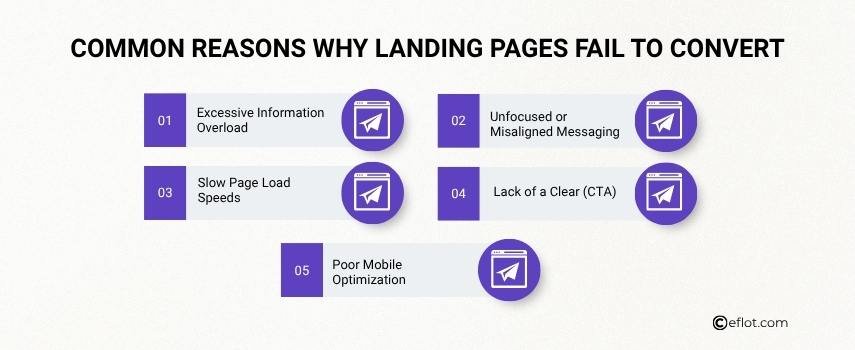
Several critical factors contribute to low conversion rates on landing pages:
-
Excessive Information Overload: Presenting too much content can overwhelm visitors, resulting in higher bounce rates and lower engagement.
-
Lack of a Clear Call-to-Action (CTA): When the desired user action is ambiguous or poorly defined, visitors may become uncertain about the next steps, resulting in missed opportunities.
-
Slow Page Load Speeds: Performance issues that delay page rendering often cause users to abandon the site before engaging with the content, directly affecting overall site performance.
-
Unfocused or Misaligned Messaging: Content that fails to resonate with the target audience or does not communicate the value proposition undermines user interest.
-
Poor Mobile Optimization: With a significant portion of traffic originating from mobile devices, an unresponsive or difficult-to-navigate mobile experience can drastically reduce conversions.
A landing page that lacks clarity, speed, and focus not only underperforms but also diminishes user trust and credibility. Given today’s limited attention spans, even minor usability issues can result in substantial loss of potential leads.
How to Measure Landing Page Conversion Effectiveness
To accurately assess whether your landing page is achieving its goals, focus on these critical performance metrics:
-
Conversion Rate (%): The proportion of visitors who complete the desired action (e.g., form submission, purchase). This is the primary indicator of success.
-
Average Time on Page: Reflects user engagement; a short duration may indicate that visitors are not finding the content relevant or compelling.
-
Scroll Depth: Measures how far users scroll down the page, helping determine if key information and CTAs are being seen.
-
Form Abandonment Rate: Tracks the percentage of users who start but do not finish forms, highlighting potential friction points or usability issues.
-
Bounce Rate: The percentage of visitors who leave after viewing only one page, which can signal a disconnect between ad messaging and landing page content.
-
Click-Through Rate (CTR) on CTAs: Measures how effectively calls-to-action are driving user interaction.
-
Load Time and Mobile Responsiveness: Slow-loading pages or a poor mobile experience can drastically reduce conversions.
How a Landing Page Supports Your Business Growth
A well-structured landing page guides visitors to take action and helps grow your business. Here’s how it improves user experience and drives results:
-
Increases Conversion Rates
Landing pages focus visitor attention on a single objective, improving the likelihood of generating traffic and completing desired actions like purchases or sign-ups.
-
Improves Campaign Results
Content that matches marketing efforts ensures visitors receive relevant information aligned with their interests.
-
Builds Customer Trust
Clear messaging, testimonials, and client logos help establish confidence in your product or service.
-
Generates Targeted Leads
Landing pages attract visitors who are more likely to take action by addressing specific audience needs.
-
Provides Valuable Analytics
Tracking user behavior reveals insights to refine and improve page performance.
-
Supports Search Engine Optimization (SEO)
Optimized pages improve organic search rankings and increase visibility.
-
Improves User Experience (UX)
A clean, intuitive design guides visitors smoothly toward the intended action, reducing confusion and increasing engagement.
FAQs
1. What is a high-converting landing page?
A high-converting landing page is a focused web page designed to turn visitors into leads or customers by guiding them toward one specific action, like signing up or making a purchase. It uses persuasive content, clear design, and a strong call-to-action to boost conversion rates.
2. What is the main purpose of a landing page?
The main purpose of a landing page is to improve a website’s conversion rate by capturing a visitor's attention and encouraging a specific action. Unlike general web pages, it eliminates distractions and drives users to complete one clear goal, such as filling out a form or making a purchase.
3. Why is developing a strong landing page important?
A strong landing page is important because it directly impacts how many visitors turn into leads or customers. Well-designed landing pages improve engagement, reduce bounce rates, and increase ROI from marketing campaigns by focusing on clarity, relevance, and trust-building.
4. How can landing pages increase conversion rate?
Landing pages increase conversion rates by presenting a focused offer, minimizing distractions, and using persuasive elements like social proof, benefit-driven headlines, and optimized CTAs. When aligned with user intent, they guide visitors smoothly toward taking action.
5. What is a good conversion rate for a landing page?
A good conversion rate for a landing page typically ranges between 10% to 20%, depending on the industry and offer. High-performing landing pages can even exceed 25% when well-optimized for audience intent, mobile usability, and clear calls-to-action.
A well-designed landing page is essential for converting visitors into customers. Clear focus, precise messaging, and a seamless user experience increase conversions and build trust. Continuous analysis and optimization ensure effectiveness, driving long-term business growth.
Ready to turn more clicks into clients?
Start building your high-converting landing page with expert guidance.
Email us at [email protected] and let’s talk results.
Digital Marketing services in Other Locations in India
Bangalore | Hyderabad | Chennai | Pune | Ahmedabad | Coimbatore | Mumbai | Kolkata | Patna | Amritsar | Indore | Kozhikode | Trivandrum | Jaipur | Nagpur | Gwalior | Dehradun | Noida | Vizag | Raipur | Agra | Gurgaon | Madurai | Udaipur | Thrissur |