







How a Conversion Rate Optimisation Expert Improves Sales
Learn how a Conversion Rate Optimisation expert boosts sales by improving user experience, testing strategies, and turning more visitors into customers effectively!
Traffic alone doesn’t grow a business, conversions do. Companies invest heavily in ads, SEO, and campaigns, yet struggle to turn visitors into actual customers. The problem is not visibility; it’s what happens after someone lands on your website. This is where a conversion rate optimisation expert makes a difference. By understanding user behaviour, identifying friction points, and applying structured improvements, they turn missed opportunities into consistent sales growth.
Why Your Website Traffic Isn’t Converting into Sales
It is common to see businesses generating thousands of visitors every month while struggling with low conversions. This creates frustration because the effort and budget are already in place.
In conversion rate in digital marketing, performance is not measured by traffic alone but by how many users complete a desired action.
Several hidden issues usually affect conversions:
Users land on the page but do not immediately understand what the business offers. When messaging lacks clarity, users hesitate and move away.
The experience feels overwhelming or confusing. Too many elements, unclear navigation, or inconsistent structure create friction.
There is a mismatch between expectation and reality. If an ad promises one thing and the landing page shows another, trust drops instantly.
There is no clear direction. When users are not guided with a strong call-to-action, they leave without taking the next step.
A conversion rate optimisation expert identifies these gaps with precision instead of assumptions.
What Does a Conversion Rate Optimisation Expert Actually Do?
A conversion rate optimization expert focuses on improving the percentage of visitors who take action on a website, whether that is making a purchase, filling out a form, or signing up.
Their role goes beyond surface-level changes. They study how users interact with the website and identify where the journey breaks.
Instead of asking, “How do we get more traffic?”, they ask:
-
Why are users not converting?
-
Where are they dropping off?
-
What is stopping them from taking action?
They work across multiple areas:
They analyse behavioural data to understand how users navigate pages. This includes scroll patterns, clicks, and time spent on sections.
They evaluate messaging and positioning to ensure the value is clear within seconds.
They test variations of pages, headlines, layouts, and CTAs to find what works best.
They continuously refine based on data, not opinions.
This is why businesses that rely only on marketing without CRO services often miss out on revenue opportunities.
How Conversion Rate Impacts Your Revenue
Conversion rate directly affects how much revenue your existing traffic can generate.
Consider a simple scenario:
A website receives 10,000 visitors in a month. If the conversion rate is 2%, it results in 200 customers. If the rate improves to 3%, the same traffic brings 300 customers.
That increase may seem small in percentage terms, but in revenue, it is significant.
For businesses trying to increase conversion rate, this becomes one of the most efficient ways to grow. Instead of spending more on acquiring traffic, they extract more value from what they already have.
This is why CRO is often considered one of the highest ROI activities in digital marketing.
Key Problems That Stop Your Website from Converting
Most websites fail to convert due to avoidable issues.
1. Weak Value Proposition
Users don’t clearly understand what you offer or why it matters.
2. Confusing User Experience
Complex navigation or cluttered layouts drive users away.
3. Slow Page Speed
Even a few seconds delay can reduce conversions significantly.
4. Lack of Trust Signals
No reviews, testimonials, or credibility indicators.
5. Poor Call-to-Actions
Generic or unclear CTAs fail to guide users.
Step-by-Step Process a Conversion Rate Optimisation Expert Follows
Understanding User Behaviour
The first step is to observe how users interact with the website. This includes analysing metrics like bounce rate, session duration, and user flow.
Heatmaps and session recordings provide deeper insights into where users click, scroll, or lose interest.
Identifying Drop-Off Points
Experts then map the user journey and identify where users exit. This could be:
-
Landing pages
-
Product pages
-
Checkout forms
Understanding these points helps in focusing efforts where they matter most.
Creating Hypotheses
Based on insights, experts form clear hypotheses. For example:
“Changing the CTA from generic to benefit-driven may improve conversions.”
This ensures every change has a purpose.
Running A/B Tests
Instead of making changes based on assumptions, a conversion rate optimisation expert tests different versions of a page with real users. For example, two variations of a headline, CTA, or layout are shown to different user groups to see which performs better.
This process is typically carried out using A/B testing tools like Google Optimize, VWO, or Optimizely, which help track performance and compare results accurately.
Continuous Optimization
CRO is not a one-time activity. Even after improvements, further testing and refinement continue.
These steps define practical and effective conversion rate optimization strategies.
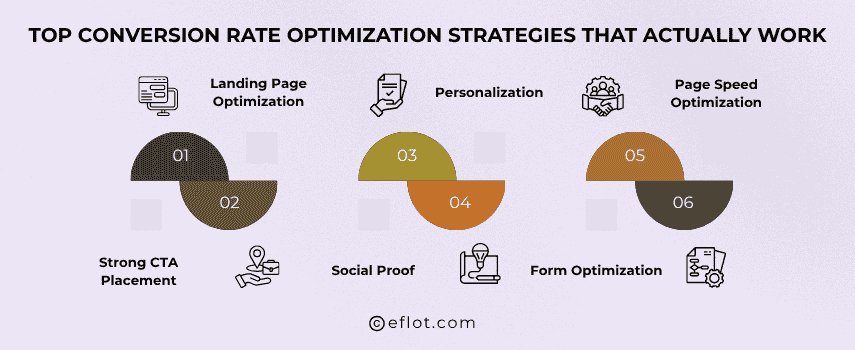
Top Conversion Rate Optimization Strategies That Actually Work
-
Landing Page Optimization: Clear headlines, focused messaging, and minimal distractions.
-
Strong CTA Placement: Visible, action-driven CTAs improve engagement.
-
Personalization: Tailoring content based on user behaviour increases relevance.
-
Social Proof: Reviews, testimonials, and case studies build trust.
-
Page Speed Optimization: Faster websites lead to better user experience and conversions.
-
Form Optimization: Reducing fields improves completion rates.
These are essential elements of website conversion optimization.
Real Examples of CRO Improving Sales (India)
ICICI Prudential Life (BFSI)
ICICI Prudential Life already had strong website traffic but struggled with converting visitors into leads for retirement and annuity plans.
With CRO-led improvements focused on:
-
Improved user journey
-
Optimized lead capture flow
Result:
-
45% increase in conversion rate
-
Significant improvement in organic lead generation
ACT Fibernet (Telecom - India)
ACT Fibernet wanted to improve conversions from search campaigns across different cities and user intents.
They implemented:
-
City-specific landing pages
-
Keyword-level personalization
-
CTA testing across segments
Result:
-
25% increase in customer acquisitions
Tools Used by Conversion Rate Optimisation Experts
-
Google Analytics – user behaviour tracking
-
Heatmap tools – visual interaction insights
-
A/B testing tools – experiment management
-
Session recordings – real user journey analysis
Tools provide data, but results depend on how insights are used.
When Should You Hire a Conversion Rate Optimisation Expert?
Businesses should consider CRO when:
-
Traffic is increasing but sales are not
-
Marketing costs are rising without ROI
-
Users are dropping off at key stages
-
There is no clarity on why conversions are low
These are clear signals that optimization is required.
How to Start Improving Your Conversion Rate Today
Start by identifying where you are losing users, not by changing everything at once. Look at your key landing pages and check if users clearly understand what you offer within the first few seconds. If the value is not obvious, conversions will drop.
Next, focus on your CTAs. They should be visible, specific, and guide users toward a clear action. If users hesitate or don’t know what to do next, they leave.
Then review your user journey. Check for friction points like slow loading pages, complicated forms, or too many steps. Even small delays or extra effort can reduce conversions.
Finally, build trust where decisions happen. Add testimonials, proof, or reassurance near CTAs so users feel confident taking action. In many cases, partnering with the right digital marketing agency helps bring an external, data-driven perspective to identify these gaps more effectively and implement structured improvements.
Improving conversion rate starts with fixing what blocks the user, not redesigning everything.
Sales growth is not always about bringing more visitors. In many cases, the real opportunity lies in improving how effectively existing traffic converts. A structured, data-driven approach helps businesses identify gaps, reduce friction, and turn user interest into real outcomes. When done consistently, conversion rate optimization becomes a strong driver of sustainable growth.
Digital Marketing services in Other Locations in India
Bangalore | Hyderabad | Chennai | Pune | Ahmedabad | Coimbatore | Mumbai | Kolkata | Patna | Amritsar | Indore | Kozhikode | Trivandrum | Jaipur | Nagpur | Gwalior | Dehradun | Noida | Vizag | Raipur | Agra | Gurgaon | Madurai | Udaipur | Thrissur |