
















What Is Organic SEO and How to Get Started?
Learn what Organic SEO is and how to start optimizing your website for free traffic, better search rankings, and long-term online success.

Businesses often face the challenge of gaining visibility without spending endlessly on ads. That’s where Organic SEO comes in as a game-changer. Unlike paid advertising, Organic SEO focuses on earning visibility in search engines through quality content, strategic keywords, and user-friendly websites. It’s about building a foundation that keeps delivering results long after the work is done.
When I first started working with clients as a digital marketing professional, many were overly dependent on paid ads for their traffic. One e-commerce client, in particular, saw a significant part of their budget being swallowed by ad campaigns with no lasting impact. I suggested a shift in focus to Organic SEO, and while they were hesitant at first, the results spoke for themselves. Within six months, their organic traffic doubled, and they started seeing consistent sales without depending on constant ad spend. The transformation wasn’t just about rankings it was about building trust with their audience. Here I will share what Organic SEO is, why it’s vital for your business, and how you can get started step by step.
What Is Organic SEO?
Organic SEO (Search Engine Optimization) refers to the process of improving a website’s visibility in search engine results pages (SERPs) without relying on paid advertising. It focuses on optimizing your website to rank higher for specific keywords by aligning with search engine algorithms. Organic Search includes strategies such as keyword optimization, creating high-quality content, building backlinks, and ensuring a user-friendly experience. The ultimate goal is to drive consistent, unpaid traffic to your site over time.
Why Is Organic SEO Important?
-
Cost-Effective Marketing:
Unlike paid ads, SEO does not require a continuous budget to maintain visibility. Once your website starts ranking, the traffic comes in without additional ad spend. -
Builds Trust and Credibility:
Users trust organic search results more than paid ads. Ranking organically signifies that your site is relevant and authoritative. -
Long-Term Results:
Organic Search delivers sustainable results, unlike paid campaigns that stop working as soon as the budget ends. It creates a solid foundation for consistent traffic growth. -
Enhances User Experience:
Many elements of SEO, such as site speed and mobile optimization, also improve the overall user experience, leading to better engagement. -
Drives Targeted Traffic:
Organic Search targets specific search terms, ensuring that the visitors coming to your site are genuinely interested in your products or services.
How Does Organic SEO Work?
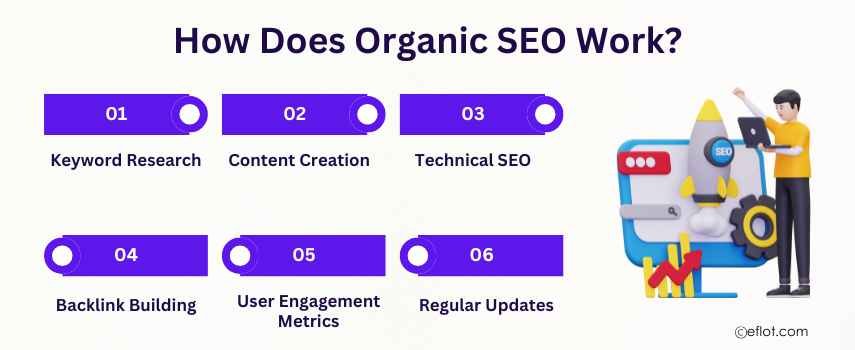
Organic SEO works by aligning your website with search engine algorithms, primarily Google’s. Here’s a breakdown of the process:
-
Keyword Research:
Identifying the search terms your target audience uses and strategically integrating them into your website content. -
Content Creation:
Developing valuable and engaging content that answers user queries and matches search intent. -
Technical SEO:
Ensuring your site is technically sound with fast load times, mobile responsiveness, and proper indexing. -
Backlink Building:
Gaining high-quality links from other reputable sites, signals to search engines that your site is trustworthy. -
User Engagement Metrics:
Factors like time spent on the page, click-through rate (CTR), and bounce rate indicate to search engines whether your content is valuable. -
Regular Updates:
Organic SEO is an ongoing process, requiring regular updates to content and strategies to maintain rankings as algorithms evolve.
How to Optimize Your Website for Organic SEO
1. Conduct Keyword Research
-
Use tools like Google Keyword Planner or Ahrefs to find relevant keywords with a balance of search volume and competition.
-
Focus on long-tail keywords that reflect user intent, such as “affordable handmade jewelry” instead of just “jewelry.”
2. Create High-Quality Content
-
Develop content that answers user questions and solves problems.
-
Incorporate keywords naturally into headings, subheadings, and body text.
-
Update content regularly to keep it relevant.
3. Optimize On-Page SEO
-
Use descriptive and keyword-rich title tags and meta descriptions.
-
Include headers (H1, H2, H3) to structure your content.
-
Add alt text to images for better accessibility and SEO.
4. Improve Technical SEO
-
Ensure fast load times by compressing images and using a reliable hosting provider.
-
Make your site mobile-friendly with a responsive design.
-
Create a clean URL structure and submit an XML sitemap to search engines.
5. Build Backlinks
-
Reach out to authoritative websites for guest posting opportunities.
-
Create shareable content, such as infographics or case studies, to attract natural backlinks.
-
Use social media to amplify your content’s reach.
6. Monitor Performance
-
Use tools like Google Analytics and Google Search Console to track your rankings, traffic, and user behavior.
-
Adjust strategies based on performance data.
How Long Does It Take for Organic SEO to Work?
The results of Organic Search are not immediate but are long-lasting. Typically, you can expect to see noticeable changes in:
-
3-6 Months:
For less competitive keywords, you may start ranking and seeing traffic growth within this time frame if your site is well-optimized. -
6-12 Months:
For more competitive industries or keywords, achieving significant rankings and traffic takes longer as you build authority and trust. -
Ongoing:
SEO is a continuous process. Even after achieving good rankings, maintaining them requires regular updates, fresh content, and monitoring.
Factors that influence how long it takes include:
-
Competition in Your Niche: More competitive industries take longer to rank in.
-
Current State of Your Website: Sites with technical issues or poor content will need more time for optimization.
-
Consistency in Efforts: Regular updates, content creation, and backlink building speed up results.
Case Studies
Case Study1:
A local fitness studio, "FitLife Gym," struggled to attract new members despite offering competitive pricing and state-of-the-art equipment. They lacked an online presence and ranked poorly on search engines, which made it difficult for potential customers to find them.
Challenges:
-
Poor visibility in local search results.
-
Lack of engaging and optimized content.
-
No reviews or online credibility, affecting trust among potential members.
Solutions:
To tackle the fitness studio’s challenges, a comprehensive Organic SEO strategy was implemented. The first step was to optimize the studio’s Google My Business profile, ensuring it included high-quality photos, accurate business hours, and a clickable location pin for easy navigation. This helped improve the studio’s visibility in local searches. Simultaneously, keyword research identified relevant terms such as “best fitness studio in New York” and “personal training near me,” which were then strategically integrated into the website’s content and meta descriptions.
Case Study2:
An e-commerce store, "PawPerfect," specializing in organic pet food and supplies, faced difficulty generating sales through organic channels. Their primary traffic came from paid ads, which resulted in high acquisition costs and unsustainable growth.
Challenges:
-
Overdependence on paid campaigns for traffic.
-
Low organic visibility for key product categories.
-
The poorly structured website impacted user experience and conversions.
Solution:
For the online pet supplies store, the SEO team devised a focused plan to reduce dependence on paid ads and enhance organic visibility. The process started with in-depth keyword research to target high-intent phrases like “natural dog food delivery” and “organic cat toys.” These keywords were incorporated into product category pages, meta titles, and descriptions to improve search rankings.
Organic SEO is a powerful, long-term strategy that helps businesses build visibility, credibility, and authority in the digital environment. By focusing on quality content, keyword optimization, technical SEO, and backlink building, you can drive consistent, cost-effective traffic to your website. Avoid common pitfalls, track your progress, and make continuous improvements to your strategy. Whether you’re a small business or a large enterprise, investing in Organic SEO will yield sustainable growth and success. Start today, and watch your organic rankings.
Digital Marketing services in Other Locations in India
Bangalore | Hyderabad | Chennai | Pune | Ahmedabad | Coimbatore | Mumbai | Kolkata | Patna | Amritsar | Indore | Kozhikode | Trivandrum | Jaipur | Nagpur | Gwalior | Dehradun | Noida | Vizag | Raipur | Agra | Gurgaon | Madurai | Udaipur | Thrissur |