




















What Is a CPA In Digital Marketing? A Beginner’s Guide
Learn what CPA in digital marketing means, how it works, and why it's essential for creating cost-effective campaigns that deliver real results.

Businesses are always looking for efficient ways to measure their marketing efforts and maximize ROI. Among the many metrics available, CPA in Digital Marketing (Cost Per Acquisition) stands out as a performance-driven model that directly ties marketing costs to actionable outcomes. For businesses and marketers alike, understanding how CPA in Digital Marketing works is crucial to creating campaigns that deliver measurable results and value.
As a digital marketing specialist, I’ve worked with clients who were initially overwhelmed by the complexity of online advertising. One of my clients, a budding e-commerce brand, was struggling to make sense of rising ad costs with no clear idea of whether their campaigns were delivering results. Once we implemented a CPA in the Digital Marketing model, they could see the actual cost of each new customer acquisition. This insight not only optimized their campaigns but also significantly improved their ROI. Here I will share what CPA in Digital Marketing means, how it works, and why it’s an essential metric for beginners and experts alike. Whether you’re new to digital marketing or looking to refine your strategy, understanding CPA will help you make smarter, data-driven decisions for your campaigns.
What Is a CPA In Digital Marketing?
CPA (Cost Per Acquisition) is a performance-based pricing model in digital marketing where advertisers pay for a specific action, such as a purchase, lead sign-up, or app download. Unlike other models like CPC (Cost Per Click) or CPM (Cost Per Thousand Impressions), CPA ensures that you’re paying only when a desired action is completed.
For instance, if you’re running an e-commerce campaign to sell a product and your CPA is ₹200, this means you’re spending ₹200 to acquire one customer who completes a purchase.
Why Is CPA Important in Digital Marketing?
CPA plays a critical role in digital marketing for several reasons:
1. Accountability for Ad Spend:
CPA ensures that advertisers pay only for completed actions, making it a highly accountable and result-oriented model.
2. Aligns Marketing Goals with Business Objectives:
Whether the goal is to generate sales, leads, or app downloads, CPA allows businesses to track the direct impact of their advertising efforts.
3. Drives Campaign Optimization:
Tracking CPA encourages marketers to refine their strategies, such as improving ad copy, targeting the right audience, and enhancing landing page designs.
4. Ensures Measurable Success:
CPA provides clear data on the cost of acquiring a customer or lead, helping businesses understand the effectiveness of their campaigns and allocate budgets efficiently.
5. Supports Scalability:
As businesses identify successful CPA campaigns, they can scale up their efforts to maximize results while keeping costs under control.
What Are the 3 Categories of CPA in Digital Marketing?
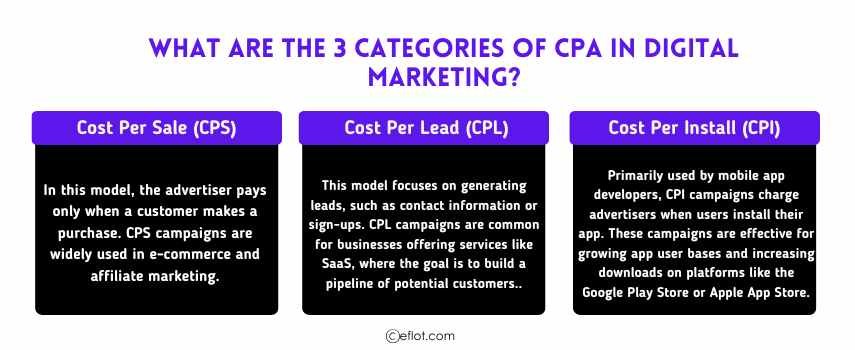
CPA in digital marketing can be categorized into three main types, each catering to different campaign objectives:
1. Cost Per Sale (CPS):
In this model, the advertiser pays only when a customer makes a purchase. CPS campaigns are widely used in e-commerce and affiliate marketing. For instance, a clothing brand running a CPS campaign might pay an affiliate a commission for every sale generated through their referral link.
2. Cost Per Lead (CPL):
This model focuses on generating leads, such as contact information or sign-ups. CPL campaigns are common for businesses offering services like SaaS, where the goal is to build a pipeline of potential customers. Advertisers pay when users fill out a lead form or subscribe to a newsletter.
3. Cost Per Install (CPI):
Primarily used by mobile app developers, CPI campaigns charge advertisers when users install their app. These campaigns are effective for growing app user bases and increasing downloads on platforms like the Google Play Store or Apple App Store.
Each category of CPA allows businesses to align their campaigns with specific goals, ensuring focused efforts and better ROI.
How Does CPA Work?
CPA (Cost Per Acquisition) works on a performance-based advertising model, where advertisers pay only when a specific action is completed. These actions can vary based on the business's goals, such as a purchase, lead form submission, app download, or newsletter subscription.
Here’s how CPA typically functions in a campaign:
-
Setting a Defined Goal:
The advertiser identifies a desired action, such as a sale or sign-up, that aligns with their marketing objectives. -
Creating Ads on CPA Platforms:
Platforms like Google Ads, Facebook Ads, and affiliate networks allow advertisers to set up CPA campaigns targeting specific audiences. -
Tracking User Behavior:
Advanced tools like Google Analytics, Facebook Pixel, or affiliate tracking systems monitor user actions to confirm successful conversions. -
Paying for Results:
The advertiser is charged only when the defined action is completed, ensuring that every penny spent directly contributes to achieving tangible results.
Benefits of CPA in Marketing
CPA is one of the most advantageous advertising models for businesses due to its focus on performance and results. Here are the key benefits:
1. Cost Efficiency:
With CPA, you pay only when a desired action is completed, ensuring that your advertising budget is spent effectively. This reduces wasted spend and ensures every dollar contributes to measurable outcomes.
2. Higher ROI:
Since CPA focuses on specific actions like sales or leads, it delivers a clear picture of how much revenue or value is generated per dollar spent. This helps businesses achieve a higher return on investment.
3. Risk Minimization:
Unlike CPM (Cost Per Thousand Impressions) or CPC (Cost Per Click), where costs accrue regardless of outcomes, CPA campaigns charge only for successful actions, minimizing financial risks.
4. Performance-Driven Campaigns:
CPA encourages advertisers to create high-quality ads and optimize their campaigns for conversions, leading to better performance and audience engagement.
5. Flexibility Across Goals:
Whether your objective is generating leads, driving app installs, or boosting sales, CPA campaigns can be tailored to meet diverse marketing goals.
How Is CPA Calculated?

Calculating CPA is straightforward, but understanding it is crucial for campaign optimization. The formula is:
CPA = Total Ad Spend ÷ Total Conversions
Example Calculation:
Suppose you spent ₹20,000 on a CPA campaign and generated 200 purchases. The CPA would be:
CPA = ₹20,000 ÷ 200 = ₹100
This means it costs ₹100 to acquire one customer or achieve one conversion.
Case Studies
Case Study 1:
FashionNova, a mid-sized e-commerce brand specializing in trendy apparel, was struggling to scale its online sales despite having a well-optimized website and high-quality products. They faced challenges in attracting high-intent customers and reducing ad spend wastage.
Challenges:
-
High Advertising Costs: Rising costs from CPC campaigns with low conversion rates.
-
Low Conversion Rates: Traffic to the website wasn’t converting into purchases effectively.
-
Inefficient Targeting: Campaigns were not reaching the most relevant audience.
Solution:
To address FashionNova’s challenges, the partnered digital marketing agency implemented a tailored CPA-based strategy focusing on driving conversions and optimizing ad spend. The campaign began with targeted Google Ads, leveraging high-intent keywords like "affordable party dresses" and "trendy women’s clothing." This ensured the ads reached users actively searching for similar products, resulting in more qualified traffic.
Case Study2:
CloudEase CRM, a SaaS startup offering cloud-based CRM solutions for small businesses, needed to increase qualified leads for its free trial program. Despite investing in CPC campaigns, the company struggled with low lead quality and high acquisition costs.
Challenges:
-
Poor Lead Quality: Many leads generated were irrelevant or uninterested in upgrading to the paid plan.
-
High Cost Per Lead: Acquisition costs were not sustainable for long-term growth.
-
Limited Brand Awareness: Struggled to position itself as a trusted CRM provider in a competitive market.
Solution:
To generate high-quality leads and lower acquisition costs, CloudEase CRM adopted a CPA-focused campaign designed to attract decision-makers in their target audience. The strategy began with LinkedIn Ads, targeting small and medium-sized business owners with ads emphasizing the benefits of their free trial. By using LinkedIn’s precise audience segmentation, the campaign reached professionals most likely to benefit from their CRM solution.
Understanding CPA in Digital Marketing is essential for running efficient, results-driven campaigns. By focusing on measurable outcomes and optimizing for cost per acquisition, businesses can achieve higher ROI while reducing advertising waste. Whether you’re a beginner or a seasoned marketer, CPA offers a transparent and performance-focused approach to digital advertising. Start experimenting with CPA campaigns, and let data guide your path to online success.
Digital Marketing services in Other Locations in India
Bangalore | Hyderabad | Chennai | Pune | Ahmedabad | Coimbatore | Mumbai | Kolkata | Patna | Amritsar | Indore | Kozhikode | Trivandrum | Jaipur | Nagpur | Gwalior | Dehradun | Noida | Vizag | Raipur | Agra | Gurgaon | Madurai | Udaipur | Thrissur |