
















What Does an SEO Agency Do
Understand the role of an SEO agency in boosting website visibility, driving traffic, and improving search rankings with simple strategies and expert insights.
When someone asks, “What does an SEO agency do?” the answer often goes beyond simply “getting your website to rank on Google.” As a digital marketer, I’ve worked alongside SEO agencies and have seen personally the many layers involved in optimizing a site for search engines. It’s about creating strategies that make a business more visible, attract the right audience, and ultimately drive growth through search.
In simple terms, an SEO agency takes on the work of ensuring a website shows up in search results when people are looking for related products or services. But there’s a lot more happening behind the scenes. SEO agencies are experts in understanding Google’s algorithms, keyword research, on-page and off-page optimization, content creation, and so much more. Their role is to build a roadmap that helps a business rank higher, improve website traffic, and, most importantly, deliver results that align with their goals.
I’ll share with you what an SEO agency actually does, from analyzing website performance to implementing technical changes, creating content, building links, and everything in between. Whether you’re considering working with an SEO agency or just want to understand how they can impact your business.
1. Initial Website and SEO Audit
Before diving into any strategy, an SEO agency begins by auditing a client’s website to identify its current SEO status. This audit includes examining:
- Site architecture and user experience (UX): How easy is it to navigate the site?
- On-page SEO factors: Are keywords optimized? Are meta tags, headers, and URLs effective?
- Technical SEO aspects: Are there broken links, slow load times, or issues with mobile-friendliness?
- Content quality and relevance: Does the content meet user intent and offer value?
- Backlink profile: What is the quality and quantity of links pointing to the site?
The audit serves as a foundation, helping the agency identify gaps and opportunities for improvement. This in-depth analysis allows them to create a customized SEO plan based on the client’s specific needs.
2. Competitor Analysis
Understanding what competitors are doing can reveal valuable insights into what works within a particular industry. SEO agencies perform competitor analysis to identify:
- Keyword targets: What keywords are competitors ranking for?
- Content strategy: What type of content do they produce, and how do they structure it?
- Link-building tactics: Where do they get their backlinks, and what sites are linking to them?
- On-page optimizations: How do they structure their pages, and what keywords do they emphasize?
This research allows SEO agencies to reverse-engineer successful tactics and discover opportunities to outperform competitors.
3. Keyword Research and Strategy
Keywords are at the core of any SEO strategy, as they reflect the search terms potential customers use. An SEO agency conducts comprehensive keyword research to identify:
- Primary keywords: Highly relevant terms that align closely with the business’s products or services.
- Secondary keywords: Supporting terms that add context and depth.
- Long-tail keywords: Phrases that may have lower search volumes but are highly specific and conversion-friendly.
SEO agencies don’t just select keywords based on popularity; they evaluate each keyword’s search volume, competition, and potential ROI. From this research, they build a keyword strategy that aligns with the client’s goals, target audience, and content approach.
4. On-Page Optimization
On-page SEO focuses on optimizing elements directly on the website to improve rankings and user experience. Key areas that an SEO agency will address include:
- Meta titles and descriptions: Crafting clear, engaging titles and descriptions that improve click-through rates.
- Headings and subheadings: Structuring content to enhance readability and relevance.
- URL structure: Ensuring URLs are clean, descriptive, and keyword-rich.
- Image optimization: Compressing images, adding alt text, and using appropriate file names.
- Internal linking: Creating a logical flow of internal links to keep visitors engaged and distribute SEO authority across pages.
- Schema markup: Adding structured data to help search engines understand and display relevant information about the website.
On-page optimization ensures that each page of the site is aligned with SEO best practices and enhances both visibility and user experience.
5. Content Creation and Optimization
Content is king in SEO. An SEO agency helps businesses develop a content strategy that attracts, engages, and converts visitors. This process includes:
- Content creation: Writing blog posts, articles, product descriptions, and other forms of content.
- Content optimization: Updating existing content with relevant keywords, refreshing outdated information, and enhancing readability.
- Content promotion: Leveraging social media, guest posts, and other channels to increase content visibility.
- User intent: Crafting content that meets the audience's needs and search intent, increases the chances of ranking well.
Well-executed content strategies help businesses build authority, improve organic traffic, and offer valuable information to their audience.
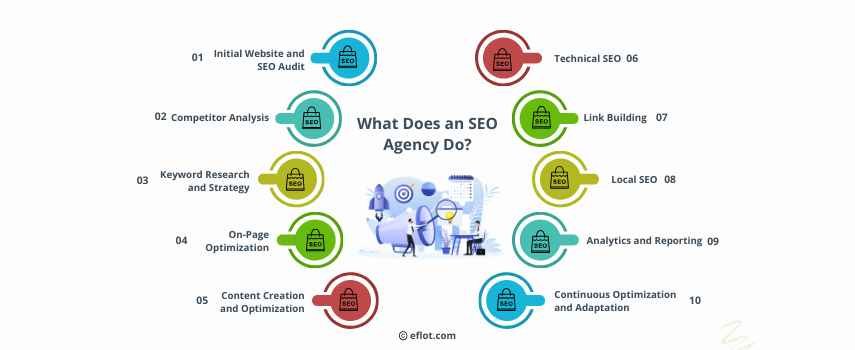
6. Technical SEO
Technical SEO ensures that a website meets the technical requirements of search engines, enabling it to be crawled, indexed, and ranked effectively. SEO agencies handle the technical aspects such as:
- Site speed optimization: Enhancing load times to reduce bounce rates and improve user experience.
- Mobile optimization: Ensuring the site is responsive and provides a seamless experience across devices.
- XML sitemaps: Creating and submitting a sitemap to guide search engine crawlers.
- Robots.txt files: Controlling which pages should and shouldn’t be crawled.
- Canonicalization: Preventing duplicate content issues by designating preferred versions of pages.
A well-optimized site is easier for search engines to index and provides a better user experience, which directly impacts rankings.
7. Link Building
Backlinks, or links from other websites pointing to your site, are a critical ranking factor. SEO agencies execute link-building strategies to increase the authority of their client’s websites. Common techniques include:
- Guest blogging: Writing articles for reputable websites in exchange for a backlink.
- Outreach: Reaching out to websites in similar industries to establish relationships and acquire links.
- Broken link building: Finding broken links on other sites and suggesting the client’s content as a replacement.
- Resource page link building: Requesting placement on “resource” pages relevant to the industry.
Link building is essential but challenging, as it requires building relationships with other sites and adhering to best practices to avoid penalties.
8. Local SEO (for Local Businesses)
For businesses that operate in specific locations, local SEO is crucial. SEO agencies use various tactics to improve visibility in local searches, such as:
- Google My Business (GMB) optimization: Setting up and optimizing the business profile on GMB.
- Local citations: Ensuring consistent business information (name, address, phone) across local directories.
- Reviews management: Encouraging positive customer reviews and responding to feedback.
- Location-specific keyword optimization: Targeting keywords with local intent, like “coffee shop in [city].”
Local SEO is vital for businesses that rely on in-person customers, as it increases their chances of appearing in local searches and maps.
9. Analytics and Reporting
One of the most significant advantages of working with an SEO agency is the data-driven insights they provide. SEO agencies track and report on key performance indicators (KPIs) such as:
- Organic traffic: Monitoring the number of visitors arriving through search engines.
- Keyword rankings: Tracking progress on keyword rankings over time.
- Conversion rates: Measuring how well traffic is turning into leads or sales.
- Bounce rates: Analyzing how long users stay on the site and where they exit.
- Backlink profile: Tracking new and lost backlinks.
Reports help clients understand the ROI of their SEO investment and guide future strategies. Agencies often use tools like Google Analytics, SEMrush, or Ahrefs to provide accurate data and actionable insights.
10. Continuous Optimization and Adaptation
SEO is not a one-time task; it requires ongoing adjustments. SEO agencies monitor algorithm updates, emerging trends, and competitors’ activities to stay ahead. They continually optimize the website by:
- Refreshing content to keep it relevant.
- Testing and updating keywords to reflect new search behaviors.
- Adapting to algorithm updates to avoid penalties and maintain rankings.
- Testing new strategies based on data and performance analysis.
Continuous optimization is critical because the digital landscape changes constantly, and staying proactive helps maintain or improve rankings.
An SEO agency provides a comprehensive suite of services, from initial audits to ongoing optimization. By taking care of the technical details, creating content, building links, and monitoring performance, they help businesses grow their online presence, reach more customers, and ultimately increase revenue. Working with an SEO agency allows businesses to focus on their core activities while experts handle the complex world of search engine optimization. If your business is looking to improve its visibility and rankings, partnering with an SEO agency could be the strategic move you need to thrive in the digital marketplace.
Digital Marketing services in Other Locations in India
Bangalore | Hyderabad | Chennai | Pune | Ahmedabad | Coimbatore | Mumbai | Kolkata | Patna | Amritsar | Indore | Kozhikode | Trivandrum | Jaipur | Nagpur | Gwalior | Dehradun | Noida | Vizag | Raipur | Agra | Gurgaon | Madurai | Udaipur | Thrissur |