

















Top Email Marketing Tools for Growing Startups
Drive growth and build lasting customer relationships with the best email marketing tools for startups. Simplify campaigns, boost engagement, and grow faster.

Starting a business is exciting, but it also comes with a lot of challenges. One of the biggest difficulties for startups is reaching the right audience and turning them into loyal customers. With so many marketing options out there, it can be overwhelming to choose the most effective strategy. However, one method that has consistently delivered results for startups is email marketing. It’s cost-effective, easy to use, and highly effective in building relationships with customers. But to truly make the most of email marketing, startups need the right tools to manage campaigns, track performance, and engage their audience effectively.
From my experience as a digital marketing specialist working with numerous startups, I’ve seen how the right email marketing tools can transform a business. I’ve watched startups go from struggling to gain influence to seeing their sales and customer engagement rise simply by using the right tools. These tools don’t just help send emails they automate tasks, personalize content, and provide valuable insights into what’s working and what’s not. Whether it’s scheduling emails, segmenting the audience, or tracking campaign results, having the right email marketing tools in place can save time and money while delivering impressive results. Here I’ll share results on how these tools can help streamline your marketing efforts, grow your audience, and ultimately drive business growth.
What is Email Marketing?
Email marketing is a digital marketing strategy that involves sending emails to a group of people to promote products, share news, or build relationships with customers. It is a direct and personal way to communicate with your audience and can be used for various purposes, including:
-
Promoting products or services
-
Sharing company news or updates
-
Offering discounts and special deals
-
Building customer loyalty
-
Educating customers about industry trends
Unlike social media marketing, where algorithms can limit your reach, email marketing gives you direct access to your audience’s inbox. This makes it one of the most effective marketing channels for startups aiming to grow their customer base.
How Does Email Marketing Work?
Email marketing works by sending targeted and personalized messages to subscribers who have opted in to receive communications from your business. Here’s a step-by-step breakdown of how email marketing works:
1. Building an Email List
Start by gathering email addresses through sign-up forms, and landing pages, or offering free resources (like eBooks or discounts) in exchange for email subscriptions.
2. Segmenting Your Audience
Not all subscribers are the same. By segmenting your audience based on their interests, behavior, or demographics, you can send more relevant and personalized content.
3. Creating Engaging Content
Craft well-designed emails with compelling subject lines, engaging content, and clear calls-to-action (CTAs). This encourages subscribers to open, read, and take action.
4. Automating Campaigns
Automation allows startups to send timely and relevant emails without manual effort. For example, welcome emails for new subscribers or follow-up emails for abandoned carts can be automated.
5. Tracking and Analyzing Results
Monitoring key metrics like open rates, click-through rates, and conversions helps measure the success of your campaigns. These insights allow you to refine your strategies for better results.
How to Choose the Right Email Marketing Tool
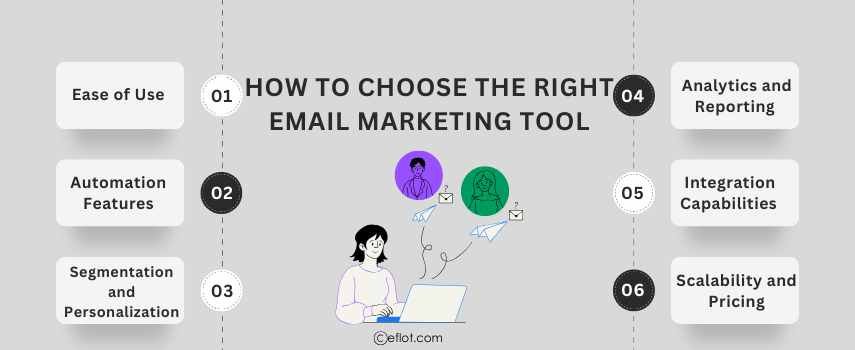
With so many email marketing tools available, choosing the right one can be challenging. Here are some factors startups should consider:
1. Ease of Use
Startups need a user-friendly platform that doesn’t require technical expertise. Look for tools with drag-and-drop editors and pre-designed templates to simplify email creation.
2. Automation Features
Automation is essential for saving time and maintaining consistent communication. Choose tools that offer automated workflows for welcome emails, abandoned carts, and follow-ups.
3. Segmentation and Personalization
The ability to segment your audience and personalize emails is critical. Tools should allow you to categorize subscribers and tailor content based on their preferences.
4. Analytics and Reporting
Detailed analytics help track performance and identify what’s working. Opt for tools that provide insights into open rates, click-through rates, and conversions.
5. Integration Capabilities
Your email marketing tool should integrate seamlessly with other tools like CRM software, e-commerce platforms, and social media for a cohesive marketing strategy.
6. Scalability and Pricing
Startups should look for affordable tools that offer scalability. Free plans are great for getting started, but ensure the tool can grow with your business.
Top 6 Email Marketing Tools for Startups
1. Mailchimp
Mailchimp is one of the most popular email marketing tools for startups. It offers a user-friendly interface, automation features, and detailed analytics. Its free plan makes it ideal for startups with small lists.
Key Features:
-
Drag-and-drop email builder
-
Audience segmentation
-
Automation workflows
-
Integration with e-commerce platforms
2. HubSpot Email Marketing
HubSpot offers a free email marketing tool that integrates with its CRM. This makes it perfect for startups looking to manage customer relationships while running effective campaigns.
Key Features:
-
Free CRM integration
-
Customizable templates
-
Advanced analytics
-
Automation features
3. Sendinblue
Sendinblue is a versatile tool that combines email and SMS marketing. It’s great for startups that want to diversify their marketing channels.
Key Features:
-
Email and SMS marketing
-
Marketing automation
-
Advanced segmentation
-
A/B testing
4. Constant Contact
Known for its excellent customer support, Constant Contact is a great tool for startups new to email marketing. It offers easy-to-use design tools and marketing automation.
Key Features:
-
Simple drag-and-drop editor
-
Event marketing features
-
List-building tools
-
Social media integrations
5. ActiveCampaign
ActiveCampaign is ideal for startups looking for advanced automation and customer experience tools. It allows highly personalized email marketing campaigns.
Key Features:
-
Powerful automation workflows
-
CRM integration
-
Predictive analytics
-
Email Segmentation
6. ConvertKit
ConvertKit is designed for creators and startups that rely on content marketing. It’s excellent for building email lists and automating email sequences.
Key Features:
-
Automation for email sequences
-
Subscriber tagging and segmentation
-
Landing page and form builder
-
Clean and simple interface
7. ContactOut
ContactOut is ideal for sales, recruiting, and growth teams that need accurate, verified contact data fast. With its email finder and verification feature, It helps find professional email addresses and phone numbers so you can reach the right people with confidence.
Key Features:
- High-accuracy email finder and phone numbers
- Chrome extension for LinkedIn and web sourcing
- Bulk email lookup and enrichment
- ATS and CRM integrations
Why Email Marketing Tools Are Essential for Startups
1. Cost-Effective Marketing
Startups usually operate on tight budgets. Email marketing tools provide affordable solutions with free or low-cost plans, offering excellent ROI.
2. Direct Communication with Customers
Emails land directly in customers’ inboxes, providing a personal way to engage with them. This builds trust and strengthens customer relationships.
3. Measurable Results
With built-in analytics, startups can easily measure how their campaigns perform. This data helps improve future marketing efforts.
4. Time-Saving Automation
Automation features save time and effort, allowing startups to focus on growing their business while maintaining consistent communication.
5. Scalable Growth
As the startup grows, email marketing tools offer scalable features to handle larger audiences and more complex campaigns.
Case Studies
Case Study1:
UrbanStyle, a Bangalore-based fashion e-commerce startup, specializes in trendy and affordable apparel for young adults. Despite having a well-optimized website and an active social media presence, the startup struggled with low customer retention and high cart abandonment rates, which negatively impacted sales and overall growth.
Challenges:
-
High Cart Abandonment Rates: Customers frequently added items to their carts but didn’t complete purchases.
-
Low Customer Engagement: The brand struggled to engage customers beyond their first purchase, leading to limited repeat sales.
-
Lack of Automation: All promotional emails were manually sent, making it hard to scale and personalize campaigns.
Solutions:
To address these challenges, UrbanStyle adopted Mailchimp as its primary email marketing tool. First, they implemented automated cart isolation emails that triggered personalized reminders to customers who left items in their carts. These emails included limited-time discount codes to incentivize purchases.
Case Study2:
FinMate, a Chennai-based SaaS startup, offers cloud-based accounting software tailored for small businesses. While they successfully attracted users with free trials, they struggled to convert those users into paying customers and retain them long-term.
Challenges:
-
Low Trial-to-Paid Conversion Rate: Many users signed up for the free trial but didn’t upgrade to a paid subscription.
-
Limited Customer Engagement: Users weren’t fully engaging with the platform’s features, reducing their perceived value of the product.
-
No Audience Segmentation: Generic email campaigns led to low engagement and missed opportunities for targeted communication.
Solutions:
To solve these issues, FinMate integrated ActiveCampaign into its marketing strategy. They started by setting up an automated onboarding email sequence to guide new users through the software. This series included tutorials, feature highlights, and tips to help users understand the platform’s value, making it easier for them to navigate and adopt the product.
Email marketing remains one of the most effective channels for startups to connect with their audience, build relationships, and drive growth. By using the right email marketing tools, startups can streamline their campaigns, personalize communication, and achieve measurable results. Whether you’re just starting or looking to scale, tools like Mailchimp, HubSpot, and Sendinblue offer features that cater to every stage of your business. By choosing a tool that aligns with your needs and following best practices, your startup can unlock the full potential of email marketing and stay ahead in a competitive market.
Digital Marketing services in Other Locations in India
Bangalore | Hyderabad | Chennai | Pune | Ahmedabad | Coimbatore | Mumbai | Kolkata | Patna | Amritsar | Indore | Kozhikode | Trivandrum | Jaipur | Nagpur | Gwalior | Dehradun | Noida | Vizag | Raipur | Agra | Gurgaon | Madurai | Udaipur | Thrissur |