






















The Key SEO Ranking Factors Your Business Needs!
Discover the power of SEO with the key ranking factors your business needs! Boost visibility, drive traffic, and grow your business. Start today!

Is your business struggling to rank on Google?
Are you wondering why your website isn’t getting the traffic it deserves despite your best efforts? Ranking factors in SEO are the key to improving your website's visibility and performance on search engines. With over 3.5 billion searches happening on Google every day, if your website doesn’t rank on the first page, you're missing out on potential customers.
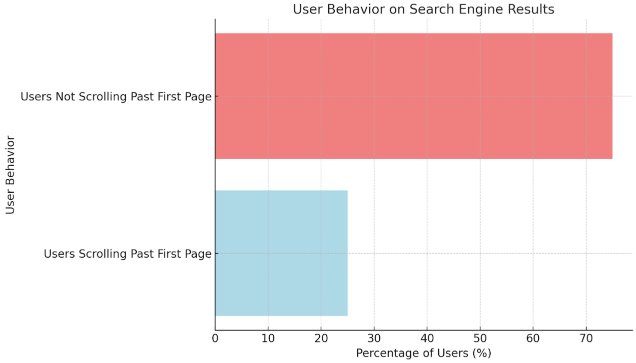
Studies show that 75% of users never scroll past the first page of search results. Understanding and optimizing the right ranking factors in SEO can make all the difference in boosting your online presence and driving traffic to your site.
A prime example of how focusing on ranking factors in SEO can transform a business is Moz, a leading SEO software company. When Moz first started, they struggled to get noticed in a competitive market. However, by focusing on content quality, building authoritative backlinks, and optimizing their site’s technical performance, they were able to climb to the top of search rankings.
Moz’s commitment to SEO ranking factors like creating in-depth, valuable content and fostering a strong backlink profile allowed them to rank for competitive keywords such as “SEO tools” and “SEO analytics.” As a result, Moz saw a significant increase in organic traffic, brand visibility, and sales, ultimately establishing itself as an industry leader.
What Are Ranking Factors in SEO?
Ranking SEO factors refer to the elements and signals that search engines like Google use to determine where a webpage should appear in search results. These factors include a variety of on-page and off-page criteria, such as website content, backlinks, page load speed, mobile optimization, and user experience. Google uses more than 200 ranking factors in its algorithm to rank websites, and staying on top of these factors is crucial for your business's success in the digital environment.
Key Ranking Factors in SEO That Matter for Your Business
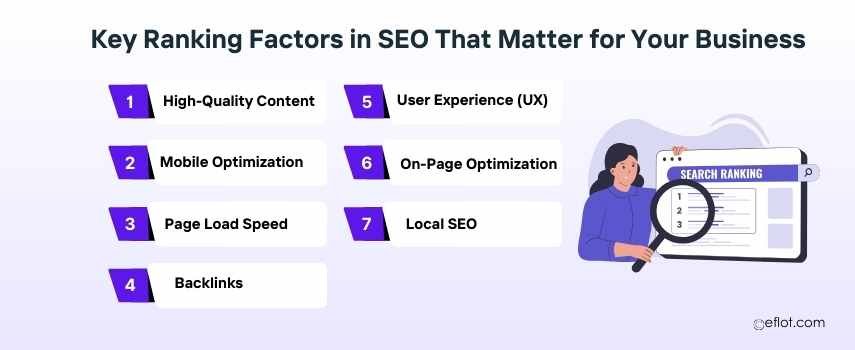
1. High-Quality Content
Content is still king when it comes to SEO. High-quality, relevant, and engaging content is crucial to improving your rankings on search engines. Google’s algorithms are designed to prioritize content that answers the user’s query effectively and provides value. When you publish well-researched, informative, and engaging content, your website becomes a trusted source of information, leading to better rankings.
Including targeted keywords naturally in your content helps search engines understand the topic of your page and match it to relevant searches. Moreover, updating old content and consistently adding fresh, high-quality content ensures your site remains relevant and ranks higher.
2. Mobile Optimization
Google uses mobile-first indexing, meaning it primarily uses the mobile version of your website for indexing and ranking. If your website isn’t mobile-friendly, you risk being penalized in search rankings.
3. Page Load Speed
Search engines, especially Google, take page speed into account when ranking websites. Page load speed is a critical factor for both SEO and user experience.
To optimize your page load speed, you should focus on compressing images, enabling browser caching, and minimizing the use of heavy scripts. A fast-loading website improves your chances of ranking higher and keeps users engaged for longer periods, which ultimately boosts conversions.
4. Backlinks
Backlinks, or external links pointing to your website, are one of the most influential ranking factors. Google views backlinks as a vote of confidence in the quality of your content. Websites with high-quality, authoritative backlinks tend to rank higher in search results.
Focus on earning backlinks from reputable sources within your industry by creating valuable content, building relationships with influencers, and promoting guest posts. The quality and relevance of backlinks matter more than the quantity, so always prioritize earning links from high-authority sites.
5. User Experience (UX)
User experience plays a significant role in SEO rankings. Google wants to provide its users with the best possible experience, so websites that are easy to navigate, have intuitive designs, and load quickly tend to rank higher. Metrics such as bounce rate, average time on site, and pages per session are indicators of a positive user experience.
6. On-Page Optimization
On-page SEO refers to the practices you implement directly on your website to improve its search ranking. This includes optimizing title tags, meta descriptions, headers, URL structure, and internal linking. A clean and organized URL structure that includes relevant keywords helps search engines understand what your page is about.
7. Local SEO
If you run a local business, local SEO is essential. Optimizing your website for location-based searches can significantly increase your visibility within your community. Google’s local pack often appears at the top of search results, and being part of that pack can drive more traffic to your business.
How to Stay on Top of SEO Ranking Factors
Businesses should regularly audit their websites' performance to maintain high rankings and ensure sustained growth. Tools like Google Analytics, Google Search Console, and Ahrefs can help monitor ranking factors in SEO and provide insights into areas for improvement.
Understanding and optimizing the ranking factors in SEO is crucial for your business’s success in the digital environment. By focusing on high-quality content, mobile optimization, site speed, backlinks, and user experience, you can improve your website’s visibility, attract more traffic, and ultimately increase conversions. SEO is a long-term strategy, and by continuously working on these factors, you’ll position your business for sustained growth.
Start optimizing today, and watch your business climb the ranks! Contact us at [email protected] for expert guidance on implementing a tailored SEO strategy.
Digital Marketing services in Other Locations in India
Bangalore | Hyderabad | Chennai | Pune | Ahmedabad | Coimbatore | Mumbai | Kolkata | Patna | Amritsar | Indore | Kozhikode | Trivandrum | Jaipur | Nagpur | Gwalior | Dehradun | Noida | Vizag | Raipur | Agra | Gurgaon | Madurai | Udaipur | Thrissur |