



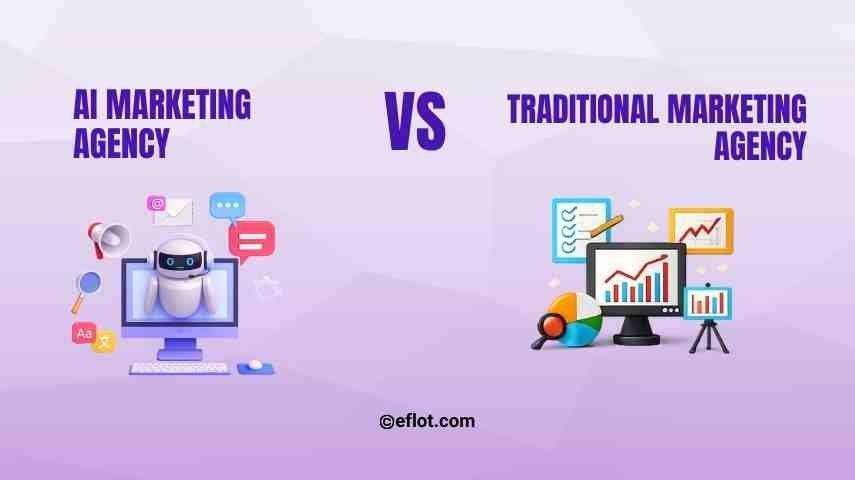
AI Marketing Agency vs Traditional Marketing Agency
AI Digital Marketing Agency uses data, automation, and real-time optimisation, while traditional agencies focus on creativity, strategy, and brand storytelling.
Every growth decision comes down to one question: who can generate better results with the budget you have?
Marketing leaders today are under pressure to show measurable ROI, faster customer acquisition, and smarter use of data. That pressure has changed how businesses choose their partners. The debate is no longer about creative versus digital. It is about precision versus process. Automation versus manpower. Data intelligence versus manual execution.
An ai digital marketing agency promises predictive insights, real-time optimisation, and scalable performance. A traditional marketing agency offers brand expertise, human creativity, and strategic depth built over decades.
If you are evaluating which model aligns with your revenue goals, customer acquisition targets, and long-term brand strategy, the difference matters more than ever.
What Is an AI Digital Marketing Agency?
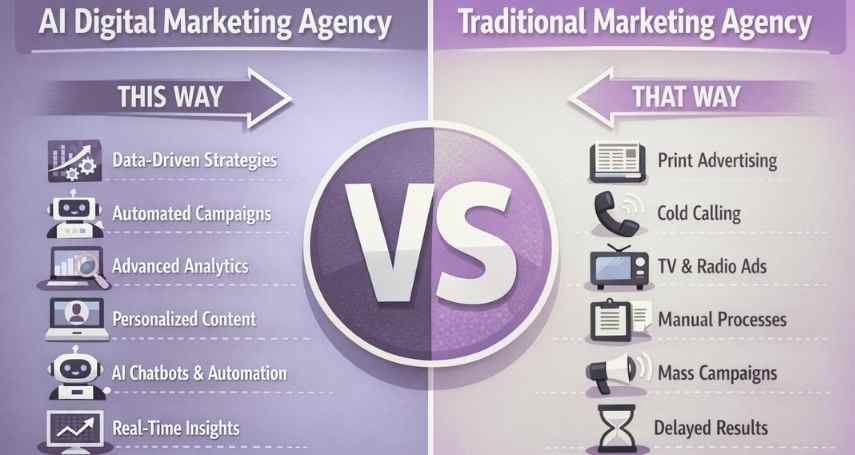
An ai digital marketing agency uses machine learning, automation, and advanced analytics to power marketing activities across channels. These agencies leverage data science to anticipate customer behaviour, personalise messaging, and optimise campaigns continuously.
AI digital marketing agency include automated campaign optimisation, predictive lead scoring, hyper-personalisation, real-time ad management, and data-driven strategy development. AI tools reduce manual workload and help deliver measurable results faster.
What is a Traditional Marketing Agency?
Traditional marketing agencies are staffed by strategists, creatives, account managers, and media buyers executing campaigns through human-led processes. They emphasise brand storytelling, relationship management, and strategic planning grounded in experience and intuition.
Typical services span creative development, media planning, content production, offline campaigns, and audience research executed without pervasive automation.
Key Differences Between AI and Traditional Marketing Agency
1. Approach to Data and Decision-Making
A core difference lies in how decisions are driven. AI marketing agencies use advanced algorithms and machine learning to analyse large datasets continuously. These systems detect patterns, forecast trends, and optimize campaigns automatically. This allows them to respond dynamically to performance signals across channels, often leading to more precise targeting and improved campaign effectiveness. Traditional agencies, by contrast, rely on human analysts and strategic teams to interpret data, which can be slower and more subjective.
Fast, data-driven decision cycles can improve campaign responsiveness and scalability, valuable for businesses prioritising measurable performance.
2. Speed and Operational Efficiency
AI digital marketing agencies automate repetitive tasks such as audience segmentation, bid optimisation, content testing, and reporting. These tasks, when automated, enable faster campaign launches and iterative improvements without significant manual intervention. Traditional agencies typically require longer lead times for planning, review, and manual optimisation cycles. As a result, execution timelines may span several weeks, especially for complex multi-channel strategies.
Faster execution matters for industries with time-sensitive goals, such as e-commerce launches, seasonal promotions, and rapid market entry.
3. Personalisation and Targeting Depth
One of the significant strengths of AI digital marketing agencies is their ability to personalise communications at scale. AI can generate thousands of message variations and deliver personalized experiences to micro-segments based on user behaviour, intent signals, and past interactions. Traditional agencies can personalise content but often face operational limits when scaling to large audiences because much of the work remains manual and resource-intensive.
High personalisation improves engagement and conversion rates, making this capability particularly relevant for brands with diverse or complex customer profiles.
4. Cost Structure and Pricing Model
AI digital marketing agencies often deliver leaner cost structures by automating labour-intensive tasks, potentially offering lower monthly costs and higher efficiency. Some agencies use subscription or performance-based pricing aligned with outcomes, reducing financial risk for clients. Traditional agencies usually operate with retainers and project-based fees tied to human hours, creative production, and campaign management efforts. These models can be higher cost, especially for comprehensive services involving creative development and strategic consulting.
Both models have valid cost considerations. AI agencies may incur technology and data integration costs, while traditional agencies may require longer contracts and higher creative production budgets.
5. Creative Strategy, Brand Narrative, and Human Insight
Traditional agencies have a clear advantage in creative storytelling, brand identity development, and strategic counsel rooted in human experience. Human teams can interpret cultural nuance, emotional context, and strategic brand positioning, elements that AI systems still struggle to replicate reliably. AI tools can aid creative processes (e.g., draft generation or data-informed messaging), but the strategic framing and emotional resonance often depend on human insight.
For brands seeking deep emotional engagement or high-impact creative differentiation, human expertise remains a critical component.
6. Real-Time Optimisation and Analytics
AI digital marketing agencies continuously monitor campaign performance and adjust tactics in real time based on live signals. This capability drastically improves optimisation, helping reallocate budgets where performance is strongest and pause underperforming creatives immediately. Traditional agencies typically operate with periodic reporting cycles, using post-hoc analysis to guide future strategy rather than real-time refinement.
Real-time optimisation aligns with marketing goals where responsiveness to customer behaviour drives competitive advantage.
7. Scalability Across Channels and Markets
AI systems scale more efficiently across multiple channels and regions because automated workflows can handle complexity without a proportional increase in resource requirements. Traditional agencies can scale too, but doing so often necessitates expanding teams, coordinating additional specialists, and investing more time into regional or channel-specific strategies.
For businesses with global ambitions or multi-market campaigns, AI-enabled scalability can reduce operational overhead while maintaining performance.
8. Limitations and Balanced Realism
AI is not without limitations. It heavily depends on clean, structured data to perform well. If underlying customer data is incomplete, inaccurate, or poorly integrated, AI models may deliver suboptimal recommendations. Traditional agencies, with human analysts, may be better suited to interpreting ambiguous or incomplete datasets. Additionally, AI can generate generic creative outputs if not curated carefully, potentially diluting brand voice.
A hybrid approach, combining AI-powered execution with strategic human oversight often yields balanced results, optimising performance while preserving brand integrity.
AI and Traditional Marketing Agency: Which is Better?
The better choice depends on your growth objective and operational readiness. An ai digital marketing agency is suited for businesses that prioritise measurable performance, faster optimisation, and scalable customer acquisition. Through predictive analytics, automated campaign management, and data-driven targeting, a marketing agency can improve budget efficiency and accelerate performance outcomes, particularly for e-commerce, SaaS, and performance-focused brands.
A traditional marketing agency delivers strong creative direction, brand storytelling, and strategic positioning built on human expertise. This approach benefits companies focused on long-term brand equity, premium positioning, or complex offline campaigns.
If your priority is performance marketing, rapid testing, and continuous optimisation, an ai digital marketing agency aligns better. If brand building and emotional engagement are central to your strategy, traditional expertise adds value. The right decision connects directly to your business model, growth stage, and marketing goals.
How to Choose a Right Marketing Agency
Choose an AI Digital Marketing Agency If:
-
You need rapid growth and scalability
-
You want data-driven campaigns
-
Your business depends on real-time optimization
-
You’re targeting multiple segments or markets
-
Efficiency and measurable ROI are priorities
Choose a Traditional Marketing Agency If:
-
You require deep creative insight
-
Your campaigns depend on storytelling and emotional branding
-
Cultural nuance and human judgment are critical
-
You value long-term strategic partnership
Smart Move: Hybrid Approach
Many leading firms are moving toward a hybrid model that combines the analytical strength of an ai digital marketing agency by fixing low CTRs. AI systems handle large-scale data processing, predictive targeting, automated campaign optimization, and performance tracking. This improves efficiency, accuracy, and scalability across paid media, search, and content channels.
At the same time, human experts guide brand positioning, messaging tone, creative storytelling, and long-term growth strategy. This balance ensures campaigns remain performance-driven while staying aligned with brand identity and audience psychology. An ai marketing agency operating with human oversight can interpret insights responsibly, refine strategy thoughtfully, and adjust to market nuances that data alone may not capture.
For businesses seeking sustainable growth with measurable ROI, a hybrid approach offers both precision and perspective.
Ready to combine AI intelligence with strategy? Let’s discuss how to grow your business with AI-powered solutions combined with real-world experience.
Digital Marketing services in Other Locations in India
Bangalore | Hyderabad | Chennai | Pune | Ahmedabad | Coimbatore | Mumbai | Kolkata | Patna | Amritsar | Indore | Kozhikode | Trivandrum | Jaipur | Nagpur | Gwalior | Dehradun | Noida | Vizag | Raipur | Agra | Gurgaon | Madurai | Udaipur | Thrissur |