











AI in Advertising: How It's Transforming Marketing in 2026
AI in advertising helps brands analyze data, automate campaigns, improve targeting, and boost ROI with smarter optimization and faster creative production.
Artificial intelligence has become a practical driver of modern advertising strategy. Marketing teams use AI systems to analyze large datasets, automate campaign management, generate ad creatives, and deliver highly relevant messages to the right audience. In 2026, brands that integrate AI into advertising operations achieve faster campaign optimization, deeper audience insights, and stronger return on ad spend.
Key Takeaways
-
AI is widely adopted in marketing operations - According to a McKinsey global survey, more than 70% of organizations now use AI in at least one business function, including marketing and advertising.
-
AI improves advertising performance - Businesses using AI-powered optimization report ROI-driven results in conversion rates, engagement, and return on ad spend.
-
Generative AI accelerates ad production - Marketing teams use AI to produce multiple ad variations quickly, enabling faster testing and creative experimentation helps to fix low ctr with ai advertising.
What Is AI in Advertising?
AI in Advertising refers to the use of machine learning, predictive analytics, and generative technologies to improve advertising performance and efficiency. AI tools process large volumes of user data, identify patterns in customer behavior, and help marketers make data-driven campaign decisions.
Traditional advertising processes often involve manual campaign setup, keyword research, and creative development. AI introduces automation and predictive insights that allow advertisers to optimize campaigns continuously.
Several core technologies support AI-powered advertising:
-
Machine learning algorithms that predict audience behaviour and optimize campaign delivery
-
Natural language processing used to generate ad copy and analyse search queries
-
Predictive analytics that forecast campaign performance
-
Generative AI models that produce ad creatives and content variations
Why AI Is Transforming Advertising in 2026
Advertising channels generate massive amounts of customer data. Human analysis alone cannot process this scale efficiently. AI tools analyze behavioral signals, campaign metrics, and customer interactions to uncover insights that guide advertising decisions.
Several trends explain the rapid growth of AI adoption in marketing:
Data-driven marketing requirements: Brands rely on data to understand customer behavior across websites, apps, and advertising platforms. AI systems analyze these datasets to identify high-intent audiences.
Personalization expectations: Consumers respond better to relevant advertising. AI helps marketers deliver personalized messages based on user interests, browsing patterns, and purchase history.
Performance marketing growth: Digital advertising budgets increasingly focus on measurable outcomes such as conversions, leads, and revenue. AI tools continuously optimize campaigns to improve performance metrics.
Generative AI adoption: Creative production previously required significant time and resources. Generative AI now helps marketers produce multiple ad variations quickly, enabling faster testing and optimization.
These factors explain why AI has become a central component of advertising strategy across industries.
Key Benefits of AI in Advertising
Organizations implementing AI in advertising experience improvements in efficiency, targeting accuracy, and campaign performance.
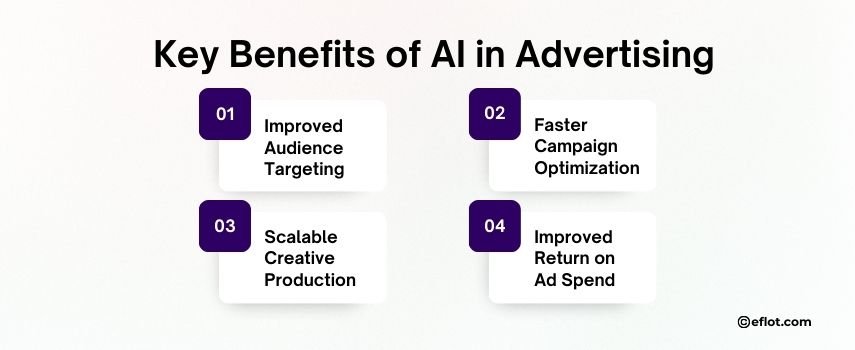
Improved Audience Targeting
AI algorithms analyse user behaviour across search engines, websites, and social platforms. These systems identify audience segments that show strong purchase intent.
Instead of broad demographic targeting, marketers can reach smaller high-value segments with tailored messaging. This approach increases engagement and conversion potential.
Faster Campaign Optimization
AI platforms monitor campaign performance continuously and adjust bids, budgets, and placements automatically. These adjustments help advertisers improve performance while reducing manual campaign management.
Many performance marketers rely on automated optimization tools because AI advertising fixes low CTR (Click-through-rate) by identifying creative elements or placements that generate stronger engagement.
Scalable Creative Production
Generative AI tools enable marketing teams to produce multiple versions of ad copy, images, and headlines. These variations support rapid A/B testing and creative experimentation.
Teams testing generated ads often identify higher-performing messaging faster than traditional creative workflows allow.
Improved Return on Ad Spend
AI systems allocate advertising budgets more efficiently by directing spend toward high-performing audiences and placements.
This data-driven optimization leads to improved campaign profitability and stronger marketing ROI.
Major Use Cases of AI in Advertising
AI technologies influence several stages of advertising campaigns, from audience research to lead generation.
AI for Search Advertising
Search advertising benefits significantly from AI-driven automation. Machine learning algorithms evaluate keyword performance, user intent, and bidding opportunities in real time.
Platforms increasingly rely on automated campaign management where tools continuously refine targeting strategies. Many organizations integrate AI solutions such as ai-driven google ads to increase visibility and improve cost efficiency in paid search campaigns.
AI for Social Media Advertising
Social platforms generate large volumes of behavioral data, making them ideal environments for AI-driven advertising.
Advertisers running AI facebook ads campaigns benefit from machine learning models that evaluate engagement patterns and optimize ad delivery automatically.
Marketing teams increasingly rely on machine learning because AI improves Facebook and Instagram ads by refining targeting, optimizing creatives, and adjusting delivery timing using engagement data.
AI-Generated Ad Creatives
Generative AI tools allow marketers to produce ad copy, product descriptions, and image variations quickly. These systems analyse high-performing ad formats and generate creative variations aligned with audience preferences.
Startups and small businesses increasingly adopt tools that enable ai-generated ads for startups, helping smaller teams launch campaigns without large creative departments.
Conversational Advertising
AI also supports interactive advertising experiences where customers engage with automated assistants after clicking an ad.
Businesses often connect advertising campaigns with conversational technologies such as AI chatbots to answer customer questions, qualify leads, and guide users toward purchases.
This approach improves lead conversion while reducing response time.
Predictive Campaign Strategy
Predictive analytics tools evaluate historical campaign data and estimate the potential impact of new advertising strategies.
These systems help marketers determine:
-
Which audience segments may convert at higher rates
-
Which creatives could generate stronger engagement
-
Which channels may deliver higher returns
Predictive insights allow marketers to allocate budgets more strategically before campaigns launch.
How AI Tools Are Used in Modern Advertising Campaigns
AI platforms support advertising teams throughout the campaign lifecycle.
-
During campaign planning, AI tools analyse historical marketing data to identify promising audience segments and messaging opportunities.
-
During campaign creation, generative models assist in writing headlines, generating ad copy, and producing visual concepts.
-
During campaign execution, machine learning algorithms monitor performance metrics such as click-through rate, engagement, and conversions. The system automatically adjusts bids, placements, and audience targeting.
-
During performance analysis, AI tools interpret campaign data and highlight actionable insights. These insights help marketers refine strategy and improve future campaigns.
This end-to-end automation enables marketing teams to manage complex campaigns with greater efficiency and precision.
Best Practices for Using AI in Advertising for High ROI
AI tools produce strong results when combined with structured marketing strategy and high-quality data.
Combine Human Strategy With AI Insights
AI excels at analyzing patterns and optimizing performance metrics. Marketing teams still guide brand messaging, creative direction, and campaign objectives.
Human expertise ensures advertising remains aligned with brand positioning and customer expectations.
Build Strong Data Foundations
AI systems depend on reliable data inputs. Businesses should maintain accurate customer data, conversion tracking, and campaign performance metrics.
Clean data improves algorithm accuracy and campaign effectiveness.
Prioritize Continuous Experimentation
AI makes it easier to test multiple ad variations simultaneously. Advertisers should experiment with different creative formats, audience segments, and campaign objectives.
Frequent testing helps identify strategies that generate stronger engagement and conversions.
Focus on Meaningful Performance Metrics
AI platforms provide extensive analytics. Marketing teams should prioritize metrics that directly affect business outcomes.
Important metrics include:
-
Return on ad spend
-
Conversion rate
-
Cost per acquisition
-
Customer lifetime value
Tracking these indicators ensures AI optimization aligns with overall marketing goals.
Ethical and Practical Considerations of AI Advertising
AI offers significant advantages, yet organizations must address ethical and operational challenges.
Data Privacy and Compliance
Advertising systems rely heavily on user data. Businesses must follow privacy regulations and maintain transparent data practices.
Responsible data management protects consumer trust and supports long-term brand credibility.
Algorithm Bias
AI systems learn from historical data. If training datasets contain bias, algorithms may produce uneven targeting results.
Regular audits and diverse training data help ensure fair and inclusive advertising practices.
Over-Automation
Automation improves efficiency, yet marketing teams should maintain oversight of campaign strategy and messaging.
Human review helps ensure advertising remains consistent with brand values and customer expectations.
AI Skill Gaps
Many organizations adopt AI tools without sufficient training or expertise. Marketing teams benefit from ongoing education in AI analytics, automation platforms, and data interpretation.
How Businesses Can Implement AI Advertising Successfully
Organizations adopting AI advertising strategies often benefit from expert guidance in selecting tools, building data infrastructure, and optimizing campaigns.
Eflot helps businesses implement AI-powered advertising strategies that combine automation, analytics, and performance marketing expertise. With the right technology and strategic approach, organizations can improve targeting accuracy, scale campaigns efficiently, and achieve stronger digital marketing results.
Conclusion
AI continues to redefine advertising by improving targeting accuracy, automating campaign optimization, and accelerating creative production. These capabilities help marketing teams reach the right audience with relevant messaging while maximizing advertising efficiency.
Businesses that integrate AI strategically gain a competitive advantage in digital marketing. With strong data foundations, ethical practices, and human expertise guiding AI systems, advertising campaigns can achieve greater performance, scalability, and long-term growth.
Frequently Asked Questions
What is AI in advertising?
AI in advertising refers to the use of machine learning, predictive analytics, and generative technologies to automate campaign management, analyze customer behavior, and improve ad performance.
How do AI ads improve marketing performance?
AI ads analyse campaign data in real time and adjust targeting, bidding, and creatives to increase engagement and conversions.
Are AI-generated ads effective for startups?
Yes. AI-generated ads help startups create professional marketing campaigns quickly and test multiple creative variations with limited resources.
Can AI improve social media advertising?
AI tools optimize audience targeting, ad delivery, and creative performance on platforms such as Facebook and Instagram.
What challenges come with AI advertising?
Key challenges include data privacy concerns, algorithm bias, skill gaps in AI usage, and maintaining human oversight in automated campaigns.
Digital Marketing services in Other Locations in India
Bangalore | Hyderabad | Chennai | Pune | Ahmedabad | Coimbatore | Mumbai | Kolkata | Patna | Amritsar | Indore | Kozhikode | Trivandrum | Jaipur | Nagpur | Gwalior | Dehradun | Noida | Vizag | Raipur | Agra | Gurgaon | Madurai | Udaipur | Thrissur |