





What Is Growth Marketing?
Discover what growth marketing is, how it works, and how it helps drive sustainable customer acquisition and business growth.

Are you struggling to get more leads, customers, and sales from your marketing efforts?
It’s frustrating to spend on ads, content, and campaigns, and still not see a strong return. That’s the pain many small businesses and startups face. This is where Growth Marketing comes in.
It isn’t about tactics only. It’s a mindset focused on experiments, data, and results. It avoids unnecessary steps and focuses on actions that drive business growth.
Research shows that businesses using growth marketing strategies can increase customer acquisition by up to 30%.
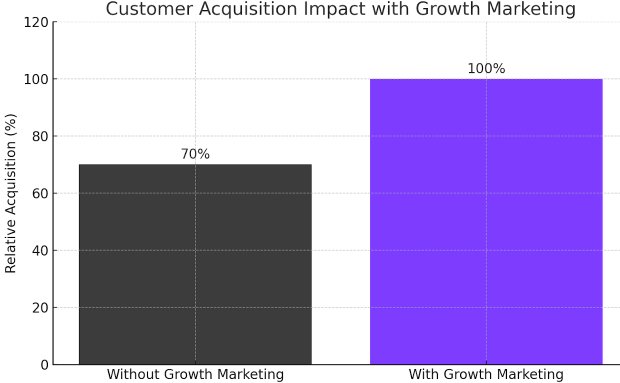
What is Growth Marketing?
Growth Marketing is a long-term, data-driven approach that focuses on testing, analyzing, and optimizing every stage of the customer journey. It helps businesses understand user behavior to attract new customers, increase retention, and build strong customer loyalty. By continuously refining marketing strategies based on real-time data and customer feedback, it drives sustainable business growth, improves customer lifetime value, and maximizes return on investment. This method enables businesses to allocate resources more effectively and respond quickly to market changes, ensuring ongoing success.
Why Growth Marketing is Important for Businesses?
Businesses must continuously test and adjust their marketing strategies to remain competitive. Without ongoing improvement, competitors may gain an advantage.
Advertising costs are increasing, making it essential to focus on achieving meaningful results rather than just generating impressions. It ensures efficient use of resources to attract and retain real customers.
Customers expect personalized experiences and relevant value. It enables businesses to deliver tailored messages that build trust and long-term loyalty.
Failing to adapt to real-time data and insights can lead to missed opportunities and declining market share.
Example: Netflix applies this strategy by analyzing viewer behavior to personalize content recommendations. This strategy enhances customer engagement and supports sustained business growth.
Effective Ways to Drive Results
-
Testing Over Assumptions
Every idea, such as headlines, calls to action, visuals, and offers, is carefully tested. This approach helps identify what truly works for your audience.
Purpose: To base decisions on evidence rather than assumptions, ensuring marketing efforts are effective.
-
Agile Testing Approach
Uses an agile testing method where small experiments are launched and results are reviewed frequently. This allows quick adjustments and improvements based on real data.
Purpose: To speed up learning and optimization, enabling timely changes that improve campaign performance and overall results.
-
Real-Time Data Tracking
All key metrics like clicks, conversions, bounce rates, customer retention, and revenue are tracked continuously. This provides accurate insight into campaign effectiveness.
Purpose: To make informed decisions based on up-to-date data, improving marketing efficiency.
-
Full-Funnel Focus
Targets every stage of the customer journey, from initial awareness to acquisition, retention, referrals, and revenue growth.
Purpose: To build long-term customer loyalty and maximize business growth at every step.
-
Continuous Improvement
Campaigns are constantly reviewed and refined based on feedback and data to enhance performance over time.
Purpose: To ensure ongoing growth by adapting strategies as market conditions and customer preferences change.
Growth Marketing vs Traditional Marketing
|
Traditional Marketing |
Growth Marketing |
|
Uses fixed campaigns with limited flexibility |
Adapts through continuous testing and optimization |
|
Focuses on reach and awareness |
Focuses on conversions, retention, and long-term results |
|
Delivers the same message to a wide audience |
Uses data to create personalized customer experiences |
|
Relies on offline channels like TV, print, and radio |
Uses digital tools, automation, and analytics |
|
Short-term goal of visibility |
Long-term goal of business growth |
The RACE Framework in Growth Marketing
The RACE framework stands for Reach, Act, Convert, Engage, a powerful way to structure and execute your plan.
-
Reach: Use organic and paid channels to reach new audiences and increase brand visibility.
-
Act: Encourage interaction through helpful content, social engagement, and valuable resources.
-
Convert: Turn visitors into customers with optimized funnels, strong CTAs, and trust-building tactics.
-
Engage: Build loyalty through follow-ups, retargeting, loyalty programs, and personalized experiences.
Each stage is connected and helps drive long-term growth.
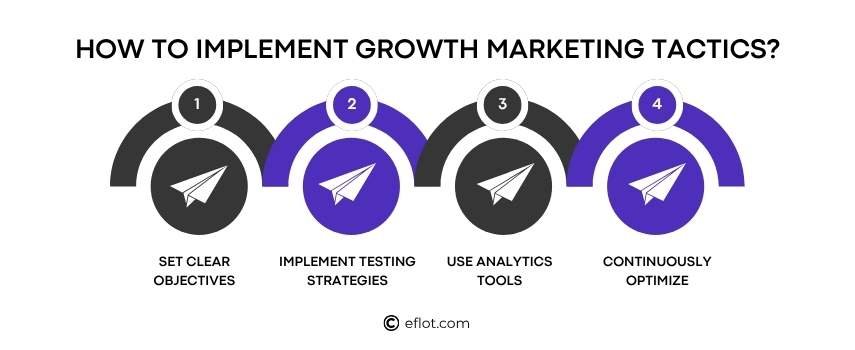
How to Implement Growth Marketing Tactics?
-
Set Clear Objectives
Identify the key performance indicators (KPIs) that align with your business goals, such as sign-ups, sales, or customer retention.
-
Implement Testing Strategies
Conduct A/B tests on critical touchpoints like your website, email campaigns, and social media content to determine the most effective approaches.
-
Use Analytics Tools
Utilize platforms like Google Analytics, Mixpanel, and heatmaps to monitor user behavior and measure campaign performance accurately.
-
Continuously Optimize
Analyze test results regularly and refine your strategies accordingly. Focus on incremental improvements through ongoing experimentation.
Growth Marketing for Long-Term Success
The objective goes beyond achieving a single viral moment. It focuses on developing a consistent system that delivers results over the long term. This approach helps you:
-
Build steady and reliable revenue streams
-
Increase customer retention and loyalty
-
Gain a clear understanding of the key drivers behind genuine growth
All of this is achieved through continuous testing, analysis, and scaling strategies that prove effective.
FAQs:
What is growth marketing?
Growth marketing is a data-driven strategy that uses testing and customer insights to increase sales, retention, and customer loyalty.
How does growth marketing differ from traditional marketing?
It focuses on continuous testing and optimization across the entire customer journey, while traditional marketing centers on one-time campaigns and brand awareness.
Can small businesses benefit from growth marketing?
Yes, it is ideal for small businesses because it maximizes limited budgets and delivers measurable results quickly.
How long does it take to see results from growth marketing?
Some growth marketing efforts show results within a few weeks, but most strategies take 2 to 3 months to generate meaningful growth.
What tools are used in growth marketing?
Common tools include Google Analytics, A/B testing platforms, heatmaps, and customer behavior tracking software to measure and improve marketing performance.
This strategy helps your business grow by testing ideas and using proper data. It focuses on every step, from finding new customers to keeping them happy.
This approach works better than just running ads once because it builds long-term success. It’s great for small businesses because it saves money and gets real results.
To do well, set clear goals, watch your progress, and keep improving. Using it will help your business stay strong and grow in the future.
Want to grow your business and get more customers?
Email us at [email protected] to find out how.
Digital Marketing services in Other Locations in India
Bangalore | Hyderabad | Chennai | Pune | Ahmedabad | Coimbatore | Mumbai | Kolkata | Patna | Amritsar | Indore | Kozhikode | Trivandrum | Jaipur | Nagpur | Gwalior | Dehradun | Noida | Vizag | Raipur | Agra | Gurgaon | Madurai | Udaipur | Thrissur |