
























The Ultimate Guide to Google Ads Bidding Strategies
Struggling with Google Ads costs? Learn how to bid smarter, maximize ROI, and outshine competitors with the best bidding strategies. Start winning today!

As a digital marketing specialist, I’ve helped businesses of all sizes improve their Google Ads campaign optimization through strategic bidding. Many businesses struggle with their ad spend, unsure whether they’re bidding too high or too low. Without a well-defined PPC bidding technique, campaigns often result in wasted budget, low ROI, and missed conversions.
When I started working with Google Ads, I quickly realized that every business has unique advertising needs. Some businesses focus on brand awareness, while others prioritize conversions and lead generation. The right bidding strategy can make a huge difference, ensuring ads are placed in front of the right audience at the right cost. Here, I’ll explain everything you need to know about bidding strategies in Google Ads, how to choose the best one for your business, and real-world case studies from leading brands to show how smart bidding strategies can drive success.
What Are Google Ads Bidding Strategies?
Bidding strategies in Google Ads determine how much advertisers are willing to pay to display their ads on Google Search, Display Networks, YouTube, and Shopping Ads. The goal is to achieve the best possible results within the allocated budget while ensuring the highest return on ad spend (ROAS).
Bidding strategies help advertisers optimize ad placements by adjusting bids based on campaign goals, competition, and audience intent. Google offers both manual and automated bidding options to balance cost efficiency and performance. Choosing the right strategy ensures better visibility, more conversions, and a higher return on investment (ROI).
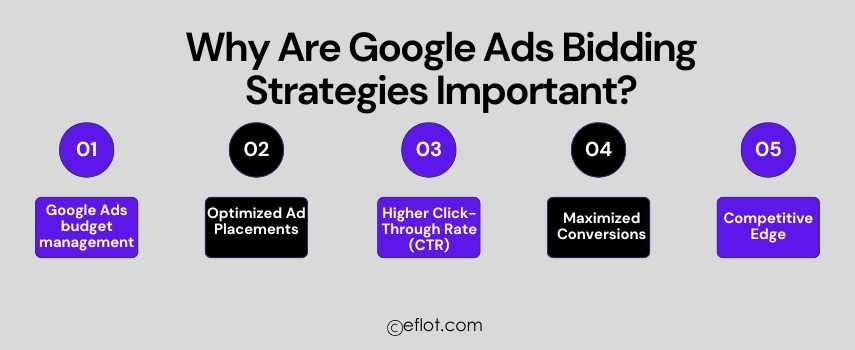
Why Are Google Ads Bidding Strategies Important?
-
Google Ads budget management: Ensures you’re not overspending on clicks that don’t convert.
-
Optimized Ad Placements: This helps your ads appear in the right position to reach your audience.
-
Higher Click-Through Rate (CTR): Well-bid ads get more impressions and engagement.
-
Maximized Conversions: Choosing the right pay-per-click (PPC) strategy increases leads and sales.
-
Competitive Edge: Staying ahead of competitors in ad auctions is critical for online success.
How Google Ads Bidding Works
Understanding how Google Ads bidding strategies work is crucial for ensuring you don’t overspend while maximizing conversions. Google Ads operates on an automated auction system, where advertisers compete to have their ads displayed when users search for relevant keywords. Here’s how the Google Ads bidding process works step by step:
1. Advertisers Set Bids
Every advertiser places a maximum bid amount they are willing to pay when a user clicks on their ad. This bid can be based on:
-
CPC (Cost-Per-Click): Paying per actual click received.
-
CPM (Cost-Per-Thousand Impressions): Paying per 1,000 ad views (for Display and Video ads).
-
CPA (Cost-Per-Acquisition): Paying for specific conversions like form submissions or sales.
2. Google Calculates Ad Rank
Ad Rank is not just about who bids the highest; Google also considers other factors to decide which ad appears and in what position. Ad Rank is determined by:
-
Bid Amount: How much you’re willing to pay.
-
Quality Score: Google's rating of your ad relevance, CTR (Click-Through Rate), and landing page experience.
-
Expected Impact of Ad Extensions: Extra features like site links, callouts, and structured snippets can improve an ad’s placement.
3. The Ad Auction Determines Placement
When multiple advertisers bid on the same keyword, Google runs an instant auction every time a user searches. Ads with higher Ad Ranks will be placed above others, meaning that a lower-bidding advertiser can still win top placement if they have a better Quality Score.
4. The Final CPC is Calculated
Many advertisers assume they will always pay their maximum bid amount, but that’s not how Google Ads works. Instead, you only pay one cent more than the next highest bidder’s Ad Rank, ensuring you get the best return on investment.
5. Smart Bidding Adjustments
For businesses using automated bidding strategies like Target CPA and Target ROAS, Google’s AI-powered algorithms adjust bids in real time based on:
-
User intent and behavior patterns.
-
Device type, time of day, and location.
-
Likelihood of conversion based on past data.
Types of Google Ads Bidding Strategies
Google Ads offers manual and automated bidding strategies that can be chosen based on business goals.
1. Manual CPC (Cost-Per-Click) Bidding
With Manual CPC, advertisers control their maximum cost-per-click, making it ideal for businesses that want full control over their Google Ads budget management.
-
Best for small businesses that manually optimize their ad spend.
-
Drawback: Requires continuous monitoring to prevent overspending.
2. Enhanced CPC (ECPC)
This is a semi-automated bidding strategy that adjusts manual CPC bids based on conversion likelihood.
-
Best for businesses looking to balance manual control with automation.
-
Not as precise as fully automated bidding strategies.
3. Target CPA (Cost-Per-Acquisition)
Google automatically adjusts bids to get conversions at a predefined cost per acquisition.
-
Best for businesses focused on cost-efficient lead generation.
-
Needs historical data to optimize effectively.
4. Target ROAS (Return on Ad Spend)
This automated bidding in Google Ads strategy adjusts bids to achieve a target return on investment.
-
Best for e-commerce businesses tracking revenue per conversion.
-
Requires consistent sales data to work efficiently.
5. Maximize Clicks
Google optimizes bids to get the highest number of clicks within the budget.
-
Best for businesses focusing on website traffic & brand awareness.
-
Does not guarantee quality conversions.
6. Maximize Conversions
This fully automated bidding strategy aims to get as many conversions as possible within the set budget.
-
Best for businesses with well-optimized landing pages and strong CTAs.
-
Drawback: Google controls bids entirely, limiting manual adjustments.
7. Target Impression Share
This strategy maximizes ad visibility by adjusting bids to appear in specific positions on Google’s search results.
-
Best for businesses focused on brand awareness and visibility.
-
This can lead to higher CPC without direct conversions.
How to Choose the Right Google Ads Bidding Strategy
Choosing the right bidding strategy in Google Ads depends on your campaign objectives, budget, and the level of control you want over bids.
1. For Traffic & Brand Awareness
-
Maximize Clicks: Google automatically adjusts your bids to drive the highest possible traffic within your budget.
-
Target Impression Share: Ensures ads appear in top positions for better brand visibility.
2. For Conversions & Lead Generation
-
Maximize Conversions: Uses smart bidding strategies to focus on high-intent users.
-
Target CPA: Ensures cost-per-acquisition remains within budget.
3. For ROI Optimization & Revenue Growth
-
Target ROAS: Adjusts bids dynamically for a better return on ad spend.
-
Enhanced CPC: A balance between manual CPC and Google Ads automation.
4. For Full Control & Manual Adjustments
-
Manual CPC: Best for businesses that prefer custom bidding strategies.
-
Portfolio Bid Strategies: Helps advertisers combine multiple campaigns under one bidding method.
Case Studies
Case Study1:
Airbnb wanted to increase online bookings while reducing acquisition costs.
Challenges
-
High competition in the travel and rental industry.
-
Needed a cost-effective Google Ads campaign optimization strategy.
Solutions Implemented
-
Implemented Target CPA bidding strategies in Google Ads to automate bid adjustments.
-
Used Google Ads conversion tracking to optimize ad placements.
Case Study2:
Samsung wanted to improve sales of its latest smartphones using Google Shopping Ads.
Challenges
-
Needed to optimize Google Ads budget management.
-
High competition from Apple and OnePlus.
Solutions Implemented
-
Used Target ROAS bidding strategy to optimize revenue growth.
-
Improved Google Ads conversion tracking to refine high-performing ads.
Mastering bidding strategies in Google Ads is key to maximizing ad performance while maintaining budget efficiency. Whether your goal is traffic, conversions, or revenue optimization, selecting the right pay-per-click (PPC) strategy will ensure better results. By using automated and manual bidding tactics, businesses can optimize ad spend, improve ROI, and stay competitive in search rankings. Regular performance analysis and bid adjustments ensure sustained success.
Digital Marketing services in Other Locations in India
Bangalore | Hyderabad | Chennai | Pune | Ahmedabad | Coimbatore | Mumbai | Kolkata | Patna | Amritsar | Indore | Kozhikode | Trivandrum | Jaipur | Nagpur | Gwalior | Dehradun | Noida | Vizag | Raipur | Agra | Gurgaon | Madurai | Udaipur | Thrissur |