





















The Role of Analytics in Digital Marketing in India
Explore how analytics drives digital marketing strategies in India, enhancing customer engagement, ROI, and decision-making.
In India's quickly changing digital environment, businesses are constantly searching for ways to maximize their online presence and make smarter decisions. Having worked as a digital marketing specialist for years, I’ve seen how analytics can transform how businesses approach their marketing strategies. In the competitive world of digital marketing in India, the ability to understand customer behavior and optimize campaigns based on data is no longer a luxury, it’s a necessity.
When I first started in the field, digital marketing seemed like a creative playground. However, I quickly realized creativity alone wasn’t enough to deliver results. That’s when I turned to analytics. It gave me a clear picture of what was working and what wasn’t. Today, analytics is at the core of every successful digital marketing campaign, helping businesses across India to not just survive but grow. As businesses move online and competition increases, using data to understand customer behavior and preferences is becoming more important than ever. Analytics allows brands to make smarter decisions, improve their marketing strategies, and deliver personalized experiences to their customers, all of which play a key role in driving growth and success in the digital environment.
What is Analytics in Digital Marketing?
Analytics in digital marketing refers to the process of collecting, measuring, and analyzing data to understand and optimize marketing efforts. It helps businesses monitor website traffic, user behavior, conversion rates, and campaign performance. By leveraging analytics, businesses in India can make informed decisions to improve their online presence, enhance customer experience, and achieve better ROI (Return on Investment).
What is the Role of Analytics in Digital Marketing?
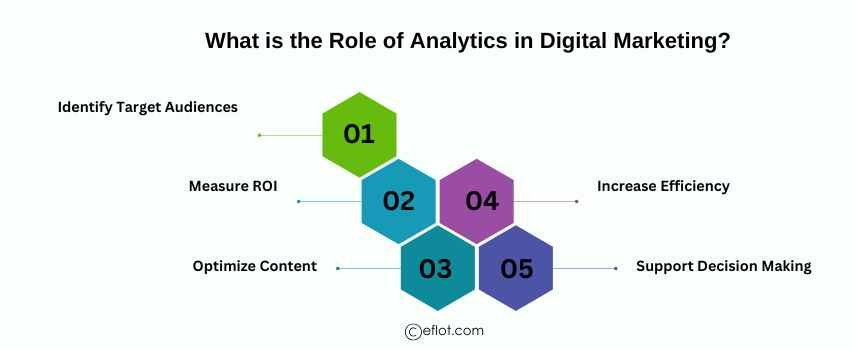
The role of analytics in digital marketing is to provide actionable insights that improve the effectiveness of campaigns. It helps businesses:
-
Identify Target Audiences: By analyzing demographics, interests, and behaviors, marketers can better target their audience.
-
Measure ROI: Analytics allows for precise tracking of how much revenue is generated from marketing efforts.
-
Optimize Content: Insights from analytics help refine content to better resonate with the audience.
-
Increase Efficiency: By understanding what works and what doesn’t, marketers can avoid wasting resources on ineffective strategies.
-
Support Decision Making: Data driven decisions minimize guesswork and improve outcomes.
What Are the Three Models of Analytics in Digital Marketing?
The three models of analytics in digital marketing are:
-
Descriptive Analytics:
-
What it does: Explains what has already happened by summarizing past data. It helps marketers understand the success of previous campaigns.
-
Example: “How many users visited the website last month?”
-
Predictive Analytics:
-
What it does: Uses historical data and statistical algorithms to forecast future trends and behaviors.
-
Example: “Which customer segment is most likely to make a purchase next month?”
-
Prescriptive Analytics:
-
What it does: Suggests actions based on data insights to achieve desired outcomes.
-
Example: “What strategies should be implemented to increase sales by 20% in the next quarter?”
How do Digital Marketers Use Analytics?
Digital marketers use analytics to:
-
Track Campaign Performance: Analyze the success of campaigns by monitoring metrics like reach, engagement, and conversions.
-
Understand Audience Behavior: Learn how users interact with websites, apps, and ads to tailor strategies.
-
Improve SEO: Use tools like Google Analytics to identify popular keywords, track traffic sources, and improve search rankings.
-
Optimize Ad Spend: Monitor cost-per-click (CPC), cost-per-acquisition (CPA), and conversion rates to ensure ad budgets are used efficiently.
-
Personalize Marketing: Leverage data to deliver personalized messages and product recommendations based on user preferences and behavior.
-
Predict Trends: Use predictive analytics to forecast future behaviors and adapt strategies accordingly.
How Analytics Play Their Part in Digital Marketing?
-
Understanding Audience Behavior:
-
Analytics helps marketers track and analyze how users interact with websites, ads, and content.
-
It provides insights into user demographics, preferences, and online behaviors, enabling personalized marketing.
-
Optimizing Campaign Performance:
-
Analytics tools monitor key metrics like click-through rates (CTR), conversion rates, and bounce rates.
-
These insights help marketers identify which campaigns are successful and which need improvement.
-
Enhancing SEO Strategies:
-
Analytics tracks traffic sources, keyword rankings, and search engine performance.
-
This data helps refine SEO strategies to improve website visibility and attract organic traffic.
-
Improving Ad Spend Efficiency:
-
Analytics monitors metrics such as cost-per-click (CPC), cost-per-acquisition (CPA), and return on ad spend (ROAS).
-
Marketers can use this data to allocate budgets effectively and reduce wasted spending.
-
Tracking Conversion Rates:
-
Conversion tracking helps measure how many users take desired actions (e.g., purchases, sign-ups).
-
Analytics identifies roadblocks in the customer journey and helps optimize funnels.
-
Personalizing User Experience:
-
Analytics provides insights into user preferences, enabling marketers to create personalized content and offers.
-
Personalization leads to better engagement and higher conversion rates.
Case Studies
Case Study1:
Pepperfry, one of India’s leading online furniture and home decor marketplaces, operates in a highly competitive market. With its vast product range, Pepperfry needed to deliver a personalized shopping experience and optimize its marketing campaigns to stay ahead of competitors.
Challenges:
Pepperfry faced several challenges in its quest to dominate the online furniture space. Firstly, the brand grappled with intense competition from other e-commerce platforms, including those specializing in furniture and larger general marketplaces offering similar products. Differentiating itself in a crowded field requires innovative and effective strategies.
Solutions:
To tackle these challenges, Pepperfry implemented a range of data-driven solutions. One key approach was to leverage user behavior analytics. The brand used advanced analytics tools to monitor customer behavior, including browsing patterns, popular categories, and time spent on specific product pages. This data provided valuable insights into customer preferences, allowing the team to refine the shopping experience and focus on what users genuinely wanted.
Case study2:
FabIndia, one of India’s most iconic retail brands specializing in traditional and handcrafted products, operates both online and offline. As digital adoption surged in India, FabIndia sought to expand its online presence while maintaining a seamless experience across its stores and website. The challenge was to integrate data from various touchpoints and use analytics to enhance customer engagement and boost sales.
Challenges:
FabIndia faced several challenges in its digital transformation journey. Firstly, the brand needed to integrate its online and offline customer data. With customers shopping across physical stores and the website, the lack of a unified view of customer behavior made it difficult to understand preferences and deliver personalized experiences.
Solutions: To overcome these challenges, FabIndia partnered with experts in analytics and digital marketing to create a robust data-driven strategy. The first step was to integrate data across online and offline channels. By implementing a unified Customer Relationship Management (CRM) system, FabIndia consolidated customer information from both its physical stores and website. This allowed the brand to gain a 360-degree view of customer behavior and preferences, which became the foundation for personalized marketing.
Analytics is no longer optional for businesses engaging in digital marketing in India. It’s the backbone of every successful campaign, providing the insights needed to make smarter decisions, optimize performance, and achieve measurable growth. For marketers in India, Using analytics effectively can mean the difference between staying ahead or falling behind in a fiercely competitive market. Whether you’re a small business owner or a large enterprise, embracing analytics will empower you to understand your audience better, improve customer experience, and drive long-term success in the dynamic world of digital marketing in India.
Digital Marketing services in Other Locations in India
Bangalore | Hyderabad | Chennai | Pune | Ahmedabad | Coimbatore | Mumbai | Kolkata | Patna | Amritsar | Indore | Kozhikode | Trivandrum | Jaipur | Nagpur | Gwalior | Dehradun | Noida | Vizag | Raipur | Agra | Gurgaon | Madurai | Udaipur | Thrissur |