





















How to Use Web Analytics to Maximize Your Sales Potential
Learn how to use web analytics to understand customer behavior, improve conversions, and make data-driven sales decisions.

Are you optimizing your website traffic? Or are you leaving money on the table by failing to use the information at your disposal?
Web Analytics in Digital Marketing can be the difference-maker that not only enables you to monitor website activity but also convert it into sales. By studying the behavior of your visitors, you can gain vital insights that assist in optimizing your strategies, increasing conversions, and ultimately maximizing your sales potential.
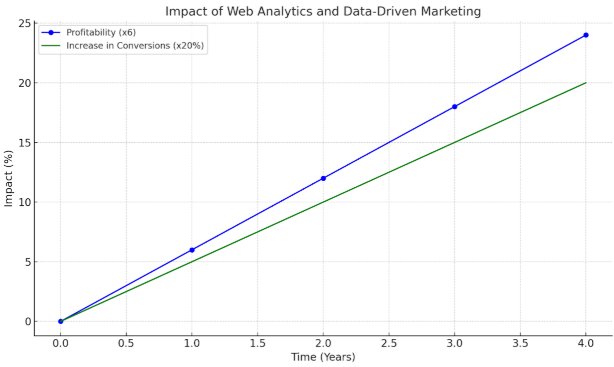
Research indicates that companies employing data-driven marketing are six times more likely to be profitable year after year. Additionally, 70% of marketers indicate that web analytics is crucial in enhancing their marketing performance. In reality, firms that can implement web analytics into their online marketing activities achieve up to a 20% increase in conversions.
Amazon, the largest online retailer in the world, is a good example of how Web Analytics in Digital Marketing can greatly increase sales. Amazon applies web analytics to monitor customer activities on its website, which assists in personalizing shopping experiences and product recommendations. Through analyzing large volumes of customer data, Amazon is aware of what customers want to purchase and when they wish to purchase it.
For example, Amazon employs client browsing history and buying information to propose related products or display special promotions, leading to increased conversion ratios and more revenue. The corporation also employs data analytics to personalize its checkout flow, minimize shopping cart abandonment rates, and optimize its overall website user interface.
As a result, Amazon has emerged as an e-commerce leader and owes much success to its cutting-edge application of web analytics as a means for maximizing sales possibilities.
What is Web Analytics in Digital Marketing?
Web analytics refers to the practice of gathering and examining data on your website to comprehend how users are engaging with your content, products, and services. Through tools such as Google Analytics, companies can monitor metrics including page views, user demographics, session length, bounce rates, and most significantly, conversion rates.
With Web Analytics in Digital Marketing, you can track which sources of traffic are doing best, how visitors get around on your site, and which pages drive the most sales. If companies can understand these behaviors, they can adjust their marketing to reach high-value customers and drive more sales opportunities.
Key Metrics in Web Analytics That Impact Sales
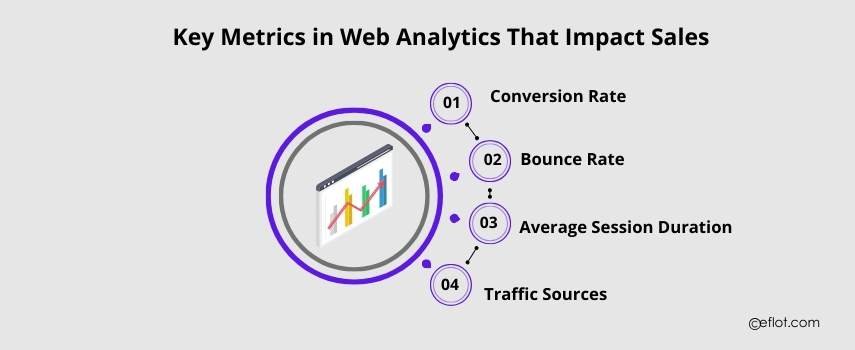
To maximize your sales potential, you need to focus on key web analytics metrics that directly influence the buying journey:
1. Conversion Rate
This is perhaps the most important metric in determining how well your website turns visitors into paying customers. It measures the percentage of visitors who complete a desired action, such as making a purchase or filling out a contact form.
-
How to Use It: Track where your highest conversion rates are coming from (specific traffic sources, landing pages, etc.). Then, optimize those pages and strategies to drive more traffic to them.
2. Bounce Rate
Bounce rate refers to the percentage of visitors who leave your site after viewing only one page. A high bounce rate could mean that users are not finding what they need or that your landing page is not compelling enough.
-
How to Use It: Use web analytics to identify pages with high bounce rates and make adjustments to your content, calls to action (CTAs), and user experience (UX) design to encourage visitors to stay and explore more.
3. Average Session Duration
This metric shows how long visitors are staying on your website. A longer session duration often indicates that users find your content engaging and are more likely to convert into customers.
-
How to Use It: Create more engaging, informative, and valuable content to encourage visitors to spend more time on your site, increasing the chances of them making a purchase.
4. Traffic Sources
Knowing where your website traffic is coming from, whether it’s organic search, paid ads, social media, or email campaigns is essential in evaluating the effectiveness of your marketing channels.
-
How to Use It: Identify which channels are driving the most high-quality traffic and focus your efforts on optimizing and scaling those channels. You can also use this data to allocate your marketing budget more effectively.
How Web Analytics Helps You Maximize Sales Potential
1. Optimizing User Experience (UX)
One of the key advantages of using Web Analytics in Digital Marketing is understanding how users interact with your website. By analyzing bounce rates, session duration, and page flow, you can identify areas of your site that need improvement.
2. Personalizing Customer Journeys
Web analytics provides insights into how different segments of your audience behave. By understanding demographics, geographic location, and interests, you can tailor your marketing campaigns to specific customer groups. This level of personalization increases the chances of making a sale.
3. A/B Testing and Experimentation
Web analytics allows you to run A/B tests on your website’s content, layout, and CTAs. By testing variations of your pages, you can identify which ones perform better in terms of conversion rates and make data-driven decisions to increase sales.
4. Tracking ROI and Measuring Campaign Effectiveness
With web analytics, you can track the performance of your digital marketing campaigns. You can measure how much traffic your campaigns are driving, which leads are converting into customers, and whether you’re getting a good return on investment (ROI).
Applying Web Analytics to Digital Marketing is essential for any company aiming to optimize its sales potential. Through the measurement of important metrics like conversion rate, bounce rate, and session duration, companies can make intelligent decisions to enhance their websites, deliver personalized customer experiences, and enhance marketing effectiveness.
Begin utilizing web analytics today and fuel growth while optimizing your marketing efforts. For expert advice, call us at [email protected]
Digital Marketing services in Other Locations in India
Bangalore | Hyderabad | Chennai | Pune | Ahmedabad | Coimbatore | Mumbai | Kolkata | Patna | Amritsar | Indore | Kozhikode | Trivandrum | Jaipur | Nagpur | Gwalior | Dehradun | Noida | Vizag | Raipur | Agra | Gurgaon | Madurai | Udaipur | Thrissur |