



















How to Improve Organic Results Using SEO
Struggling to get noticed online? Learn proven SEO strategies to boost organic search rankings, drive sustainable traffic, and grow your business long-term!

Many business owners believe that customers will start pouring in once they build a website. However, that’s not how things work. I remember working with a small e-commerce business that struggled to get traffic and generate sales. They had spent time and money on ads but saw little return. That’s when they came to me, looking for a long-term solution. As a digital marketing specialist, I introduced them to the concept of organic results SEO. By optimizing their website’s content, fixing technical issues, and targeting the right keywords using various keyword research tools, we could rank their site on the first page of Google within a few months. The result? A 60% increase in organic search traffic and a significant boost in sales.
If you’re wondering what organic results SEO is, it’s all about improving your site’s visibility on search engines without depending on paid ads. It focuses on optimizing the website to naturally appear higher in search rankings when users search for products or services like yours. The beauty of organic SEO is that once you achieve a high ranking, you can enjoy long-term traffic without constantly spending on ads. But the question is how do you achieve that? Here I will share everything you need to know, including on-page SEO factors, backlink-building techniques, and local SEO practices. Whether you’re just starting or looking to refine your strategy, this will help you to drive sustainable growth and increase your visibility on search engines. Ready to get started?
Understanding Organic Results for Long-Term Success
Organic results are the unpaid listings that appear on search engine results pages (SERPs) when a user searches for something online. Unlike paid ads, which are labeled as “sponsored” or “ad,” organic results earn their position through relevance, content quality, user experience, and search engine optimization techniques. These results are the backbone of online visibility for businesses that want to build long-term, sustainable traffic without constantly paying for clicks.
Why Organic Results Are Important for Businesses
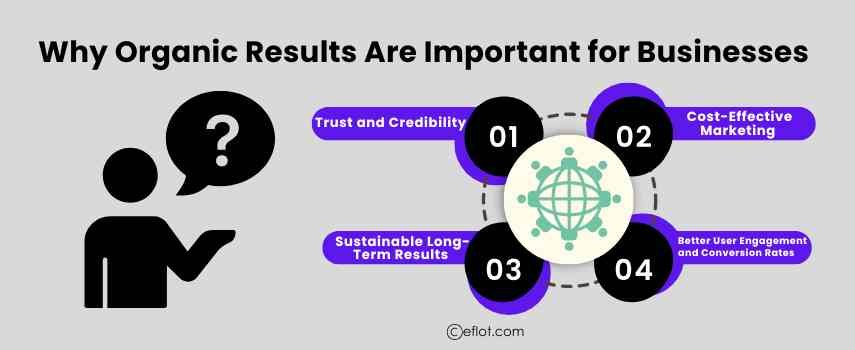
1. Trust and Credibility:
Users trust organic results more than paid ads because they believe these listings earned their spot naturally. A top-ranking organic result signals to users that your website offers relevant and trustworthy information. According to studies, over 70% of users prefer clicking on organic search results compared to ads. If your business can secure one of these spots, you’ll benefit from increased clicks, better engagement, and a higher likelihood of conversions.
2. Cost-Effective Marketing:
Unlike paid ads that require continuous investment, organic traffic is essentially free once you rank. While SEO requires time and resources upfront, the long-term benefits make it a cost-effective strategy. As long as you maintain and update your content using effective content marketing strategies, you can enjoy sustained traffic without ongoing ad spend.
3. Sustainable Long-Term Results:
Paid campaigns generate immediate results, but they stop as soon as the budget is exhausted. Organic results, on the other hand, provide long-term benefits as long as you continue optimizing and maintaining your SEO efforts. Once you rank for important keywords, you’ll generate traffic over months or even years.
4. Better User Engagement and Conversion Rates:
Organic results often align with user intent, which leads to better engagement and higher conversion rates. When users search for specific terms and find your content matching their needs, they are more likely to stay on your site and convert into leads or customers.
What Determines Organic Results on Search Engines?
To earn a top spot on the search engine results page, search engines analyze multiple factors to determine how relevant and valuable your site is to the search query. Here are some of the key factors:
-
Relevance to Search Intent:
Does your website content answer the specific query users are searching for? Google and other search engines prioritize pages that match user intent, whether it’s informational, transactional, or navigational. -
On-Page Optimization:
On-page SEO involves optimizing various elements like titles, headers, meta descriptions, URLs, and internal links. Proper keyword placement signals search engines that your page is relevant to the query. -
Quality and Authority of Content:
Websites with high-quality content such as blogs, guides, and product descriptions are favored by search engines. Content should be well-structured, informative, and provide value to users. -
Backlink Profile:
Backlinks, or links from external websites pointing to your site, are a key factor in determining the authority of your content. The more authoritative and relevant the backlinks, the higher the trust signals sent to search engines. -
Technical SEO:
Ensuring that your site is mobile-friendly, fast-loading, and free from crawl errors is crucial. Technical SEO optimizations ensure that search engines can index and understand your pages effectively.
How to Use SEO to Enhance Organic Results
1. Conduct Comprehensive Keyword Research
Keywords are the foundation of SEO and play a critical role in determining your website’s visibility on search engines. Targeting the right search terms ensures you attract relevant users.
Steps to Effective Keyword Research:
-
Use tools like Google Keyword Planner, SEMrush, or Ahrefs to find keywords with high search volumes and manageable competition.
-
Focus on long-tail keywords like “best running shoes for marathon beginners” instead of generic terms like “running shoes.”
-
Analyze competitor keyword usage to discover gaps and new opportunities.
Why It Matters:
Effective keyword research ensures you’re targeting queries that match user intent, which is crucial for attracting qualified traffic.
2. Optimize On-Page Elements
On-page SEO involves optimizing individual pages to help search engines understand their relevance and content.
Key On-Page Optimization Elements:
-
Title Tags: Include primary keywords in titles, keeping them under 60 characters.
-
Meta Descriptions: Write compelling descriptions (under 160 characters) with secondary keywords.
-
Header Tags (H1, H2, H3): Structure content with headers to improve readability and SEO.
-
Internal Linking: Connect relevant pages within your site to improve navigation and pass link equity.
-
Image Alt Text: Optimize images with descriptive alt text that includes relevant keywords.
Why It Matters:
On-page SEO ensures that both users and search engines can easily navigate and understand your site, boosting visibility and engagement.
3. Publish High-Quality, Engaging Content
Content is the backbone of organic results SEO. Search engines prioritize websites that provide relevant, valuable, and up-to-date information.
How to Create Effective Content:
-
Write long-form, detailed blog posts, guides, and FAQs that address user questions and pain points.
-
Use a mix of text, visuals, videos, and infographics to increase engagement.
-
Include LSI keywords (related phrases) naturally to enhance content relevance.
-
Regularly update existing content to maintain relevance and improve rankings.
Why It Matters:
Quality content attracts backlinks, improves user retention, and sends positive signals to search engines, boosting your chances of ranking higher.
4. Build a Strong Backlink Profile
Backlinks act as “votes of confidence” for search engines, signaling that your content is credible and authoritative.
How to Build Backlinks:
-
Reach out to reputable websites in your niche for guest blogging opportunities.
-
Create shareable content like case studies, infographics, and research reports to attract natural backlinks.
-
Monitor your backlink profile using tools like Ahrefs or Moz and disavow toxic links that could harm your rankings.
Why It Matters:
A diverse and high-quality backlink profile improves your site’s domain authority and visibility on search engines.
5. Optimize Technical SEO
Technical SEO ensures that search engines can crawl, index, and understand your site efficiently.
Key Technical SEO Areas to Focus On:
-
Site Speed: Improve loading times by compressing images, enabling browser caching, and using a CDN.
-
Mobile-Friendliness: Ensure your site is responsive and performs well on all devices.
-
XML Sitemap: Submit a sitemap to search engines for better indexing.
-
Secure Site: Use HTTPS to ensure secure data transmission.
Why It Matters:
Technical SEO fixes prevent indexing issues and improve user experience, which directly impacts rankings.
6. Improve User Experience (UX)
Google prioritizes websites that offer a positive user experience, as it reduces bounce rates and keeps users engaged.
How to Enhance UX:
-
Simplify site navigation so users can easily find what they’re looking for.
-
Optimize for readability by using short paragraphs, bullet points, and subheadings.
-
Incorporate multimedia such as images and videos to make content more engaging.
-
Monitor engagement metrics like time on page and bounce rates to identify areas for improvement.
Why It Matters:
When users stay on your site longer, it sends positive signals to search engines, helping to boost rankings.
7. Leverage Local SEO (for Location-Based Businesses)
For businesses targeting local customers, local SEO is crucial for appearing in location-based search queries and Google’s local pack.
Local SEO Best Practices:
-
Optimize your Google My Business profile with accurate business details and categories.
-
Collect positive customer reviews on platforms like Google and Yelp.
-
Ensure NAP consistency (Name, Address, Phone Number) across all online listings.
-
Include location-specific keywords in your content.
Why It Matters:
Local SEO helps you rank higher for “near me” searches and improves visibility among local customers.
8. Monitor Performance and Adjust Strategies
SEO isn’t a one-time task, it requires continuous monitoring and adjustments to stay competitive.
Tools to Monitor Performance:
-
Google Analytics: Track organic traffic, bounce rates, and user behavior.
-
Google Search Console: Monitor indexing issues, search performance, and backlinks.
-
SEMrush/Ahrefs: Analyze keyword rankings and competitor strategies.
Why It Matters:
Regular performance tracking helps you identify what’s working, where you’re lagging, and what adjustments are needed for continuous improvement.
Case Studies
Case Study1:
Trendique, an online fashion brand offering trendy and affordable products, struggled to attract organic traffic and relied heavily on paid advertisements. Despite their efforts, the business faced high marketing costs and inconsistent traffic flow.
Challenges:
The website lacked targeted keyword optimization, and product descriptions were minimal, limiting visibility in search results. Additionally, the brand had a weak backlink profile, which reduced its authority and search engine rankings.
Solutions:
A comprehensive SEO plan was implemented, focusing on long-tail keyword research and optimizing product descriptions. A fashion blog covering trends and styling advice was introduced to provide value and attract organic visitors. The team also established partnerships with fashion bloggers and industry websites for guest posting and link building.
Case Study2:
FinTech Analytics, a provider of financial forecasting software, faced difficulties in generating leads through organic traffic. The company primarily relied on paid advertising and cold outreach, which yielded temporary results but lacked sustainability.
Challenges:
The company’s website had limited content targeting relevant industry-specific keywords, leading to poor visibility in search engines. On-page SEO elements such as meta descriptions, headers, and internal linking were poorly optimized. Additionally, FinTech Analytics had little presence in local search results.
Solutions:
A tailored SEO strategy was introduced, starting with creating optimized blog posts and industry-specific landing pages. On-page SEO improvements included fixing meta tags, enhancing internal links, and optimizing the overall structure for better search engine crawlability. Local SEO practices were also implemented, including setting up and optimizing Google My Business listings and incorporating location-specific keywords.
Understanding and optimizing for organic results SEO is essential for any business looking to achieve long-term growth and online visibility. By targeting the right keywords, publishing quality content, optimizing for mobile SEO best practices, and maintaining technical optimization, you can earn higher search rankings without depending on paid ads. The key is consistency SEO takes time, but the payoff in terms of sustainable traffic, brand authority, and conversions is worth the effort. Start optimizing, and watch your website climb the rankings!
Digital Marketing services in Other Locations in India
Bangalore | Hyderabad | Chennai | Pune | Ahmedabad | Coimbatore | Mumbai | Kolkata | Patna | Amritsar | Indore | Kozhikode | Trivandrum | Jaipur | Nagpur | Gwalior | Dehradun | Noida | Vizag | Raipur | Agra | Gurgaon | Madurai | Udaipur | Thrissur |