





















How to Evaluate Results from Digital Marketing Companies
Learn how to assess the effectiveness of digital marketing companies with key metrics and strategies to ensure solid results for your business.

As a digital marketing specialist, I’ve worked with several businesses across industries, helping them scale and achieve measurable growth through well-executed marketing strategies. What stands out, though, is that one of the most common challenges businesses face is understanding how to evaluate the results delivered by top digital marketing companies. Many businesses focus heavily on self-importance metrics such as likes or clicks, but these numbers often fail to reflect the success of a campaign truly. What truly matters is how effectively these metrics contribute to your bottom-line conversions, revenue, and long-term customer engagement.
Evaluating the performance of your digital marketing efforts is no longer a luxury, but a necessity. Without a clear understanding of top digital marketing companies' impact on your business, it’s nearly impossible to gauge the return on investment (ROI) or determine areas that need improvement. So, how can you assess whether your marketing strategies are truly working? Here, we’ll uncover the secret formula for evaluating digital marketing results effectively.
What Is a Digital Marketing Strategy?
A digital marketing strategy is a comprehensive plan that outlines how a business will use online channels to reach its target audience, achieve specific marketing goals, and drive business growth. This strategy involves using various digital marketing tools and techniques to create a united and effective online presence. The ultimate goal of a digital marketing strategy is to engage potential customers, drive conversions, and build long-term relationships that lead to business success.
A well-crafted digital marketing strategy is essential for businesses to stay competitive in the digital time. It aligns marketing efforts with business objectives, ensuring that resources are spent efficiently and that marketing campaigns are targeted and measurable.
Role of Top Digital Marketing Companies
One of the reasons why working with top digital marketing companies is beneficial is their ability to leverage data in decision-making. These agencies use a data-driven approach to analyze, tweak, and optimize campaigns in real-time, ensuring maximum ROI. They continually test and refine their strategies based on insights gathered from various digital channels, ensuring that every marketing dollar spent is driving the best possible results for your business.
By using advanced analytics, A/B testing, and ongoing optimization, top digital marketing companies provide transparency and help businesses understand exactly how their marketing investments are paying off. This analytical approach ensures that businesses are always moving in the right direction, refining their strategies based on actual results, rather than assumptions.
1. Real-Time Data Analysis for Campaign Optimization
Top digital marketing companies use real-time data analysis to monitor the performance of campaigns across various platforms. This allows them to adjust strategies instantly, ensuring that marketing efforts are always aligned with current trends and audience behavior. For instance, if a particular ad isn’t performing well, they can tweak the ad copy, targeting, or bidding strategies immediately to optimize the performance, maximizing the ROI for businesses.
2. A/B Testing for Accurate Decision-Making
A/B testing is a crucial part of the decision-making process for top digital marketing companies. By testing different variations of ads, landing pages, or emails, they can determine what works best for your audience. This scientific approach eliminates guesswork, ensuring that marketing decisions are based on solid data. Whether it's testing headlines or call-to-action buttons, A/B testing helps refine content for higher conversions, directly benefiting your business's growth.
3. Transparency and Continuous Performance Monitoring
Top digital marketing companies provide complete transparency by sharing detailed reports and insights. They utilize advanced analytics tools to track key metrics like website traffic, engagement, lead generation, and sales. This ongoing monitoring helps businesses see exactly how their digital marketing investments are performing. It allows companies to make informed decisions and continuously refine their strategies based on actual performance data, fostering long-term success.
Elements of a Digital Marketing Strategy
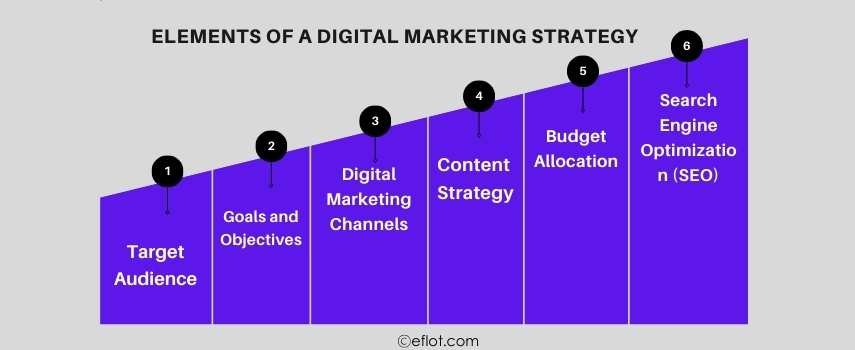
A digital marketing strategy is not a one-size-fits-all approach. The specific elements will vary depending on the business’s goals, industry, and target audience. However, several key components are critical to creating a successful digital marketing plan:
1. Target Audience
Understanding your target audience is the first step in building an effective digital marketing strategy. Identifying the characteristics of your ideal customer such as demographics, interests, online behaviors, and pain points will help tailor your messaging and tactics.
Why It Matters: A well-defined target audience ensures that your marketing efforts are directed at the right people, increasing the chances of engagement and conversion.
2. Goals and Objectives
Clearly defined goals and objectives provide direction for your digital marketing efforts. These could include increasing website traffic, generating leads, improving brand awareness, boosting sales, or building a loyal customer base.
Why It Matters: Goals guide your strategy, help you measure success, and allow you to adjust tactics when necessary. Be sure to make your goals SMART: Specific, Measurable, Achievable, Relevant, and Time-bound.
3. Digital Marketing Channels
The next step is selecting the right digital marketing channels based on your target audience and business objectives. Some of the most popular channels include:
-
Search Engine Optimization (SEO): Optimizing your website to rank higher on search engine results pages (SERPs).
-
Content Marketing: Creating valuable, relevant content to attract and engage your audience.
-
Social Media Marketing: Engaging with users on platforms like Facebook, Instagram, LinkedIn, Twitter, etc.
-
Pay-Per-Click (PPC) Advertising: Using paid ads to appear on search engines or social media platforms.
-
Email Marketing: Building relationships with customers through personalized emails.
-
Affiliate Marketing: Partnering with other businesses or influencers to promote your products.
Why It Matters: Each channel serves a different purpose and reaches people at various stages of the buyer's journey. The right mix of channels will ensure maximum reach and engagement.
4. Content Strategy
Content is at the heart of most digital marketing strategies. A content strategy involves planning, creating, and distributing content that resonates with your target audience. Content can take various forms, such as blog posts, videos, infographics, podcasts, and social media posts.
Why It Matters: Engaging, high-quality content helps build trust and authority with your audience, leading to higher conversion rates.
5. Budget Allocation
A successful digital marketing strategy requires a clear budget to ensure that resources are allocated effectively. This involves determining how much to invest in various channels, tools, and campaigns.
Why It Matters: Proper budget allocation helps businesses focus their efforts on the most effective channels and avoid overspending on underperforming tactics.
6. Search Engine Optimization (SEO)
SEO is a critical component of any digital marketing strategy. It involves optimizing your website and content to rank higher on search engines, which increases organic traffic. SEO includes both on-page factors (like keyword optimization and content quality) and off-page factors (like backlinks and domain authority).
Why It Matters: A well-optimized website ensures visibility on search engines, allowing you to attract more organic traffic and generate leads without paying for ads.
Tools Used by Top Digital Marketing Companies
To accurately evaluate the success of digital marketing campaigns, top digital marketing companies use a variety of tools and platforms. These tools provide in-depth insights into campaign performance, customer behavior, and overall effectiveness.
-
Google Analytics: A staple in the digital marketing world, Google Analytics provides comprehensive data about website traffic, user behavior, conversion rates, and more. It allows businesses to measure both traffic quality and ROI.
-
SEMrush: This is a favorite for SEO-focused evaluation. SEMrush helps track keyword rankings, backlink profiles, organic traffic, and competitor performance, enabling businesses to optimize their SEO efforts.
-
HubSpot: This marketing automation platform helps businesses track leads, conversions, and customer journeys, offering deep insights into which marketing tactics are most effective for lead generation.
-
Hootsuite: For social media evaluation, Hootsuite provides analytics to track engagement, follower growth, and post-performance across multiple platforms, making it easy to analyze social media ROI.
-
Sprout Social: Like Hootsuite, Sprout Social is another powerful tool for measuring social media success. It includes in-depth reporting on engagement, sentiment, and reach across various platforms.
Case Studies
Case Study 1:
UpGrad is an online education platform offering a variety of courses, ranging from data science to management programs. As a growing player in the ed-tech industry, UpGrad was looking to expand its online presence and drive more qualified leads. Their objective was not just to increase the number of website visitors but to specifically attract students who were likely to convert into paying customers.
Challenges: UpGrad faced fierce competition from other online education platforms such as Coursera, Udemy, and edX. In a crowded marketplace, standing out and attracting the right audience proved to be a major challenge. This competition meant that the company had to ensure their marketing efforts were highly targeted to avoid wasting resources.
Results: The results were evaluated using in-depth data analytics tools and A/B testing to identify what worked best for each specific course and audience segment. By analyzing which ads and content pieces performed better, UpGrad was able to continuously optimize campaigns. As a result, they reduced CPA by 25% and saw a 40% increase in sign-ups within three months.
Case Study 2:
Housing.com is an online real estate platform that connects buyers and sellers. The company wanted to increase its lead generation capabilities, but it wasn't just about the quantity of leads—they were looking to improve the quality of leads to drive higher conversions.
Challenges: One of the significant challenges Housing.com faced was receiving high volumes of leads that were not converting. Their previous digital marketing strategy focused primarily on generating a large number of leads, but many of them weren’t qualified, leading to wasted resources.
Results: The agency employed advanced data analytics tools to assess how different campaigns were performing across various digital channels. Housing.com used A/B testing to refine its messaging, targeting, and landing pages, ensuring that the leads generated were not only abundant but also of high quality. In just six months, they saw a 35% improvement in lead quality, measured by an increase in conversions, and a 20% decrease in cost-per-lead (CPL).
Evaluating the results of digital marketing campaigns is critical for any business striving to succeed in the online world. By focusing on key metrics such as traffic quality, conversions, ROI, CLV, and social media engagement, you can gain a clear understanding of how well your strategies are performing. Tools like Google Analytics, SEMrush, and HubSpot can provide the data needed to make informed decisions, while top digital marketing companies offer the expertise and insight required to drive real business results.
Remember, digital marketing is not a one-time effort it’s an ongoing process. By regularly evaluating your marketing efforts, you ensure that your strategies are always aligned with your business goals, helping you stay ahead of the competition and drive sustainable growth in the long term.
Digital Marketing services in Other Locations in India
Bangalore | Hyderabad | Chennai | Pune | Ahmedabad | Coimbatore | Mumbai | Kolkata | Patna | Amritsar | Indore | Kozhikode | Trivandrum | Jaipur | Nagpur | Gwalior | Dehradun | Noida | Vizag | Raipur | Agra | Gurgaon | Madurai | Udaipur | Thrissur |