













Is Your Clinic Missing Out on Online Visibility?
Struggling to attract more patients online? Improve SEO, local listings, and social media to boost your clinic's visibility and reach the right audience effectively.
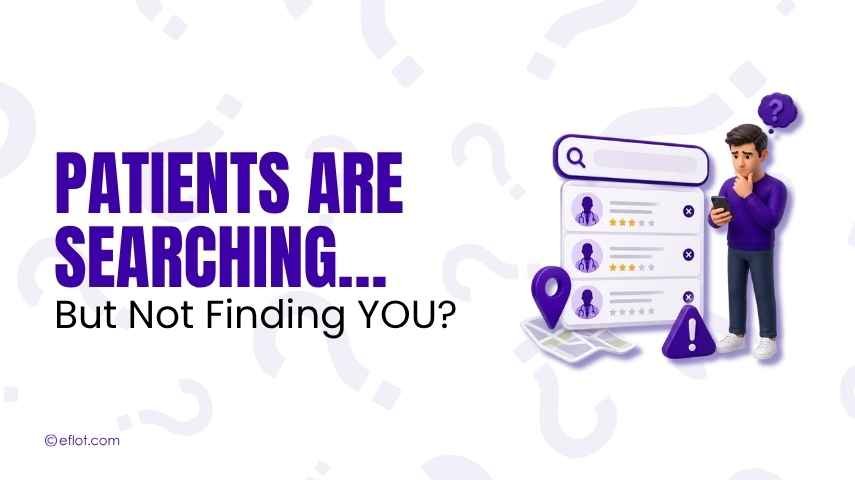
A patient nearby just searched their symptoms on Google, compared a few clinics, read reviews, and booked an appointment.
Not with you.
77% of patients start their healthcare journey online. If your clinic isn’t on page one, you’re not part of the decision at all.
Many clinics still rely on referrals or a basic website. Meanwhile, competitors using SEO and ads are capturing high-intent patients daily, often seeing up to 3x more enquiries.
Digital marketing isn’t optional anymore. It directly influences who finds you, trusts you, and books with you.
Let's break down what actually works, the key channels, proven tactics, and costly mistakes to avoid, so your clinic stops being invisible and starts becoming the first choice.
Why does digital marketing for healthcare matter more than ever?
84% of patients checked online reviews before booking services.
Patients behave like consumers now. They research, compare, and read reviews before they ever pick up a phone. A clinic with a well-maintained Google Business Profile, strong reviews, and an optimised website will always win over one that relies purely on word-of-mouth.
The shift is already visible in the numbers. 2025 was the first year that social media advertising in healthcare surpassed traditional linear TV spend. In 2026, hospitals and clinics that adapted early are pulling ahead. Those that are still stuck with just a brochure website are quietly losing patients every single day.
Digital marketing for healthcare covers every touchpoint - SEO, paid ads, social media, reputation management, email, and content.
Each one plays a different role in bringing patients from "I have a problem" to "I've booked an appointment."
What channels actually work in healthcare digital marketing?
Not every channel performs equally. Here is a breakdown of the ones that deliver consistent results for healthcare providers:
Local SEO: Gets your clinic found when someone searches "cardiologist near me." The highest purchase-intent traffic you can capture.
Content Marketing: Educational blog posts and health guides that answer patient questions and build authority in Google's eyes.
Google Ads (PPC): Paid search drives immediate visibility. Healthcare conversion rates average 2.6%, higher than most other paid display formats.
Reputation Management: Actively requesting and responding to Google reviews improves rankings and directly influences patient decisions.
Social Media: 52% of patients tried a health approach they first discovered on social media. Video content from doctors builds trust at scale.
Email Marketing: Appointment reminders, follow-up care tips, and seasonal health campaigns keep patients engaged between visits.
How does SEO work differently in healthcare than in other industries?
Healthcare SEO carries extra weight. Google classifies medical content as YMYL - "Your Money or Your Life." Pages in this category are held to a higher quality standard.
A poorly written article from a clinic with weak authority will not rank, even with great keywords.
|
SEO Factor |
What it means for healthcare |
Priority |
|
E-E-A-T (Experience, Expertise, Authority, Trust) |
Content must be written or reviewed by medical professionals. Author bios matter here. |
High |
|
Google Business Profile |
Your local listing controls how you appear in map searches. Keeps hours, services, and reviews current. |
High |
|
Location-specific landing pages |
If you have multiple clinics, each needs its own optimised page, not one generic "contact us" page. |
High |
|
Page speed and mobile experience |
80% of patients search on mobile. A slow website means lost appointments, not just lost rankings. |
High |
|
Schema markup (MedicalOrganization) |
Structured data helps Google understand your specialty, location, and services instantly. |
Medium |
|
Patient review velocity |
Consistently getting fresh Google reviews signals activity and trustworthiness to the algorithm. |
High |
What does the patient's digital journey actually look like?
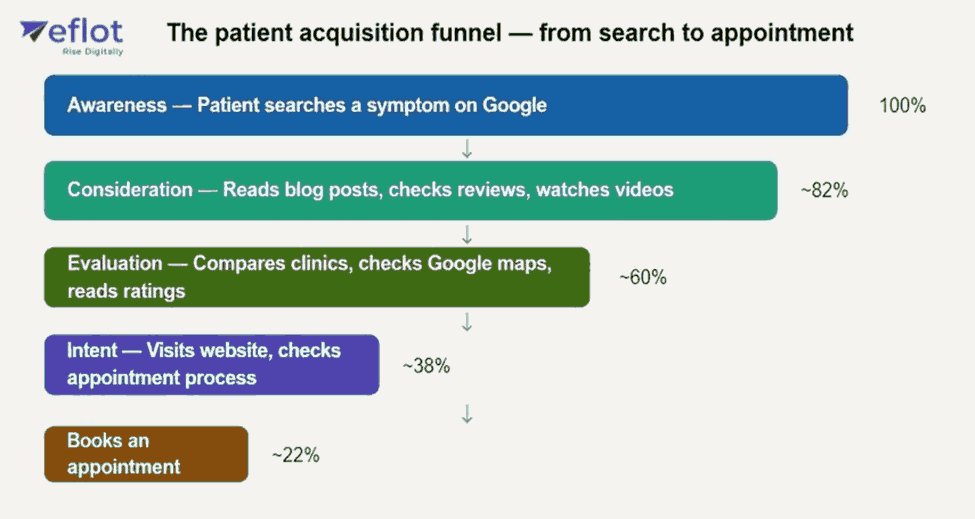
Every stage of this funnel requires a different strategy. Content marketing wins the awareness stage. SEO and reputation management handle consideration and evaluation.
A fast, mobile-friendly website with a clear booking flow closes the conversion. Missing even one stage means losing patients to a competitor who covered it.
How do Google Ads work for healthcare providers?
Paid search in healthcare is one of the fastest ways to increase patient appointments. Unlike SEO, which takes months to gain traction, a well-structured Google Ads campaign can deliver enquiries within days of launching.
The key things that separate a performing healthcare PPC campaign from one that wastes budget:
Is targeting hyper-local a must?
Yes. A patient searching for "orthopaedic surgeon in Bengaluru" will never drive to Mumbai for a consultation. Your ads should target the specific pin codes or the radius around your clinic. Broad national targeting drains the budget with zero bookings.
What ad formats work best for clinics?
Responsive search ads with location extensions perform best. Include your clinic's address, call button, and booking link in the ad itself. Patients searching from mobile want one tap to call, make that as easy as possible. Ads for healthcare also need HIPAA-compliant landing pages that do not collect sensitive data beyond what is necessary.
Are negative keywords important?
Critically important. Without them, your cardiology clinic might show up for "cardiology salary" or "cardiology textbook." Build a thorough negative keyword list from day one to avoid paying for irrelevant clicks.
How does social media fit into healthcare digital marketing?
Social media for healthcare is not about going viral. It is about increasing visibility for healthcare brands among people who are actively making health decisions.
The format that works best right now: short-form video. A 90-second video of a doctor explaining a common condition outperforms a polished graphic post every time. Patients want expertise and authenticity, not production value.
For instance, TalkSpace, a mental health platform, built its entire brand awareness through educational long-form blog content and social video. Both rank at the top of Google for high-intent health searches. Their content strategy, educate first, promote second is exactly what independent clinics should replicate at a local level.
Platforms worth prioritising for healthcare:
-
YouTube: 2.49 billion monthly users. Ideal for explainer videos and procedure walkthroughs
-
Instagram: Strong for before/after content (within ethical guidelines), health tips, and doctor introductions
-
LinkedIn: Effective for B2B healthcare (hospital networks, medical device companies, health-tech)
-
Facebook: Still the highest-reach platform for patients aged 40+ in India and Southeast Asia
What makes a healthcare digital marketing strategy genuinely compliant?
Compliance is where many clinics trip up. Healthcare advertising is governed by specific rules that vary by country. In India, the Indian Medical Council (Professional Conduct, Etiquette and Ethics) Regulations restrict testimonials, guarantees of treatment outcomes, and comparative advertising.
Key compliance checkpoints for any digital marketing in hospital or clinic settings:
1. No outcome guarantees in ads or content
2. Patient testimonials must be voluntarily given
3. Data collection must follow local privacy laws
4. Ad copy cannot be misleading about qualifications
Working with a digital marketing agency that understands healthcare compliance is critical. Generic marketing agencies will write ad copy that gets disapproved or, worse, gets a clinic flagged by a regulatory body.
When should a clinic work with a dedicated healthcare digital marketing agency?
Most clinics try to handle digital marketing in-house at first. A front-desk manager posts on Instagram, a junior staff member updates the Google listing, and the website looks the same as it did in 2018. This works, until it does not.
The right time to start finding a digital marketing agency for healthcare is when:
-
Competitor clinics are consistently outranking you in search.
-
You are running Google Ads, but have no clear data on which campaigns drive appointments.
-
Your website receives traffic, but appointment bookings have not grown proportionally.
-
You want to expand to new locations and need a scalable local SEO strategy.
-
Your online review score is below 4.2, and you have no system for recovering it.
Eflot works specifically with healthcare providers to build marketing systems that connect online visibility directly to patient bookings. The team brings together SEO services, paid media, and reputation management under one strategy built around the specific compliance and trust requirements of the healthcare sector.
Key takeaways
-
Patients research before they book: 77% begin on Google. If you are invisible there, you lose to whoever is visible.
-
Reviews drive decisions: 84% of patients checked online reviews before booking. A proactive review strategy is non-negotiable.
-
Local SEO outperforms paid for sustained growth: One well-optimised location page can drive enquiries for years with zero ongoing ad spend.
-
Content builds authority in healthcare: Google's E-E-A-T standards mean low-quality content actively harms your rankings. Expert-written articles win.
-
PPC is for speed, SEO is for scale: Use Google Ads to generate immediate appointments while SEO builds long-term organic dominance.
-
Compliance is not optional: Healthcare marketing has specific rules. Working with specialists like Eflot prevents costly mistakes.
Frequently asked questions
1. How long does it take for digital marketing to show results for a healthcare clinic?
Paid ads (Google Ads) can generate enquiries within 48–72 hours. SEO typically takes 3–6 months for noticeable rankings, while reputation improvements (reviews) show results in 60–90 days with consistent effort.
2. What is the most cost-effective digital marketing channel for small clinics?
Local SEO, optimising your Google Business Profile and generating consistent reviews, offers the best ROI. It’s time-intensive, not budget-heavy, and can significantly increase inbound calls over time.
3. Is it ethical for doctors to run ads on Google or social media?
Yes, if done responsibly. Promoting services and access is allowed, but misleading claims, guaranteed outcomes, or fake testimonials are restricted, especially under Indian guidelines.
4. How important are online reviews for a hospital or clinic's search ranking?
Very important. Google prioritises review quantity, recency, and ratings; clinics with frequent, recent reviews rank higher than those with outdated feedback.
5. What should I look for when choosing a digital marketing agency for a healthcare brand?
Choose an agency with healthcare experience, compliance knowledge, and clear reporting tied to patient appointments. Proven case studies are essential.
Digital Marketing services in Other Locations in India
Bangalore | Hyderabad | Chennai | Pune | Ahmedabad | Coimbatore | Mumbai | Kolkata | Patna | Amritsar | Indore | Kozhikode | Trivandrum | Jaipur | Nagpur | Gwalior | Dehradun | Noida | Vizag | Raipur | Agra | Gurgaon | Madurai | Udaipur | Thrissur |