

















How SEO & Content Marketing Work Together
Discover how SEO and content marketing work together to drive traffic, improve visibility, and grow your business effectively.
As a digital marketing specialist, I have worked with several businesses, from small startups to large enterprises, in building their online presence. One thing I’ve consistently noticed is how businesses often treat SEO and content marketing as separate strategies when in reality, they work best when combined. The association between SEO and content marketing can drive both short-term traffic and long-term growth. When used together effectively, they create a powerful combination that not only enhances your search engine rankings but also helps you connect with your audience in a more meaningful way. So, how exactly do SEO and content marketing work together to fuel business success?
The teamwork between SEO and content marketing is essential for businesses aiming to succeed in the digital space. By combining SEO techniques such as keyword optimization, on-page SEO, and link building with high-quality, relevant content, businesses can boost their visibility on search engines while providing value to their audience. Content marketing fuels SEO by creating fresh, engaging material that attracts organic traffic, while SEO ensures that this content is discoverable. In essence, SEO and content marketing are not stand-alone strategies but complementary elements that, when used together, deliver measurable business growth and long-term success.
What Is SEO?
SEO, or Search Engine Optimization, is the practice of optimizing a website to increase its visibility in search engine results pages (SERPs). The goal of SEO is to make a website more discoverable and accessible to search engines like Google, Bing, and Yahoo, in order to drive organic (unpaid) traffic to the site.
SEO involves a variety of techniques, strategies, and best practices aimed at improving a website’s ranking for relevant search queries.
What Is Content Marketing?
Content marketing is a strategic approach to creating, distributing, and sharing valuable, relevant, and consistent content to attract and engage a specific target audience. Unlike traditional advertising, which focuses on selling products or services directly, content marketing aims to educate, inform, entertain, or solve problems for the audience, thereby building trust and fostering long-term relationships. The core idea behind content marketing is to provide content that adds value to the audience's experience and helps them at various stages of their buying journey.
Key Differences Between SEO and Content Marketing
SEO (Search Engine Optimization) and content marketing are two of the most essential digital marketing strategies for driving traffic to your website, but they are often confused or used interchangeably. While both are integral to improving your online visibility and attracting an audience, they serve different purposes and require distinct approaches. Below, we’ll break down the key differences between SEO and content marketing:
1. Definition and Focus
-
SEO: SEO is the process of optimizing your website to rank higher on search engine result pages (SERPs) for specific keywords. It involves technical optimization, keyword research, on-page SEO (like meta tags, URLs, headers), off-page SEO (like backlinks), and improving site speed and mobile-friendliness. The main goal of SEO is to increase the visibility of a website in search engine results, making it easier for people to find you when they search for relevant queries.
-
Content Marketing: Content marketing, on the other hand, involves creating and distributing valuable, relevant, and engaging content to attract, inform, and nurture your target audience. It aims to build relationships and brand awareness through blogs, videos, social media posts, podcasts, infographics, and more. The primary goal of content marketing is to educate, inform, entertain, or solve problems for your audience, encouraging them to take action over time.
2. Goal and Purpose
-
SEO: The main goal of SEO is to improve your website’s ranking in search engines so that it can be discovered by a larger audience. It's focused on driving organic traffic by optimizing content and web pages for better search visibility.
-
Content Marketing: Content marketing focuses on building a relationship with your audience by offering valuable information. It aims to provide a solution, answer a question, or create engagement, with the ultimate goal of converting your audience into customers, subscribers, or loyal brand advocates.
3. Content Type
-
SEO: SEO revolves around ensuring your content is discoverable and relevant to search engines. It involves keyword research, backlink building, and technical optimization to ensure your content has the best chance of appearing on search engines for target queries. SEO applies to content like blogs, articles, product pages, or any other content on your website that you want to rank.
-
Content Marketing: Content marketing involves creating original and valuable content to address the needs of your audience. This includes blogs, eBooks, white papers, case studies, infographics, and videos. The focus is not on the search engines but on the audience, making sure your content resonates with them.
4. Time Frame for Results
-
SEO: SEO is a long-term strategy. It often takes time to see significant results, as it involves a mix of on-page, off-page, and technical elements. Changes made to optimize your website could take weeks or even months to positively impact your rankings and organic traffic.
-
Content Marketing: Content marketing results can also take time but can sometimes generate faster engagement. When done right, content can drive instant interactions through social media shares, email sign-ups, or clicks. However, it also requires consistent effort to maintain ongoing visibility and audience interest.
5. Strategy and Approach
-
SEO: SEO is more technical. It involves various elements such as keyword research, on-page optimization (title tags, meta descriptions, internal linking), off-page tactics (backlinking, outreach), and technical SEO (site speed, mobile optimization, crawl errors). SEO is a strategic process that aims to make sure your content ranks well in search engines.
-
Content Marketing: Content marketing is more about creating and distributing valuable, high-quality content that addresses your audience’s needs or interests. It’s about developing a strategy for content creation and distribution across various channels like blogs, social media, newsletters, and more.
6. Measurement
-
SEO: SEO performance is typically measured using metrics like organic traffic, keyword rankings, domain authority, page authority, and backlink quality. The focus is on metrics that show how well your website ranks and how much organic traffic it’s receiving.
-
Content Marketing: Content marketing is measured through engagement metrics like social shares, comments, time spent on the page, conversions, and lead generation. Content performance is evaluated based on how well it engages the audience and how it drives actions (e.g., email signups, and product purchases).
How Content Marketing and SEO Benefit Each Other
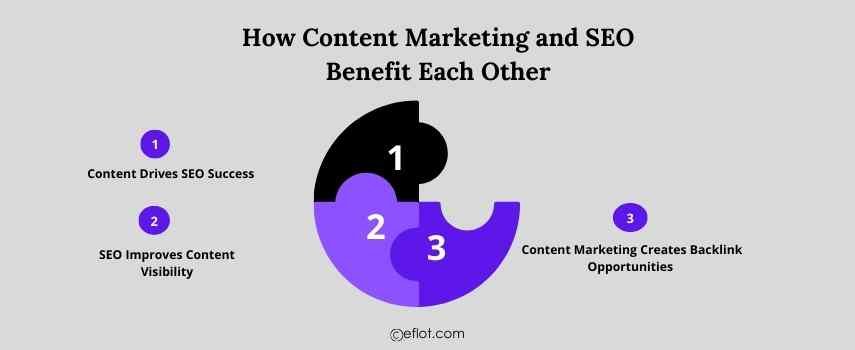
SEO and content marketing are often seen as two separate entities, but in reality, they work hand in hand to drive organic traffic, increase brand visibility, and generate leads. When implemented together strategically, they form a powerful combination that can enhance the effectiveness of your overall marketing strategy.
1. Content Drives SEO Success
Content marketing involves creating valuable, relevant content to engage your target audience, and this content can be optimized to rank higher on search engine results pages (SERPs). SEO, on the other hand, is about ensuring that this content is structured in a way that makes it easy for search engines to crawl and index it.
-
SEO Benefit: When you create high-quality, engaging content, you naturally include the right keywords that people are searching for. This helps search engines understand what your content is about and improves its chances of ranking higher for those specific keywords.
-
Content Benefit: Great content that is optimized for search engines has the potential to reach a wider audience. By focusing on creating content that meets both user needs and SEO standards, you're ensuring that your content will not only be helpful to your audience but also visible to them when they search for relevant topics.
2. SEO Improves Content Visibility
When you combine SEO techniques with content marketing, you give your content the best chance of being seen by your target audience.
-
SEO Benefit: Keyword research, for example, helps you identify what your audience is searching for and what keywords you should target in your content. Without SEO, your great content might not even be visible to those who are searching for the topics you cover. Effective SEO ensures that your content ranks for the right search terms, boosting its visibility and making it more discoverable to potential readers.
-
Content Benefit: When your content is optimized with SEO best practices (like using the right keywords, improving page speed, and creating user-friendly meta descriptions), it has a higher chance of showing up on the first page of search results, leading to more clicks, shares, and engagement. This visibility increases the likelihood that your content will be shared across social platforms or referenced by other authoritative websites.
3. Content Marketing Creates Backlink Opportunities
Backlinks are one of the most important off-page SEO factors. They act as endorsements for your content, indicating to search engines that your site is authoritative and trustworthy. The more high-quality backlinks you receive, the higher your rankings will be.
-
SEO Benefit: When you create high-quality, shareable content through content marketing, others in your industry or niche are more likely to link back to your content. These backlinks signal to search engines that your content is valuable and relevant, which improves your SEO ranking.
-
Content Benefit: Quality content is essential for building backlinks. If your content doesn’t offer anything of value, no one will want to link to it. Content marketing that focuses on creating valuable resources such as research reports, case studies, guides, and infographics tends to attract more backlinks, further enhancing your SEO efforts.
Case studies
Case Study 1:
Livspace, one of India’s leading home interior design platforms, provides a seamless experience for users to design, plan, and execute interior décor projects. However, despite its innovative services, Livspace faced challenges in generating online traffic and leads, especially in a competitive space dominated by other home décor services. They turned to a top digital marketing agency to improve their digital footprint and lead-generation strategies.
Challenges:
-
Low organic search rankings for competitive keywords related to home interior services.
-
Struggling to convert website traffic into actual leads.
-
Difficulty in establishing a strong digital brand presence in a competitive market.
Solution:
The agency’s first step was a detailed audit of Livspace’s website and digital assets. They implemented an SEO overhaul, improving keyword rankings, optimizing on-page elements, and boosting content relevancy. Additionally, they focused on targeted paid media campaigns, including search ads and social media marketing. The agency also integrated a strong content marketing strategy with engaging blog posts and customer success stories to build brand trust and authority.
Case Study 2:
Chumbak, a leading Indian lifestyle, and home décor brand, wanted to enhance its online visibility and reach a broader audience, both in India and internationally. Known for its quicky and colourful designs, Chumbak wanted to make sure its e-commerce platform and social media presence reflected its unique brand voice. To achieve this, they sought the help of a top digital marketing agency.
Challenges:
-
Limited online visibility compared to competitors.
-
Difficulty in creating a brand voice that connected with diverse audience segments.
-
Low organic search traffic and conversion rates from digital channels.
Solution:
A top digital marketing agency stepped in with a comprehensive strategy combining SEO, social media marketing, paid advertising, and content marketing. By performing in-depth audience research, the agency optimized Chumbak’s website for both search engines and user experience. They also developed a targeted social media strategy, which leveraged influencers and engaging content to enhance brand recognition and build a loyal community.
SEO and content marketing are the backbone of any successful digital strategy. When these two elements work together, they enhance each other’s effectiveness, helping businesses achieve greater visibility, engage more customers, and ultimately drive more conversions. By understanding how SEO and content marketing complement each other, businesses can stay ahead of the competition and achieve sustained growth. So, if you're looking to boost your online presence and drive real business results, combining SEO with content marketing is the way to go.
Digital Marketing services in Other Locations in India
Bangalore | Hyderabad | Chennai | Pune | Ahmedabad | Coimbatore | Mumbai | Kolkata | Patna | Amritsar | Indore | Kozhikode | Trivandrum | Jaipur | Nagpur | Gwalior | Dehradun | Noida | Vizag | Raipur | Agra | Gurgaon | Madurai | Udaipur | Thrissur |