

























Keyword Mapping: Your First Step to a Powerful SEO Foundation
Build a strong SEO base with keyword mapping. Learn how to organize keywords for better rankings, improved content planning, and a more effective SEO strategy.

90% of SEO projects stall at the same point. The keyword research is done, the spreadsheet has hundreds of terms, and the team is ready to create content. Then someone asks: "Which keyword goes on which page?" and there is no clear answer.
That is where keyword mapping comes in. It is the step that converts raw keyword data into a structured, page-by-page content plan.
Skip it, and your site ends up with pages competing against each other, confused search engines, and rankings that plateau for no obvious reason.
The pattern is consistent: sites that invest time in keyword mapping before writing a single word of content grow faster, rank more sustainably, and recover from algorithm updates with less drama.
This guide covers everything you need to build, execute, and maintain a keyword mapping strategy that holds up long-term.
What Is Keyword Mapping in SEO?
Keyword mapping is the process of assigning specific target keywords to individual pages on your website.
Each page gets a primary keyword (the main search term it is built around) and a small cluster of supporting or secondary keywords (supporting terms).
Think of it as a blueprint for your website. It defines:
-
Which page targets which intent
-
What each page is responsible for
-
How pages avoid overlapping
Keyword mapping is the plan for your website. It tells you which page targets which search intent, and prevents two pages from accidentally doing the same job.
A keyword map is usually a spreadsheet with these core columns:
-
Page URL: existing or planned
-
Primary Keyword: the main focus term for that page
-
Secondary Keywords: supporting terms to weave into the content
-
Search Intent: informational, commercial, transactional, or navigational
-
Search Volume: monthly search volume for the primary keyword
-
Keyword Difficulty: how competitive the term is
-
Status: draft, published, needs update
|
Difference between Keyword Mapping and Keyword Research: Keyword research finds which terms exist and how they perform. Keyword mapping decides which page owns each term. Both are essential, but they serve different roles. |
Benefits of Keyword Mapping in SEO
Keyword mapping is worth the upfront investment. Here is what it delivers in practice:
1. Eliminates Keyword Cannibalization
Cannibalization happens when two or more pages on the same site target the same keyword. When multiple pages target the same keyword, rankings weaken.
Keyword mapping ensures one keyword = one page.
2. Aligns Every Page With Search Intent
Each page is built for a specific user intent, which improves relevance and engagement.
3. Supports Stronger On-Page SEO
With a clear keyword plan, elements like:
-
Title tags
-
H1s
-
Meta descriptions
-
Internal links
become structured and aligned.
4. Builds a Logical Site Structure
Keyword mapping creates:
-
Pillar pages
-
Supporting clusters
-
Clear internal linking paths
5. Exposes Content Gaps
Your keyword map reveals:
-
Missing topics
-
Untapped opportunities
-
Competitor advantages
When each page targets a clear keyword, rankings become more stable and easier to improve.
Moving from position #2 to #1 can increase organic traffic by 50% on average. This is why precise keyword targeting and proper mapping directly impact traffic growth.
How to Do Keyword Mapping: Step-by-Step Process

Here is the exact process used for client campaigns. Follow these steps in order, and you will end up with a map that is both strategic and immediately usable.
Step 1: Audit Your Existing Pages
-
Before adding any new keywords, understand what you already have.
-
Export all published URLs from your site.
-
For each page, note the current focus topic, any keywords it already ranks for (pull this from Google Search Console), and current traffic levels.
This prevents you from accidentally mapping keywords to pages that already serve a different purpose.
Step 2: Conduct Thorough Keyword Research
Use a combination of tools to build your keyword pool. Start with your core topic seeds, then expand using keyword research platforms. Collect data on:
-
Monthly search volume
-
Keyword difficulty score
-
Search intent (informational, commercial, transactional, navigational)
-
Related terms and long-tail variations
Step 3: Group Keywords Into Clusters
-
Keywords that share the same search intent and topic belong on the same page. Group them into clusters.
-
Each cluster gets one primary keyword (highest volume, most representative) and several secondary keywords (supporting terms, long-tail variations, synonyms).
Keep this rule simple: if two keywords would be satisfied by the same piece of content, they belong in the same cluster.
Step 4: Match Clusters to Pages
-
Assign each keyword cluster to a page.
-
For existing pages, match clusters to the most relevant URL.
-
For gaps where no page exists, mark the row as 'new page needed' and use it as your content calendar.
Cannibalization check: Once you have assigned clusters to pages, scan for any primary keyword appearing in more than one row. If it does, consolidate, either merge the pages or differentiate the intent so they target genuinely different queries.
Step 5: Prioritise by Opportunity
Not all keywords deserve equal attention. Prioritise based on:
-
Business impact — does ranking here lead to leads or revenue?
-
Volume vs. difficulty ratio — high volume with achievable difficulty
-
Intent alignment — does the page already exist, or does it need to be created?
-
Quick wins — keywords where your page ranks on Google page 2, and a small push could move it to page 1
Step 6: Implement On-Page SEO
With your map in hand, update or create each page. The primary keyword should appear in:
-
The H1 tag
-
The SEO title (page title tag)
-
The meta description
-
The URL slug (where possible)
-
The first 100 words of the body content
-
At least one subheading (H2 or H3)
Secondary keywords from the cluster are woven naturally into subheadings and body paragraphs, with no keyword stuffing.
Step 7: Review and Refresh Quarterly
A keyword map is a living document. Search trends shift, new competitors emerge, and Google updates change what ranks.
Set a quarterly review to update search volume data, reassign keywords where pages have drifted, and add new clusters for emerging topics.
According to the SEMrush State of Content Marketing Report, 73% of companies that invest in structured content strategies achieve better engagement and visibility.
Best Keyword Mapping Tools
The right tools make keyword mapping faster and more accurate. Below are the tools worth using, what they do, and where they fit in your workflow.
|
Tool |
Best For |
Key Feature |
Pricing |
|
Google Search Console |
Auditing existing keyword performance |
Shows which queries already drive clicks to each page |
Free |
|
Google Keyword Planner |
Initial keyword discovery |
Search volume ranges and related term suggestions |
Free |
|
SEMrush |
Full-cycle mapping and cannibalization detection |
Keyword Magic Tool + Keyword Strategy Builder + Cannibalization Report |
Paid (Free trial) |
|
Ahrefs |
Competitor keyword gap analysis |
Site Explorer shows competitor keyword clusters and traffic pages |
Paid |
|
Google Sheets / Excel |
Building and maintaining the keyword map |
Flexible, shareable, easy to filter and sort |
Free |
How to use Keyword Mapping Tools together
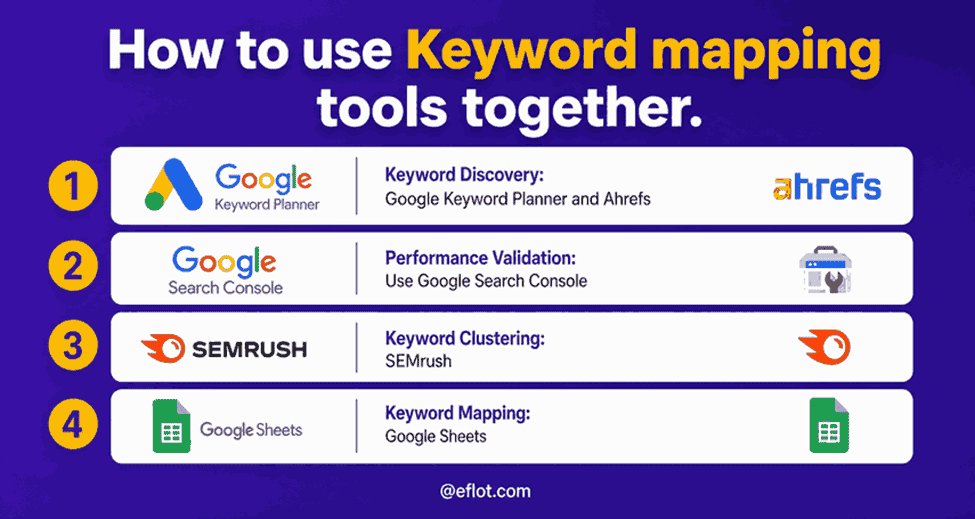
1. Keyword Discovery: Use Google Keyword Planner and Ahrefs to find keyword ideas, search volume, and variations.
2. Performance Validation: Use Google Search Console to identify existing rankings, clicks, and keyword overlaps.
3. Keyword Clustering: Use SEMrush to group keywords based on search intent and topic relevance.
4. Keyword Mapping:
Use Google Sheets to assign:
-
One primary keyword per page
-
Supporting secondary keywords
-
Clear search intent
5. SEO Execution
Create and optimize pages with:
-
Clear keyword focus
-
No cannibalization
-
Strong internal structure
|
Practical Tip: Start your keyword map in a Google Sheet with these column headers: URL | Primary Keyword | Search Volume | Difficulty | Intent | Secondary Keywords | Status | Last Updated. Keep it simple. A map you actually use beats a complex system you abandon after one week |
How Eflot Helps You With Keyword Mapping Strategy
Keyword mapping gets complex quickly, especially for large or growing websites. Eflot keeps the process structured and focused on outcomes.
-
Business-first approach: Keywords are mapped based on your goal — leads, sales, or visibility. Every page supports a defined outcome.
-
Full-funnel coverage: Keywords are mapped across all stages: Awareness, consideration, and conversion. This creates multiple entry points and steady traffic flow.
-
Cannibalization audit: Pages targeting the same keyword are identified and fixed through content merging, redirects, or clear differentiation.
-
Clear page ownership: Each page is assigned one primary keyword. This improves clarity for both users and search engines.
-
Data-backed execution: Insights from Google Search Console and SEMrush guide decisions and ongoing improvements.
Ready to build a keyword strategy that actually moves rankings?
Speak with the Eflot team about a keyword mapping audit for your website
FAQs About Keyword Mapping
1. How many keywords should one page target?
One primary keyword and 3–8 related secondary keywords. The primary keyword defines the page focus, while secondary keywords support it.
2. What is keyword cannibalization, and how does mapping prevent it?
Cannibalization happens when multiple pages target the same keyword and compete in search results. Keyword mapping fixes this by assigning one keyword to one page.
3. How often should I update my keyword map?
Review it every 3–6 months. For active websites, check monthly using Google Search Console to catch overlaps or new opportunities.
4. Can keyword mapping help an existing website?
Yes. It helps identify duplicate targeting, weak pages, and content gaps. Fixing these can improve traffic without creating new content.
5. Is keyword mapping different for small and large websites?
The process is the same. Smaller sites are quicker to map, while larger sites need a structured audit. The core rule stays the same: one keyword per page.
Keyword mapping turns SEO into a structured system. It takes the abstract goal of 'ranking higher' and turns it into a precise, page-by-page content plan where every piece of content has a clear purpose, a clear audience, and a clear set of keywords it is accountable for.
The sites that consistently outperform their competitors in search are rarely the ones with the most content or the biggest budgets. They are the ones with the clearest structure, and keyword mapping is what builds that structure.
Key Takeaways
-
One primary keyword per page
-
Prevent cannibalization
-
Align content with intent
-
Structure improves rankings
-
Regular updates keep the strategy effective
Start with a simple spreadsheet, a clear list of your existing pages, and a focused keyword research session. The keyword map you build in the next few hours will shape how your site performs in search for the next several years, and that is worth the investment.
Digital Marketing services in Other Locations in India
Bangalore | Hyderabad | Chennai | Pune | Ahmedabad | Coimbatore | Mumbai | Kolkata | Patna | Amritsar | Indore | Kozhikode | Trivandrum | Jaipur | Nagpur | Gwalior | Dehradun | Noida | Vizag | Raipur | Agra | Gurgaon | Madurai | Udaipur | Thrissur |