




How Digital Marketing and Advertising Drive Business
Learn how digital marketing and advertising strategies can enhance business growth, improve customer engagement, and drive revenue.
As a digital marketing specialist, I've seen personally how digital marketing and advertising have changed the way businesses interact with their customers. The progress of digital marketing has been amazing, from simple strategies like email marketing and banner ads to complex, data-driven methods. The current digital marketing allows companies to target customers with greater understanding, resulting in greater individualization and meaningful activities.
Search Engine Optimization (SEO) and Pay-Per-Click (PPC) are currently among the many ways of digital marketing and advertising, as are social media and content marketing. These methods give businesses more tools than ever to reach global audiences and engage them in unique ways, all while tracking progress in real-time.
What is Digital Marketing and Advertising?
Digital marketing and advertising are terms used to describe the promotion of businesses or services through various online channels such as search engines, social media, email, and paid advertising. Digital marketing links firms with customers where they spend the majority of their time online through methods such as SEO, content marketing, and paid advertising. Digital advertising, a type of digital marketing, focuses on paid ads like PPC and display ads that target consumers based on demographic, geographic, and behavioral information.
The capacity to personalize digital marketing and advertising efforts to specific demographics makes these techniques extremely efficient for increasing brand visibility, website traffic, and conversions. This customized approach offers clear outcomes, helping companies to constantly alter and improve their efforts.
Types of Digital Marketing and Advertising
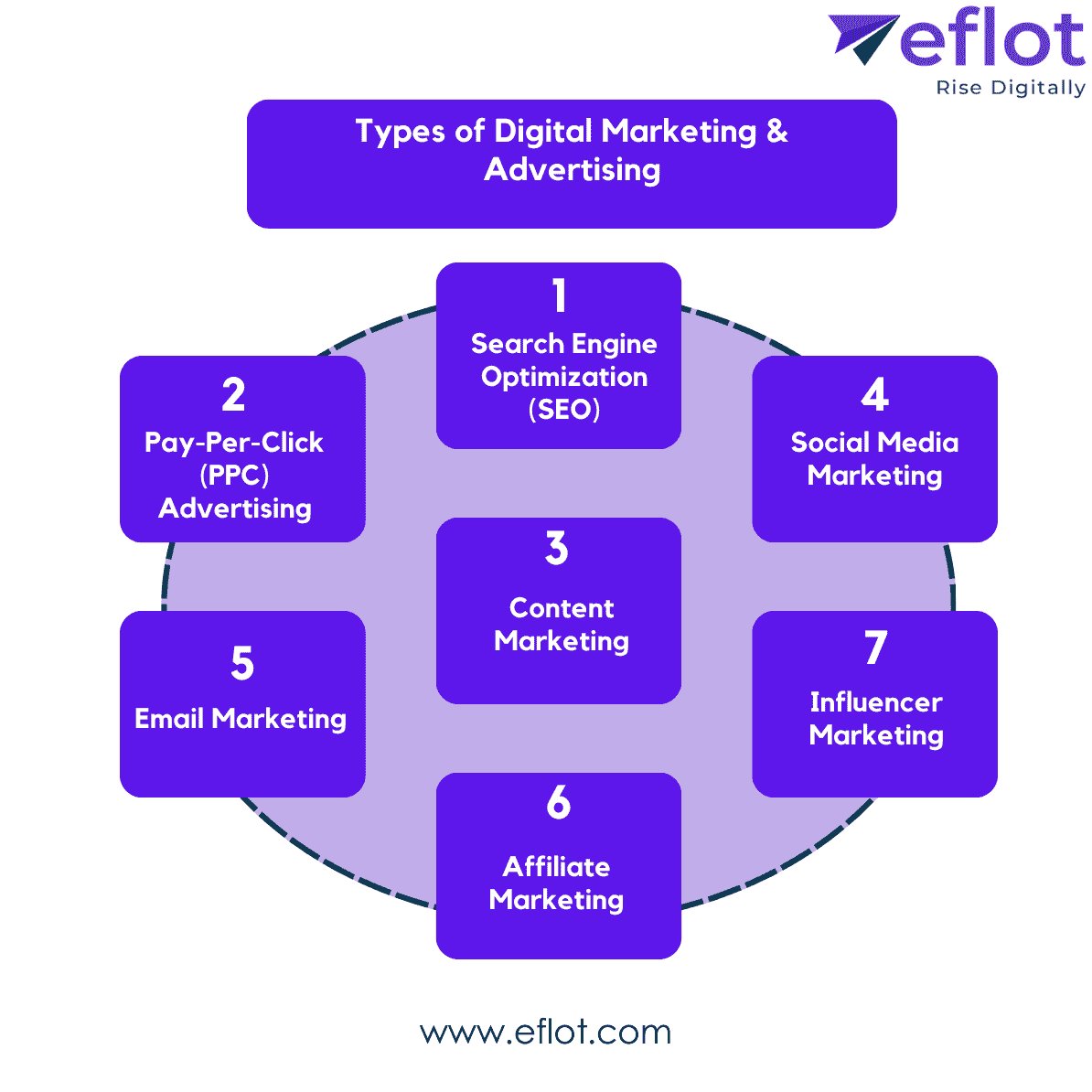
Digital marketing covers various approaches designed to meet different goals:
-
Search Engine Optimization (SEO): SEO helps businesses increase visibility on search engines through optimized content and website structure, driving organic traffic.
-
Pay-Per-Click (PPC) Advertising: This paid advertising model places ads on search engines or social media platforms, and businesses pay each time a user clicks the ad.
-
Content Marketing: Engaging content like blogs, videos, and infographics helps attract and retain customers.
-
Social Media Marketing: This involves creating and sharing content on platforms like Facebook, Instagram, and LinkedIn to build brand awareness and engagement.
-
Email Marketing: Sending personalized emails to subscribers to promote products or services.
-
Affiliate Marketing: Companies partner with affiliates who promote their products, earning a commission for each sale generated.
-
Influencer Marketing: Collaborating with influencers allows brands to leverage their audience for product promotion.
How Digital Marketing and Advertising Works
Digital marketing works through a combination of audience targeting, personalized content creation, and ongoing optimization. Key processes include:
-
Audience Research & Targeting: Marketers identify their target audiences based on factors like demographics, behaviors, and preferences.
-
Content Creation & Strategy: Tailored content such as blogs, videos, and ads are crafted to resonate with the intended audience.
-
SEO & Paid Advertising: SEO strategies help improve organic search rankings, while PPC ads drive immediate traffic to the website.
-
Engagement & Interaction: Social media and email campaigns provide opportunities for real-time interaction with customers.
-
Data Analytics & Optimization: Campaign performance is tracked and optimized to maximize ROI and improve effectiveness.
The Power of Digital Marketing and Advertising
The true power of digital marketing lies in its ability to:
-
Reach a Global Audience: Unlike traditional marketing, digital marketing breaks geographical barriers, allowing businesses to connect with global audiences.
-
Offer Targeted Marketing: Data-driven strategies ensure precise audience segmentation, making campaigns more efficient.
-
Provide Cost-Effective Solutions: Compared to traditional marketing methods, digital marketing offers a higher return on investment (ROI) at a lower cost.
-
Deliver Measurable Results: Real-time analytics allow businesses to see exactly how their campaigns are performing, enabling them to make data-driven adjustments.
-
Enable Personalization: Personalized marketing messages improve customer satisfaction and conversion rates.
-
Boost Engagement: Social media and email enable direct communication with customers, fostering strong relationships.
The Evolution of Digital Marketing and Advertising
Digital marketing has undergone significant evolution over the years:
-
Early Days: Initially, digital marketing and advertising consisted of simple banner ads and email marketing campaigns.
-
SEO & PPC: As the field matured, SEO and PPC became essential strategies for generating both organic and paid traffic.
-
Social Media & Content Marketing Growth: Platforms like Facebook, Instagram, and LinkedIn have become critical tools for businesses to engage with their audience. Content marketing also emerged as a core strategy for businesses to provide value to their customers.
-
Data-Driven Campaigns: Real-time tracking, audience segmentation, and personalized messaging began to shape modern digital marketing efforts.
-
Automation & AI: With automation tools and artificial intelligence (AI), businesses can optimize their digital marketing and advertising strategies in real time, improving efficiency and personalization.
Strategies for Targeted Reach & Personalization
Digital marketing excels because of its ability to target the right audience with personalized messaging. Successful strategies include:
-
Precise Audience Segmentation: Digital marketing and advertising allow businesses to segment audiences based on demographics, behaviors, and interests, ensuring campaigns reach those most likely to convert.
-
Personalized Messaging: Personalization improves engagement by delivering relevant content tailored to user needs and preferences.
-
Higher Engagement & Conversion Rates: Personalized content leads to improved click-through rates, engagement, and higher conversions.
-
Efficient Budget Use: By focusing on the right audience, businesses avoid wasted spending and improve ROI.
Future Trends in Digital Marketing and Advertising
The future of digital marketing and advertising will be shaped by new technologies and emerging trends:
-
Artificial Intelligence (AI) & Machine Learning: AI will further automate and optimize digital marketing campaigns, making them more efficient and personalized.
-
Voice Search Optimization: With the rise of voice-activated devices, businesses will need to optimize their content for voice search.
-
Video & Short-Form Content: Platforms like TikTok and Instagram Reels will continue to dominate digital content consumption, making short, engaging videos a critical component of digital marketing and advertising strategies.
-
Augmented Reality (AR) & Virtual Reality (VR): AR and VR will enhance customer experiences by enabling immersive product interactions.
-
Data Privacy & Compliance: As privacy regulations tighten, businesses will need to prioritize user consent and ensure compliance with data protection laws.
-
Social Commerce: The integration of e-commerce and social media will continue to grow, allowing users to make purchases directly through social platforms.
-
Predictive Analysis: Predictive analytics will enable businesses to forecast trends and provide hyper-personalized recommendations to customers.
-
Sustainability Marketing: With consumers becoming more environmentally conscious, businesses will focus on highlighting their sustainability efforts in their marketing campaigns.
In the digital time we live in, digital marketing and advertising are essential tools for corporate success. These methods provide outstanding chances for reaching and engaging with global audiences with targeted, personalized content. Businesses that adopt technologies such as AI, voice search optimization, and social commerce will remain competitive in the ever-changing landscape of digital marketing. Businesses that use these tools to develop genuine customer relationships can achieve long-term success and stay ahead in a competitive economy.
To maintain a competitive advantage as technology improves, organizations must adapt to trends such as artificial intelligence, predictive analytics, and immersive experiences such as mixed reality. These techniques not only increase customer involvement but also promote long-term brand loyalty. Businesses that leverage the potential of digital marketing can achieve long-term success while remaining quick in a changing digital world.
Digital Marketing services in Other Locations in India
Bangalore | Hyderabad | Chennai | Pune | Ahmedabad | Coimbatore | Mumbai | Kolkata | Patna | Amritsar | Indore | Kozhikode | Trivandrum | Jaipur | Nagpur | Gwalior | Dehradun | Noida | Vizag | Raipur | Agra | Gurgaon | Madurai | Udaipur | Thrissur |