








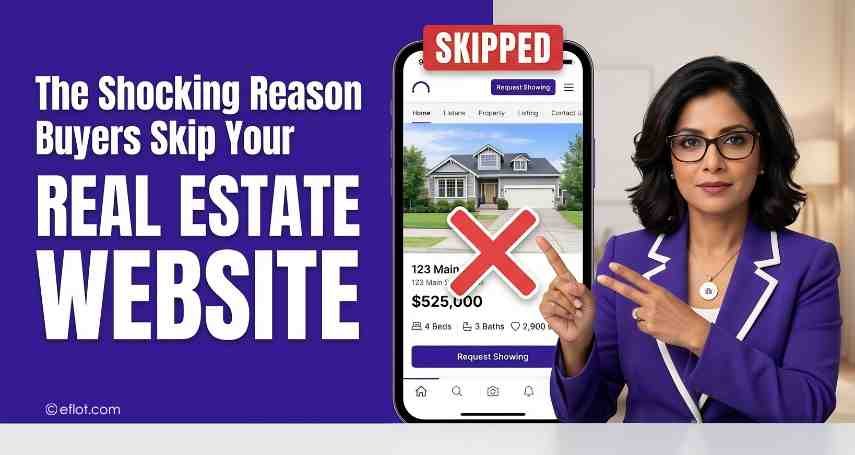
The Shocking Reason Buyers Skip Your Real Estate Website
Discover the real reason buyers abandon real estate websites and how smart digital marketing for real estate turns missed clicks into closed deals. Actionable fixes inside.
You have traffic. You have listings. You even have a decent design. So why are buyers still walking away — and closing with someone else?
Let me be direct with you. I have spent years auditing real estate websites for agencies, independent brokers, and developer groups across markets — and I keep finding the same problem dressed in different clothes. The website looks fine. The listings are there. Google Analytics shows visitors arriving. But the phones stay quiet.
The culprit? It is almost never the design. It is almost never the lack of a social media presence either. The real reason buyers skip your real estate website is far more specific and once you see it, you cannot unsee it.
Buyers are not just browsing properties. They are evaluating trust, speed, and credibility within seconds of landing on your page.
When your digital marketing for real estate fails to deliver those signals immediately, the visitor leaves. They head back to Google. And they find someone who does deliver it.
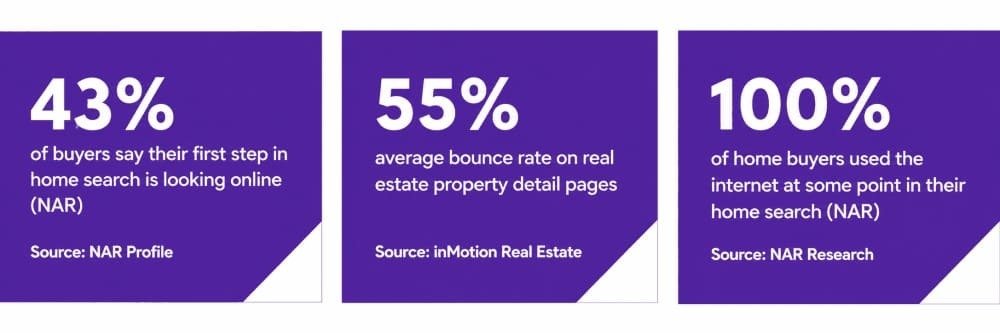
The Real Problem: You Are Selling Listings, Not Trust
Here is what most real estate professionals hear from their marketing agency: "Post more listings. Run Facebook ads. Get a virtual tour." All solid advice.
But it skips the foundational problem entirely.
When someone lands on your real estate website, they are not just looking for a three-bedroom flat with a south-facing balcony. They are quietly running an internal risk assessment.
Is this agent credible? Will this firm actually help me, or disappear after I sign? Your website has approximately eight seconds to answer those questions before they bounce.
"Before a potential client ever picks up the phone, they do research on agents online — scrolling through websites, social media profiles, client reviews, and listings, all to decide who feels like the right person to guide them through one of life's biggest transitions." — REALTOR® Magazine, September 2025
Effective digital marketing for real estate starts from this understanding. Your website is not a property catalogue. It is a trust-building machine and most real estate sites are built entirely backwards.
Where Buyers Actually Drop Off
Understanding bounce rate by page is critical for any serious digital marketing agency for real estate. Most discussions treat bounce rate as a single website metric. In practice, different pages bleed leads for completely different reasons.
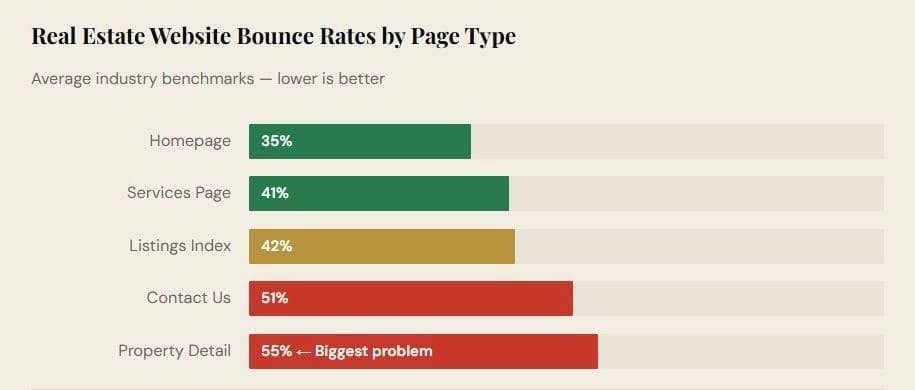
Source: https://inmotionrealestate.com/resources/bounce-rates-real-estate-websites/
The property detail page has the worst bounce rate of any page on most real estate websites. Think about that. The page carrying the most purchase-intent traffic is the page doing the worst job of holding attention. This is a digital marketing service for real estate problems at its core.
Why does this happen? Because most property pages are templates — price, square footage, location pin, and three photos. They give buyers data without giving them desire. No story. No neighbourhood context. No urgency. No sense of who to call or why.
5 Conversion Killers Hiding in Plain Sight
After auditing dozens of real estate websites, these five patterns show up consistently as the core reasons buyers leave:
|
Conversion Killer |
What Buyers Experience |
Severity |
|
Slow load time |
Page takes more than 3 seconds — buyer exits |
Critical |
|
No social proof above fold |
No testimonials, reviews, or transaction history visible |
Critical |
|
Generic listings only |
No neighbourhood guides, no agent insight, no local knowledge |
High |
|
Buried or weak CTAs |
Unclear next step — buyer guesses, then leaves |
High |
|
Mobile experience broken |
Photos crop badly, forms fail, navigation collapses |
Critical |
What Strong Digital Marketing for Real Estate Actually Looks Like
A real estate digital marketing agency worth hiring understands that the website is only one part of a larger conversion ecosystem. The channels, search, social, email, paid are the pipes. But the website is where the water has to flow cleanly.
Here is what top-performing real estate websites do differently:
1. They Lead With Proof, Not Product
The homepage opens with a number that matters. "314 families placed in their dream home" beats "Browse Our Latest Listings" every single time.
Buyers want evidence that you have done this before and done it well. Social proof at the top of the page is the single fastest trust signal in digital marketing for real estate.
2. They Treat SEO as Local Authority
Ranking for "3 BHK flats in Whitefield" is not enough.
The real estate websites that generate consistent inbound leads focused on local seo build topical authority in specific micro-markets.
They publish area guides, school zone breakdowns, price trend analyses, and infrastructure development stories for the neighbourhoods they serve.
This is content that a marketing agency for real estate cannot simply outsource to a generic writer, it requires on-ground knowledge and genuine expertise.
3. They Make Video Mandatory, Not Optional
A property video walkthrough does more than showcase a home.
It showcases the agent. It reveals personality, expertise, and communication style, the three things buyers are actually evaluating before they pick up the phone.
Digital marketing services for real estate that do not include a consistent video strategy in 2026 are leaving serious trust-building on the table.
4. They Run Retargeting as a Standard Practice
Most buyers do not convert on the first visit. They come back.
A properly set-up retargeting campaign via Google Display or Meta Ads keeps your listings and brand in front of warm prospects while they compare options.
This is foundational to any real estate digital marketing agency engagement, yet a surprising number of independent agencies still skip it.
Mistakes That Make Buyers Distrust Your Website
What to Eliminate Immediately
- Stock photography of families: Buyers can smell inauthenticity. Generic happy-family imagery signals that you are not committed to real content.
- Outdated listings left live: A sold property still showing as available damages trust faster than any bad review. Buyers feel misled before they even call.
- No agent bio with a face: Anonymity kills conversions. People buy from people. A professional photo and a genuine 100-word bio change everything.
- Generic contact forms with no context: "Fill this form and we will get back to you" tells buyers nothing. When will you respond? What happens next? That ambiguity costs leads.
- Ignoring page speed: Every second of load time beyond three seconds can increase your bounce rate by up to 32%, according to Google's own research.
Fixes That Work Fast
- Add a transaction counter to your homepage header: Even "Helped 80+ families find homes in South Bangalore" builds immediate credibility at zero cost.
- Write one neighbourhood guide per month: Hyper-local content ranking for specific area keywords drives the highest-intent traffic in digital marketing for real estate.
- Set response time expectations on your contact page: "We respond within 2 hours on business days" removes uncertainty and increases form submissions.
- Compress all images and switch to WebP format: This alone can halve your load time on listing pages — directly reducing bounce rates.
- Install a retargeting pixel on day one of any paid campaign: Building your audience from the start means cheaper, warmer retargeting traffic within 30 days.
- Add one video testimonial above the fold: It does not need production value. A phone video of a happy buyer answering "How was your experience?" outperforms a perfectly shot brand video nine times out of ten.
Choosing a Digital Marketing Agency for Real Estate
When brands reach out to a digital marketing agency for real estate, they often prioritise reach metrics, impressions, followers, ad spend. The agencies that actually move the needle focus on conversion architecture first, then traffic amplification.
Ask any agency you are evaluating these three questions before signing:
1. Can you show me a real estate client whose website conversion rate you improved with before-and-after data? Anyone can buy traffic. Converting it is harder.
2. Do you write the content in-house, or outsource it? Neighbourhood-level SEO content requires local understanding. Generic content farms cannot produce it.
3. How do you handle the period between a lead submitting a form and an agent following up? Lead nurture automation is where most real estate digital marketing fails. A good agency has a clear answer here.
Related read on this topic:
What Actually Works for Real Estate Lead Generation in Bangalore
Few Inquiries on Your Properties? Learn How PPC Can Change it
Get the Best SEO Services for Real Estate in Bangalore
Why Content Marketing is the Backbone of Real Estate Growth?
Frequently Asked Questions
1. What is digital marketing for real estate?
Digital marketing for real estate covers all online strategies used to attract buyers and sellers — including SEO, social media, paid ads, email campaigns, and content marketing. The goal is to convert online visitors into qualified leads and eventually closed deals.
2. Why do buyers leave real estate websites so quickly?
Most buyers leave because the site fails to establish trust fast enough — slow load times, no social proof, and generic listings are the top culprits. Digital marketing services for real estate must address these conversion gaps before increasing traffic.
3. How much does a real estate digital marketing agency cost?
Costs vary widely — from ₹25,000/month for basic SEO and social management to ₹2–5 lakh/month for full-funnel campaigns with paid ads, content, and CRM integration. Budget should be aligned to the value of properties you sell, not arbitrary industry benchmarks.
4. Is SEO worth it for real estate in 2026?
Absolutely — and arguably more than ever. With paid ad costs rising, organic traffic from well-targeted local SEO delivers the most cost-effective leads over time. A marketing agency for real estate that deprioritizes SEO is prioritizing short-term visibility over long-term growth.
5. What type of content performs best in real estate digital marketing?
Hyper-local neighbourhood guides, video property walkthroughs, and data-driven market reports consistently outperform generic listing posts. Content that proves local expertise builds both search rankings and buyer trust simultaneously.
The Takeaway
Buyers skip real estate websites for predictable, fixable reasons. Poor trust signals, slow pages, generic content, and missing social proof are conversion killers that traffic volume cannot overcome. The best digital marketing for real estate treats the website as a trust-building system first, and a property catalogue second.
Fix the foundation. Then amplify with traffic. In that order.
-
Trust signals must appear above the fold — before any listing
-
Property detail pages have the highest bounce rate — fix them first
-
Local SEO content outperforms generic listings content every time
-
Video and retargeting are standard practice — not optional upgrades
Digital Marketing services in Other Locations in India
Bangalore | Hyderabad | Chennai | Pune | Ahmedabad | Coimbatore | Mumbai | Kolkata | Patna | Amritsar | Indore | Kozhikode | Trivandrum | Jaipur | Nagpur | Gwalior | Dehradun | Noida | Vizag | Raipur | Agra | Gurgaon | Madurai | Udaipur | Thrissur |