

























SEO for doctors: Ways to Improve Website Traffic
Improve your clinic’s reach with SEO for doctors by optimizing your website, using local SEO, creating patient-focused content, and collecting reviews.

As a healthcare professional, you may provide excellent services and have loyal patients, but you might wonder why your clinic isn’t attracting as many new patients as others. Limited website visibility, complicated site structure, and weak local presence can make it hard for potential patients to find your services.
Clinics that implement effective location-based SEO are more likely to appear in search results and attract patient inquiries.
Why Your Healthcare Brand Can’t Ignore SEO
Search engine optimization (SEO) is the practice of improving a clinic’s visibility in search results so that patients seeking medical services can locate it. For healthcare providers, SEO plays a central role in patient acquisition, clinic reputation, and service awareness.
-
Patient Search Behavior: Individuals actively look for healthcare providers before booking consultations or treatments.
-
Credibility and Trust: Clinics appearing in relevant search results are seen as authoritative and reliable by potential patients.
-
Targeted Patient Engagement: SEO helps clinics connect with the specific patient population seeking their services.
Applying SEO Services allows a healthcare brand to be more visible, helps patients navigate available services, and increases appointment inquiries. For clinic administrators and medical directors, integrating SEO for doctors into their strategy supports patient engagement, builds credibility, and strengthens the clinic’s presence in search results.
Ways to Optimize Website for Patient Acquisition
Your website is often the first point of contact for potential patients. Optimizing it for SEO for medical practice helps visitors find your clinic easily, navigate your site, and take action to book appointments.
1. Organize Your Site Structure
A clear site layout makes it easier for patients to find information. Divide your website into distinct sections:
-
Services: List all medical services and specialties.
-
Specialties: Highlight areas of expertise for specific patient needs.
-
Patient Resources: Include guides, FAQs, and educational content.
-
Contact Information: Make phone numbers, email, and location simple to access.
Using headings (H1, H2, H3) improves readability for patients and helps search engines understand the content.
2. Create Patient-Friendly Content
Content should speak directly to patients. Use simple, clear language and explain medical terms and procedures in ways anyone can understand. Include keywords related to your niche, which help search engines connect your content with patient queries.
Informative content not only builds trust but also helps increase patient appointments with healthcare SEO services, encouraging visitors to explore and engage with your clinic’s offerings.
3. Add Clear Calls-to-Action (CTAs)
Every page should guide visitors on what to do next. CTAs make it easy for patients to act:
-
“Book an Appointment”
-
“Call Now”
-
“Request a Consultation”
Placing clear CTAs reduces confusion and helps visitors move from reading to contacting your clinic.
Focus on Technical SEO
Technical aspects affect both patient experience and search visibility. Key points include:
-
Fast loading pages: Patients leave if pages take too long to load.
-
Optimized images: Improves site speed and readability.
-
Secure website (HTTPS): Builds confidence in your clinic online.
A well-structured, technically sound website makes it simple for patients to use while supporting SEO.
4. Provide Valuable Patient Resources
Patient resources such as FAQs, blogs, and guides serve two purposes:
-
Answer common patient questions: Patients feel informed and confident.
-
Improve search visibility: Fresh, relevant content helps patients find your site.
Informative content also positions your clinic as a knowledgeable source, increasing patient trust and engagement.
Most healthcare searches are local. Patients typically look for doctors near their location, making local SEO for doctors essential to attract nearby patients. Without local optimization, your clinic may not appear when patients search for care in your area.
How Local SEO Drives More Patients to Your Clinic
Most healthcare searches are local. Patients typically look for doctors near their location, making local SEO for doctors essential to attract nearby patients. Without local optimization, your clinic may not appear when patients search for care in your area.
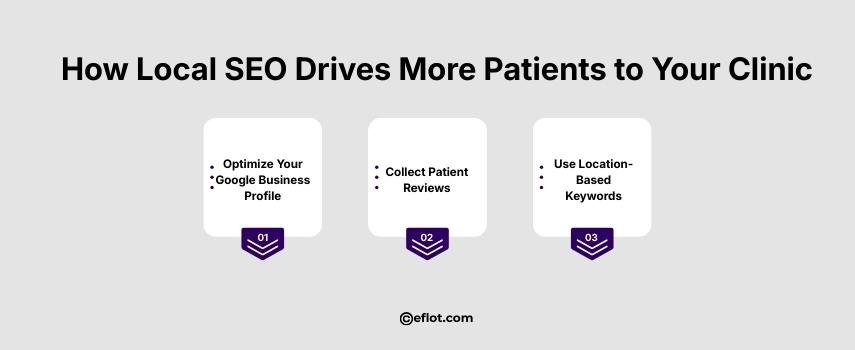
1. Optimize Your Google Business Profile
Start with your Google Business Profile (GBP). Add accurate details:
-
Clinic name, address, and phone number
-
Website link and operating hours
-
Photos of staff and the facility
A well-maintained GBP helps your clinic appear in Google Maps and local search results, making it easier for patients to find and contact you.
2. Collect Patient Reviews
Patient reviews play an important role in SEO for doctors. Encourage satisfied patients to leave feedback online. Even a few reviews each month increase trust and help search engines recognize your clinic’s relevance for local searches. Positive feedback signals credibility to both patients and search platforms.
3. Use Location-Based Keywords
Include location-specific keywords in your website content, headings, and meta descriptions. Examples:
-
“Cardiologist in [City]”
-
“Dental clinic near [Neighborhood]”
These keywords help search engines connect your clinic to patients actively looking for nearby services.
How a Mobile-Friendly Website Improves Patient Engagement
-
Faster Page Loading: Patients leave sites that take too long to load, reducing engagement.
-
Readable Text on All Devices: Clear, easy-to-read text keeps patients informed without zooming.
-
Easy-to-Tap Buttons and Links: Clickable buttons simplify actions like booking appointments or calling the clinic.
-
Improved Online Visibility: Search engines favor mobile-friendly websites, helping patients find your clinic.
-
Smooth Navigation Experience: A simple menu and clear layout make it easier for patients to access services and resources.
Common SEO Mistakes in Healthcare
-
Ignoring Local SEO: Not optimizing for local searches limits patient reach and reduces appointment inquiries.
-
Keyword Overload: Using too many keywords makes content hard to read and lowers search visibility.
-
Slow Website Performance: Pages that take too long to load frustrate patients and affect search rankings.
-
Outdated Information: Incorrect clinic hours, contact details, or service listings confuse patients and reduce trust.
-
Neglecting Content Updates: Failing to add blogs, FAQs, or guides lowers visibility and weakens patient engagement.
-
Poor Mobile Experience: Websites that don’t work well on phones lose patients and affect search rankings.
-
Missing Patient Reviews: Ignoring online feedback prevents building credibility and limits local search performance.
-
Weak Meta Descriptions and Titles: Poorly written page titles and descriptions reduce click-through from search results.
Avoiding these mistakes helps your clinic attract more patients, maintain credibility, and improve visibility. With the help of a marketing agency for healthcare, even small adjustments can have a significant impact on how patients find and choose your practice.
SEO for doctors determines how patients discover and engage with your clinic. Prioritizing website optimization, local search, patient-focused content, and correcting common SEO mistakes helps your practice reach the right patients and maintain credibility. Ongoing attention to these areas strengthens your clinic’s visibility and improves patient interaction effectively.
Digital Marketing services in Other Locations in India
Bangalore | Hyderabad | Chennai | Pune | Ahmedabad | Coimbatore | Mumbai | Kolkata | Patna | Amritsar | Indore | Kozhikode | Trivandrum | Jaipur | Nagpur | Gwalior | Dehradun | Noida | Vizag | Raipur | Agra | Gurgaon | Madurai | Udaipur | Thrissur |