




Growth Marketing vs Performance Marketing: What Shapes Your Next 6 Months
Compare growth marketing and performance marketing to choose the right strategy for your next 6 months and drive better business results with confidence.
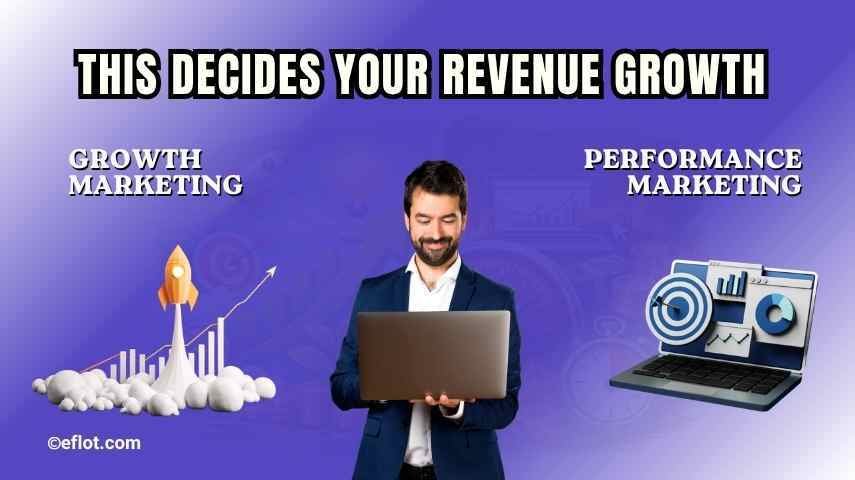
Marketing decisions shape how your business grows over the next 6 months. Some businesses rely heavily on paid ads for quick results but struggle with rising acquisition costs later.
Others focus only on long-term growth strategies and miss early momentum.
The real challenge is not choosing between Growth Marketing and Performance Marketing, but understanding how both work together.
Growth Marketing builds long-term sustainability, while Performance Marketing drives faster acquisition and optimal results. Businesses that balance both usually create more stable and scalable growth.
Understanding Growth Marketing
Growth Marketing focuses on the complete customer journey — from discovery and acquisition to retention and repeat engagement. Instead of only bringing users to a website, it improves what happens after traffic arrives.
Businesses using Growth Marketing focus on:
-
Improving conversions
-
Reducing drop-offs
-
Increasing retention
-
Building customer lifetime value
-
Creating sustainable long-term visibility
Unlike short-term campaign execution, Growth Marketing works as a continuous process where strategies are tested, refined, and optimized over time.
Key Focus Areas of Growth Marketing
-
Customer acquisition
-
Conversion optimization
-
Customer retention
-
Revenue growth
-
SEO and organic visibility
-
Email marketing and nurturing
-
User experience optimization
Every stage of the funnel is continuously improved to create stronger long-term business growth.
Businesses investing in SEO and content alongside paid campaigns often reduce customer acquisition costs over time because organic visibility continues growing even after campaigns stop.
Understanding Performance Marketing
Performance Marketing focuses on measurable outcomes generated through paid campaigns. It is built around trackable actions such as clicks, leads, sign-ups, and sales.
Platforms like Google Ads, Meta Ads, LinkedIn Ads, and affiliate networks allow businesses to monitor campaign performance at every stage.
The primary goal is immediate acquisition and faster campaign-driven results.
Key Focus Areas of Performance Marketing
-
Paid advertising
-
Lead generation
-
Conversion tracking
-
ROI measurement
-
Campaign optimization
-
Audience targeting
-
Retargeting campaigns
Performance Marketing is highly effective for businesses looking to generate traffic, leads, and conversions quickly.
However, businesses depending only on paid acquisition often experience rising costs as competition increases across advertising platforms.
Growth Marketing vs. Performance Marketing
Choosing between these two impacts how your business grows. One focuses on long-term progress, while the other brings quick results.
|
Growth Marketing |
Performance Marketing |
|
Focuses on the full customer journey across stages |
Focuses on campaign outcomes and performance results |
|
Aims for steady progress over a longer period |
Aims for quick results in shorter time frames |
|
Uses testing and continuous improvement methods |
Uses paid campaigns for direct outcome tracking |
|
Works as an ongoing and continuous process |
Works for short-term campaigns and quick execution |
|
Includes SEO, content, and email channels |
Includes ads, affiliates, and paid platforms |
Both approaches are useful, but relying on only one can limit your progress.
And in fact, SEO leads (Growth Marketing channel) have a 14% close rate, while outbound/paid leads (Performance Marketing channel) average around 1.7% close rate, showing the difference between long-term inbound growth and short-term paid acquisition.
What Shapes Your Next 6 Months
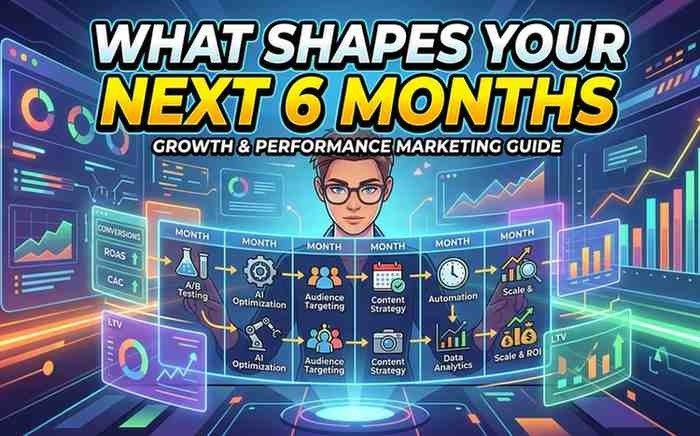
Your next six months depend on how you balance planning and execution.
If You Focus Only on Performance-Marketing
-
Rising costs: Ad spend increases as competition grows over time
-
Low conversions: Traffic comes, but users do not take action
-
Limited awareness: People see ads but do not remember the brand
Businesses investing in SEO and content alongside paid campaigns usually build lower acquisition costs over time because organic visibility compounds.
If You Focus Only on Growth-Marketing
-
Slow results: You wait a longer time to see clear results
-
Slow scaling: Growth happens slowly without quick momentum
-
Low short-term revenue: Initial revenue stays low in the early stages
The Balanced Approach
-
System building: Build a strong base that supports long-term growth
-
Traffic and leads: Drive consistent traffic and generate quality leads
Common Mistakes to Avoid
1. No clear funnel
Running ads without a proper conversion path
Tip: Build a simple step-by-step funnel before campaigns
2. No conversion focus
Ignoring conversion optimization across pages
Tip: Add a clear call-to-action on key pages
3. Traffic-only mindset
Focusing only on bringing more visitors
Tip: Track how many visitors take action
4. No data usage
Not using updated data regularly for decisions
Tip: Check reports weekly and update strategy
5. Single channel dependency
Depending only on one marketing channel
Tip: Use a mix of SEO, ads, and email
Without a proper structure, even good traffic may not lead to results.
A Practical 6 Month Plan
A structured plan provides clarity and direction for your marketing efforts. Organizing your strategy into clear phases improves focus and execution.
|
Phase |
Timeline |
Actions |
Expected Outcome |
|
Foundation |
Month 1 - 2 |
Improve website experience, set up tracking, and refine landing pages |
Strong base for better conversions |
|
Activation |
Month 3 - 4 |
Launch campaigns, test audiences, review performance |
Steady traffic and early insights |
|
Expansion |
Month 5 - 6 |
Refine funnel, retarget visitors, focus on acquisition and retention |
Balanced growth with improved results |
This plan helps you align short-term actions with long-term progress.
Why Work with Eflot
Working with the right team helps you turn strategy into consistent results. Eflot, the best digital marketing agency, focuses on both to support steady and scalable growth.
-
End-to-End Strategy: Covers every stage from awareness to conversion with structured planning
-
Insight Led Actions: Uses clear signals and user behavior to guide improvements effectively
-
Balanced Approach: Aligns long-term growth goals with short-term campaign execution smoothly
-
Ongoing Optimization: Regular updates and testing to improve overall marketing performance over time
-
Clear Progress Tracking: Keeps performance simple and easy to understand for better decision-making
FAQs
1. What is the difference between Growth Marketing and Performance Marketing?
Growth-Marketing focuses on long-term customer journey improvement, while Performance Marketing focuses on short-term, trackable campaign results.
2. Can Growth Marketing and Performance Marketing work together?
Yes, using both together helps balance long-term brand building with immediate lead generation and traffic.
3. Which is better for quick results?
Performance-Marketing is better for quick results because it uses paid campaigns to drive fast actions.
4. Is Growth Marketing useful without ads?
Yes, it can work through SEO, content, email, and user experience improvements without relying only on ads.
5. Why is a mix of both important?
A mix helps reduce dependency on a single approach and creates steady growth along with consistent performance outcomes. At Eflot, both approaches are combined to support balanced and scalable marketing results.
Growth Marketing builds long-term business strength. Performance Marketing generates faster acquisition and measurable campaign outcomes.
Businesses relying only on short-term campaigns often struggle once acquisition costs rise. At the same time, businesses focusing only on long-term organic growth may miss immediate opportunities to scale.
The strongest marketing strategies combine both approaches — using Performance Marketing for momentum and Growth Marketing for long-term sustainability.
When executed together, they create a more stable system for customer acquisition, retention, and scalable business growth over time.
Digital Marketing services in Other Locations in India
Bangalore | Hyderabad | Chennai | Pune | Ahmedabad | Coimbatore | Mumbai | Kolkata | Patna | Amritsar | Indore | Kozhikode | Trivandrum | Jaipur | Nagpur | Gwalior | Dehradun | Noida | Vizag | Raipur | Agra | Gurgaon | Madurai | Udaipur | Thrissur |