






Fix Your Ad Funnel with Facebook Retargeting Ads
Turn lost website visits into conversions with Facebook retargeting ads reconnect, guide, and convert users with precise messaging and optimized ad funnels.
Ad costs have increased across Meta platforms, but conversions haven’t kept up. The real problem starts after the click. Industry benchmarks show that over 90% of users leave a website without taking action on their first visit. That means most of your ad spend is working only at the top of the funnel.
This gap is exactly where Facebook retargeting ads come into play. They allow businesses to reconnect with users who have already shown interest and guide them toward conversion through structured follow-up.
When implemented correctly, Facebook advertising retargeting doesn’t just improve results, it stabilizes them. Instead of relying entirely on new traffic, it builds a system that consistently converts existing demand through a well-defined Facebook ads retargeting funnel.
What Are Facebook Retargeting Ads and How Do They Work?
Facebook retargeting ads are campaigns designed to reach users based on their previous interactions with your brand. These interactions are tracked using Meta Pixel and Conversion API, which record user actions such as page visits, product views, and purchase behaviour.
Once this data is captured, it is used to create custom audiences. These audiences form the foundation of Facebook remarketing, where each group receives ads tailored to their level of intent.
For example:
-
A user who visited a pricing page can be shown trust-building content such as testimonials
-
A user who viewed multiple products can be shown comparison-driven ads
-
A user who abandoned checkout can be shown urgency-based messaging
The strength of FB retargeting ads lies in this behavioural alignment. Instead of delivering the same message to everyone, the system adjusts communication based on how close the user is to conversion.
This makes retargeting a precision tool within a broader funnel strategy, rather than a standalone campaign type.
Why Most Ad Funnels Fail Without Retargeting
A large number of ad funnels are structured to generate clicks, not conversions. This creates a disconnect between traffic and outcomes.
Lack of Follow-Up Mechanism: Once a user leaves the site, there is no structured attempt to bring them back. This leads to lost opportunities, especially from high-intent users.
Single Interaction Dependency: Conversion is often expected after one click. In practice, users require multiple interactions to build trust and make a decision.
Poor Message Continuity: Users see one message in the ad, another on the landing page, and no follow-up afterward. This breaks the decision journey.
Misallocation of Budget: Without Facebook advertising retargeting, ad spend continues to focus on cold audiences while warm audiences are ignored.
No Funnel Progression: Users are not guided from awareness to decision. Instead, they are treated the same regardless of their stage.
These gaps reduce overall funnel efficiency. Retargeting addresses each of these issues by introducing structured follow-up and intent-based communication.
Key Audience Segments for Facebook Advertising Retargeting
Segmentation determines how effectively Facebook advertising retargeting performs. Broad audiences reduce relevance, while precise segmentation improves conversion rates.
General Website Visitors: These users have shown initial interest but lack strong intent. They require educational or value-driven content to stay engaged.
Product or Service Viewers: These users have moved beyond browsing and are evaluating specific offerings. Messaging here should focus on differentiation and benefits.
Cart Abandoners: These users are close to converting but drop off due to hesitation or distraction. They respond well to urgency, reminders, or incentives.
Content Engagers: Users who interact with videos or posts have shown interest but may not yet be ready to purchase. They need deeper engagement.
Existing Customers: This group offers opportunities for repeat purchases, upselling, or cross-selling.
Each of these segments represents a different stage in the funnel. Aligning messaging with these segments ensures that FB retargeting ads remain relevant and effective.
How to Fix Your Ad Funnel with Facebook Retargeting Ads (Step-by-Step)
Fixing a funnel with Facebook retargeting ads starts with one simple realization, your problem is rarely traffic. It’s what happens after the first visit.
Most funnels leak at two points:
-
Users leave without a second interaction
-
High-intent users are treated the same as low-intent visitors
Retargeting solves both, but only when it’s structured properly.
1. Start with Where You’re Losing Users
Before setting up any campaigns, look at where users are dropping off.
-
Are people visiting product pages but not adding to carts?
-
Are they reaching the checkout and leaving?
-
Are they engaging with ads but not clicking through?
Each of these behaviours signals a different problem.
If you don’t identify this clearly, your Facebook remarketing will end up pushing the wrong message to the wrong audience.
2. Separate Intent Instead of Grouping Everyone
One of the biggest issues in underperforming funnels is broad retargeting.
A user who spent 5 seconds on your homepage is very different from someone who checked pricing or added a product to cart. Yet many campaigns treat them the same.
A working Facebook ads retargeting funnel separates audiences based on how close they are to converting.
-
Short visits → low intent
-
Product or pricing views → active consideration
-
Cart or checkout actions → high intent
Once this separation is in place, your campaigns stop being generic and start becoming relevant.
3. Fix the Message Before Increasing Budget
In most cases, retargeting doesn’t fail because of targeting - it fails because of messaging.
If someone has already seen your product, showing the same introductory ad again doesn’t move them forward.
Instead, the message needs to evolve:
-
Early stage → why this matter
-
Mid stage → why this is better
-
Late stage → why act now
This shift is where Facebook advertising retargeting actually starts influencing decisions, rather than just repeating impressions.
4. Build Continuity Between Ads
A common mistake is running one retargeting ad and expecting results.
In reality, users need progression. They need to see your brand in a way that builds familiarity and reduces hesitation over time.
That means:
-
First interaction reinforces value
-
Second interaction builds trust
-
Third interaction pushes action
Without this continuity, your funnel resets every time a user sees an ad.
5. Use the Right Ad Format for the Right Moment
Ad format directly affects how users respond.
-
If someone is still exploring, video works better
-
If they’re comparing, carousel ads help
-
If they’ve already viewed products, dynamic ads bring them back
This is where choosing the right types of Facebook ads becomes part of funnel strategy, not just creative choice.
6. Watch Frequency Before It Becomes a Problem
Retargeting audiences are smaller by nature. That means users will see your ads more often.
If frequency climbs without variation:
-
Engagement drops
-
Click-through rates fall
-
Users stop paying attention
Instead of increasing spend, the better move is to refresh creatives and adjust audience windows.
7. Optimize Based on What Users Actually Do
The strongest retargeting setups are not static. They evolve based on behavior.
Look at:
-
Which audience segments convert
-
How long it takes users to come back
-
Which creatives lead to action, not just clicks
This is where a lot of teams are now optimising Facebook ads with AI, especially for adjusting bids, audience signals, and creative performance based on live data.
8. Fix the Final Step: The Conversion Point
Even strong retargeting fails if the final step creates friction.
If your ad promises something, the landing page must deliver the same thing immediately.
-
A cart reminder should take users back to checkout
-
A product-focused ad should land on that exact product
-
An offer should be visible without scrolling
This alignment often has more impact than changing the ad itself.
What Actually Changes When This Is Done Right
Once your funnel is structured this way:
-
You rely less on constant new traffic
-
Conversion rates improve without increasing spend
-
High-intent users stop slipping through
That’s the real role of Facebook retargeting ads, not just bringing users back, but moving them forward with the right context at the right time.
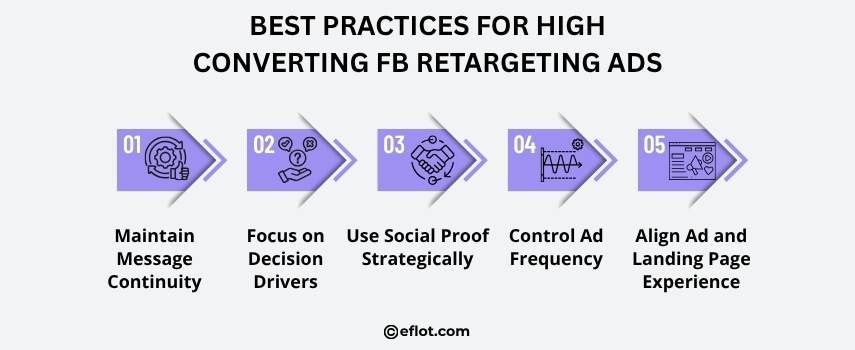
Best Practices for High-Converting FB Retargeting Ads
-
Maintain Message Continuity: Ensure that the message a user sees evolves logically across interactions.
-
Focus on Decision Drivers: Highlight specific reasons to act - price, value, trust, or urgency.
-
Use Social Proof Strategically: Incorporate reviews, testimonials, or case studies to reduce hesitation.
-
Control Ad Frequency: Balance visibility with user experience to avoid fatigue.
-
Align Ad and Landing Page Experience: Consistency between ad messaging and landing page content improves conversion rates.
Common Mistakes in Facebook Retargeting
-
Overgeneralized Targeting: Broad retargeting reduces relevance and effectiveness.
-
Lack of Exclusion Strategy: Failing to exclude converted users leads to wasted spend.
-
Excessive Frequency: Overexposure reduces engagement and can negatively impact brand perception.
-
Weak Creative Variation: Repetitive creatives lose effectiveness quickly.
-
Incomplete Data Setup: Inaccurate tracking leads to poor audience quality and weak campaign performance.
Measuring the Success of Facebook Retargeting Ads
-
Conversion Rate: Indicates how effectively retargeting drives action.
-
Cost Per Acquisition: Measures efficiency compared to acquisition campaigns.
-
Return on Ad Spend: Evaluates overall campaign profitability.
-
Audience Engagement: Provides insight into how well messaging resonates with users.
Consistent analysis of these metrics helps refine strategy and improve outcomes over time.
Turn Lost Traffic into Conversions with Facebook Retargeting Ads
A high-performing funnel is built on follow-up, not just acquisition. Without retargeting, valuable user interactions are lost before they translate into results.
Facebook retargeting ads address this gap by guiding users through a structured journey from interest to action. When supported by clear segmentation, relevant messaging, and continuous optimization, they become a central component of a stable and scalable funnel.
For brands looking to structure this effectively, working with the right digital marketing partner can make the difference, especially when the focus is on building funnels that convert existing traffic instead of constantly chasing new users.
Improving performance does not always require more traffic. In most cases, it requires better conversion of the traffic you already have.
Digital Marketing services in Other Locations in India
Bangalore | Hyderabad | Chennai | Pune | Ahmedabad | Coimbatore | Mumbai | Kolkata | Patna | Amritsar | Indore | Kozhikode | Trivandrum | Jaipur | Nagpur | Gwalior | Dehradun | Noida | Vizag | Raipur | Agra | Gurgaon | Madurai | Udaipur | Thrissur |