























How to Rank in Google with Smart SEO Tips
Struggling to rank on Google? Learn how to rank in Google with smart SEO tips, including keyword research, on-page optimization, backlinks, and content strategy.

As a digital marketing specialist, I have helped numerous businesses improve their Google rankings using strategic SEO techniques. In a competitive online environment, simply creating a website is not enough. To attract visitors and grow your brand, you need to rank higher on Google and ensure your website appears on the first page of search results. Many businesses struggle with understanding how to rank in Google effectively. Google’s algorithms have become increasingly advanced, making traditional SEO techniques less effective. Instead of keyword stuffing or link farming, businesses now need to focus on smart SEO strategies that enhance user experience, improve site authority, and provide valuable content to their audience.
Here, I will share how Google ranks websites, the benefits of higher rankings, the best SEO practices, and real-world case studies of successful companies that have used SEO to gain a competitive edge. If you are looking to increase website traffic, improve conversions, and grow your online presence, this is for you.
Understanding Google’s Ranking System
Ranking in Google refers to the position of a webpage in search results when a user enters a query. The ultimate goal is to appear on the first page, preferably within the top three results, as they generate the highest click-through rates (CTR).
Websites that rank higher on Google receive more organic traffic, which can lead to increased sales, leads, and brand awareness. Businesses that fail to rank well miss out on valuable opportunities and struggle to compete in their industry.
How Does Google Rank Websites?
Google’s search engine ranks websites based on multiple factors, including:
-
Content Relevance – Does the content match what the user is searching for?
-
User Experience (UX) – Is the website fast, mobile-friendly, and easy to navigate?
-
E-A-T (Expertise, Authority, Trustworthiness) – Does the website provide high-quality, credible information?
-
Backlinks – Are reputable websites linking to your content?
-
Technical SEO – Is your site properly optimized for search engine crawlers?
By optimizing your website for these factors, you can increase your chances of ranking higher in Google’s search results.
Why Ranking in Google Matters for Your Business
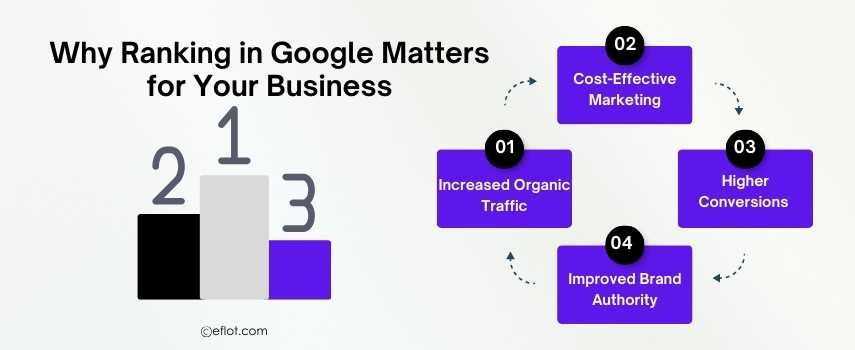
Achieving a high ranking in Google provides multiple benefits, including:
-
Increased Organic Traffic – Websites that rank on the first page receive the majority of clicks.
-
Cost-Effective Marketing – Unlike paid ads, organic traffic is free and sustainable.
-
Higher Conversions – Google users trust top-ranking websites, leading to better engagement and higher conversion rates.
-
Improved Brand Authority – A website that consistently ranks high builds trust and credibility with users.
Ranking in Google is essential for any business that wants to grow organically and establish itself as a leader in its industry.
Smart SEO Tips to Rank in Google
1. Optimize for Search Intent
Google prioritizes search intent when ranking websites. Search intent refers to the goal behind a user’s search query.
Types of Search Intent:
-
Informational – Users are looking for knowledge (e.g., "how to rank in Google").
-
Navigational – Users are searching for a specific website (e.g., "Facebook login").
-
Transactional – Users are looking to buy something (e.g., "buy wireless headphones").
-
Commercial Investigation – Users are comparing products/services (e.g., "best smartphones).
To rank higher, your content should align with user intent. If your content does not match what the user is looking for, Google is unlikely to rank your page.
2. Implement E-A-T to Improve Rankings
Google ranks websites based on Expertise, Authority, and Trustworthiness (E-A-T).
How to Improve E-A-T:
-
Create high-quality, research-backed content.
-
Use credible sources and cite authoritative references.
-
Showcase author bios with credentials to build trust.
-
Ensure website security (HTTPS) and provide clear contact information.
Websites with strong E-A-T signals rank higher in Google because they provide reliable and valuable information.
3. Optimize for Featured Snippets
Featured snippets are answer boxes that appear at the top of search results. Ranking for featured snippets increases visibility and drives more traffic.
How to Get Featured Snippets:
-
Use structured content with bullet points or numbered lists.
-
Provide concise and direct answers to common search queries.
-
Implement schema markup to help search engines understand your content.
Websites that optimize for featured snippets often outrank competitors and gain more organic traffic.
4. Improve Website Speed and Mobile Usability
Google considers page speed and mobile-friendliness as major ranking factors.
Ways to Improve Website Speed:
-
Compress images using tools like TinyPNG.
-
Enable browser caching to reduce load times.
-
Use a Content Delivery Network (CDN) for faster page loading.
A slow website leads to high bounce rates, which negatively impacts rankings. Optimizing site speed improves user experience and search visibility.
5. Optimize for Voice Search
With the rise of voice assistants like Alexa, Siri, and Google Assistant, optimizing for voice search is crucial.
Voice Search Optimization Tips:
-
Use conversational, long-tail keywords.
-
Answer questions directly (e.g., "What is digital marketing?").
-
Focus on local SEO, as many voice searches are location-based.
Businesses optimizing for voice search can capture more local customers and rank higher in Google’s voice search results.
Case Studies
Case Study 1:
Amazon faced high competition in e-commerce search results and needed to improve product page rankings.
SEO Strategy Used:
-
Optimized product titles and descriptions with buyer-intent keywords.
-
Implemented structured data markup for rich snippets.
-
Used internal linking to distribute SEO authority across pages.
Outcome:
Amazon dominates Google search rankings, driving billions in organic traffic annually.
Case Study2:
Apple wanted to rank higher for new product launches and attract local customers to physical stores.
SEO Strategy Used:
-
Optimized Apple Store pages for Google My Business.
-
Created SEO-friendly landing pages targeting specific keywords.
-
Published high-authority blog content related to Apple products.
Outcome:
Apple secured top rankings for searches like "iPhone pre-orders" and "MacBook release date," boosting in-store visits and online sales.
Ranking high on Google requires a strategic SEO approach. Instead of focusing only on keywords, businesses need to align content with user intent, improve site speed, optimize for voice search, and build credibility through E-A-T principles. By implementing these smart SEO tips, businesses can increase search visibility, drive organic traffic, and stay ahead of competitors. Are you ready to rank in Google and grow your online presence? Start implementing these SEO best practices today and watch your website climb the search rankings!
Digital Marketing services in Other Locations in India
Bangalore | Hyderabad | Chennai | Pune | Ahmedabad | Coimbatore | Mumbai | Kolkata | Patna | Amritsar | Indore | Kozhikode | Trivandrum | Jaipur | Nagpur | Gwalior | Dehradun | Noida | Vizag | Raipur | Agra | Gurgaon | Madurai | Udaipur | Thrissur |