









B2B SaaS Lead Generation Strategies You Can't Miss
B2B SaaS lead generation fails when messaging misses buyer intent. Learn why leads drop, how SaaS buyers decide, and strategies that build trust long term.
Running a B2B SaaS business can become stressful when lead generation does not work.
The product is ready.
The team is working.
Marketing activities are happening.
Still, leads do not come in.
Website traffic increases, but people do not fill out forms. Ads get clicks, but demo requests stay low. Sales teams wait, but conversations do not start.
This situation creates confusion.
Many businesses ask the same questions:
-
Why are people visiting but not contacting us?
-
Why do ads not bring serious buyers?
-
Why does interest stop before a sales call?
These problems usually happen because marketing messages do not match how SaaS buyers think and decide.
To fix lead generation issues, this gap must be understood first.
Why B2B SaaS Companies Fail to Generate Leads
B2B SaaS companies often face lead generation challenges because their marketing approach does not reflect how SaaS buyers make decisions.
SaaS purchases involve evaluation, internal discussion, and risk assessment. When marketing communication ignores this process, interest fades early.
In fact, 79% of leads never become sales, and 61% of marketers say getting good leads is their biggest challenge.
Key reasons behind lead generation failure include:
-
Unclear positioning: Buyers struggle to understand who the product is for and which problem it addresses.
-
Feature-driven communication: Decision-makers look for outcomes and impact, not long lists of functions.
-
Disconnected marketing activities: Ads, content, and email campaigns operate without a shared direction.
-
Lack of alignment between sales and marketing: Leads reach sales teams without enough context or intent.
-
Insufficient trust signals: Limited proof, use cases, or customer validation reduces confidence.
-
Unrealistic timelines: SaaS lead generation depends on steady communication over time.
Without clarity, trust, and consistency, lead generation remains unpredictable, even with a strong product.
B2B SaaS Lead Generation vs B2C Lead Generation
B2B SaaS lead generation works very differently from B2C.
In B2C, one person decides.
In B2B SaaS, many people are involved.
One user may like the tool.
Another checks pricing.
Someone else asks about security.
A manager looks at long-term value.
This changes everything.
Key differences that matter
Decision speed
-
B2C decisions are quick
-
B2B SaaS decisions take weeks or months
Content depth
-
B2C content is short and emotional
-
B2B SaaS content must explain, guide, and remove doubt
Trust level
-
B2C buyers take small risks
-
B2B buyers risk budgets, jobs, and reputation
Lead value
-
One B2B SaaS lead can be worth months or years of revenue
-
This makes buyers more careful
Because of this, lead generation cannot rely on pressure.
It depends on:
-
Clear explanations
-
Strong use cases
-
Proof from real customers
-
Consistent presence across channels
Trying to copy B2C tactics often leads to wasted effort and weak leads.
What Are the Different Types of SaaS Leads?
Not all SaaS leads are equal.
Treating them the same creates frustration for both sales and marketing teams.
Understanding lead types helps teams respond the right way.
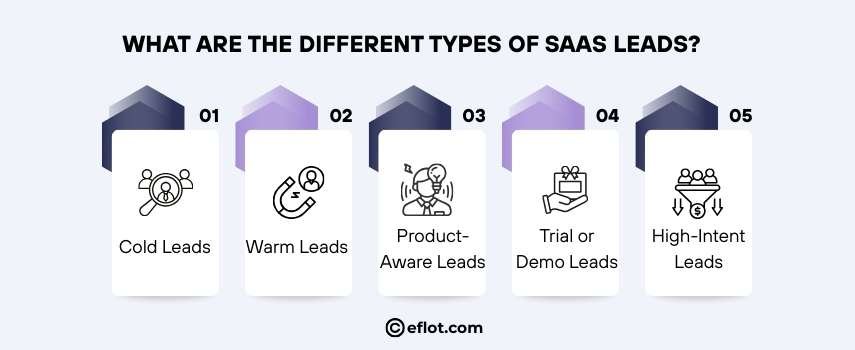
1. Cold Leads
These people are just discovering the problem.
-
They read blogs
-
They search for information
-
They are not ready to talk to sales
Cold leads need education, not pressure.
2. Warm Leads
These users show interest beyond reading.
-
They download guides
-
They subscribe to emails
-
They spend time on product pages
Warm leads are comparing options.
They want clarity, not claims.
3. Product-Aware Leads
These leads know your SaaS exists.
-
They check pricing
-
They view feature pages
-
They read case studies
At this stage, trust matters more than features.
4. Trial or Demo Leads
These users are close to a decision.
-
They sign up for trials
-
They book demos
-
They ask specific questions
What they need now is support and confidence.
5. Enterprise or High-Intent Leads
These are fewer in number but high in value.
-
Long decision cycles
-
Multiple stakeholders
-
Strong focus on security, scale, and reliability
These leads need patience and clear communication.
When SaaS companies mix these lead types together, results suffer.
Each stage needs a different approach.
Top SaaS Lead Generation Strategies
Strong SaaS lead generation is not about doing everything.
It is about doing the right things in the right order.
Below are strategies that focus on clarity, trust, and long-term thinking.
1. Content That Answers Real Questions
SaaS buyers search before they speak.
They ask:
-
How does this work?
-
Is this right for my use case?
-
What problems does it solve?
Content should help them think clearly.
Effective SaaS content includes:
-
Problem breakdowns
-
Comparison guides
-
Use-case explanations
-
Honest limitations
This kind of writing builds belief over time.
2. SEO Built Around Intent, Not Just Keywords
Search traffic matters only when the intent is right.
Many SaaS sites rank for topics that attract learners, not buyers.
Better focus areas:
-
Solution-based searches
-
Tool comparisons
-
“How to solve” queries
-
Industry-specific use cases
SEO Services work best when content depth matches buyer maturity.
3. Paid Ads With Clear Context
Ads alone do not convince people.
They work when:
-
The message matches the problem
-
The landing page explains clearly
-
The next step feels safe
Ads should guide, not push.
Sending traffic to weak pages leads to quick exits and high costs.
4. Email That Supports Decisions
Email is not about sending more messages.
It is about timing and relevance.
Useful SaaS email content:
-
Product walkthroughs
-
Customer stories
-
Common objections explained
-
Feature updates with context
Email works best when it feels helpful, not promotional.
5. Social Media for Visibility and Trust
For SaaS, social media is often a research tool.
Buyers check:
-
Company updates
-
Team voices
-
Product thinking
-
Customer interactions
Consistency matters more than posting daily.
6. Case Studies That Tell the Full Story
Strong case studies explain:
-
The problem before the tool
-
The struggle during change
-
The results after adoption
Numbers help, but clarity matters more.
Buyers want to see themselves in the story.
7. Alignment Between Marketing and Sales
Many SaaS leads fail after handover.
This happens when:
-
Sales does not know lead intent
-
Marketing does not know objections
-
Follow-ups feel disconnected
Shared understanding improves lead handling and outcomes.
8. Clear Next Steps at Every Stage
Confusion kills interest.
Every page, email, or ad should answer:
-
What happens next?
-
Why should I act now?
-
What do I gain by moving forward?
Clarity reduces hesitation.
Partnering with a Digital Marketing Agency can help streamline these strategies effectively. A professional Digital Marketing Agency ensures your SaaS leads are nurtured with clarity and precision.
Lead generation in B2B SaaS improves when marketing explains the problem clearly and builds trust step by step. When buyers understand and feel confident, leads start to come naturally.
Digital Marketing services in Other Locations in India
Bangalore | Hyderabad | Chennai | Pune | Ahmedabad | Coimbatore | Mumbai | Kolkata | Patna | Amritsar | Indore | Kozhikode | Trivandrum | Jaipur | Nagpur | Gwalior | Dehradun | Noida | Vizag | Raipur | Agra | Gurgaon | Madurai | Udaipur | Thrissur |